A new look at how genes unfold to enable their expression
July 14th, 2008 A new look at how genes unfold to enable their expression

Enlarge

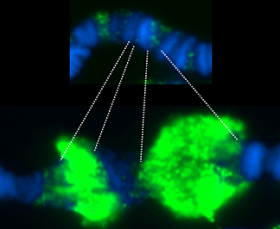
Microscope image shows a portion of DNA strand (blue) containing heat shock genes (indicated by the dotted lines), which are highly condensed under normal conditions (top). When the temperature of cells is raised, heat shock genes undergo extensive disruption (below) as seen by the formation of large puffs (green), as the strand unpacks to make the gene available for expression. Credit: Janis Werner and John Lis

(PhysOrg.com) -- Cornell researchers have uncovered surprising new information about the process by which genes are unwrapped and exposed so that they can be expressed.

There are 3 billion base pairs of DNA in the human genome, stored in compacted structures in order to fit into the nucleus of a cell. The DNA strands wrap twice around central histone proteins, like rope wrapped around a spool, to create packets called nucleosomes, which then assemble into larger and still more compact structures.

When a cell needs a particular protein, the code for it must be transcribed from a strand of DNA by a large, complex enzyme called RNA polymerase II, which copies the code onto a strand of RNA that carries instructions for the cell to produce the protein. To allow this, the nucleosomes disassemble, exposing the part of the DNA strand that is to be copied.

Scientists have long suspected that RNA polymerase II itself drives the unwrapping of DNA from its normal tightly packaged state, but a new study published in the July 11 issue of the journal Cell offers a quite different view. It presents evidence that DNA unwinds from its tight packing even before the transcription enzyme makes contact with that DNA and begins to read it. "Somehow a signal independent of the RNA polymerase II opens up the nucleosome," said John Lis, the paper's senior author and the Barbara McClintock Professor of Molecular Biology and Genetics at Cornell.

While this process has been hinted at in previous studies, this is the first study to offer detailed molecular evidence of bound DNA disassembling independent of RNA polymerase II. The researchers suspect that what they have found holds true for many highly activated genes -- those that are called upon to manufacture large quantities of proteins.

"The paper is a molecular dissection of a process we have observed with a microscope at lower resolution as puffs," Lis said. "This new mechanism is so rapid that it is rather startling. It's not the way we normally think about how transcription occurs."

"This study is exciting because everyone always believed these changes in nucleosomes were a result of active transcription and this research shows that transcription and disassembly of nucleosomes can be uncoupled from each other," added Steven Petesch, the paper's lead author and a graduate student in Lis' lab.

Petesch and Lis used heat shock genes from fruit flies as a model system. Heat shock genes are present in many organisms and become activated when temperatures rise above a threshold, as with fevers in humans and on a hot day for fruit flies. These genes activate processes that protect cells from damage, and even play a role in cancer. Researchers can turn on transcription of these genes in seconds by heating. When it is turned on, all the cells in a sample respond together, making it easy to watch processes unfold.

After applying heat, the researchers chemically froze the transcription process at a series of times separated by seconds, and at each stage probed the sample with an enzyme that cuts DNA that is not assembled into a nucleosome. This allowed them to track when and where the unpacking of nucleosomes occurred, and they found that the unpacking occurred well in advance of the arrival of the transcription enzyme.

Additionally, by studying which sections of DNA were cut during their experiment, they found that "This unpacking of nucleosomes is limited by distinct barriers, which protect neighboring genes that lie beyond these barriers," said Lis. This limits the disruption of nucleosomes to only a short section of the DNA around the gene that needs to be expressed.

"We've only tested this at heat shock genes," said Petesch. "But we wouldn't be surprised if it is used by other genes."

The research was funded by a grant from the National Institutes of Health.

Provided by: Cornell University


print this article email this article download pdf blog this article bookmark this article     Digg this Stumble it share on Facebook share on Reddit add to delicious save to Yahoo! bookmarks
4.5/5 after 13 votes


July 14th, 2008 all stories
Biology /

Comments: 0
Rank: 4.5/5 after 13 votes

  • Stumble this up

  • Digg this

  • Share it:
  • share on Facebook
  • share on MySpace
  • share on Slashdot
  • rss-newsfeed
  • share on Google
  • share on Reddit
  • add to delicious
  • save to Yahoo! bookmarks
  • share on Windows Live
  • Add to Mixx!
Rating: 4.5/5 after 13 votes

  • Related Stories

  • Saved by junk DNA
    created May 28, 2009 | popularity not rated yet | comments 0
  • Roles of DNA packaging protein revealed
    created Feb 12, 2009 | popularity not rated yet | comments 0
  • Researchers 'unzip' molecules to measure interactions keeping DNA packed in cells
    created Jan 28, 2009 | popularity not rated yet | comments 0
  • Genes that control embryonic stem cell fate identified
    created Jul 10, 2008 | popularity not rated yet | comments 0
  • Scientists identify key roadblock to gene expression
    created May 08, 2008 | popularity not rated yet | comments 0


  • Physicists Demonstrate Quantum Memory with Matter Qubits
    Physicists Demonstrate Quantum Memory with Matter Qubits
    Physics / General Physics
    created Jul 03, 2009 | popularity 4.4 / 5 (17) | comments 1
  • 'Holey' Nanosheets for Wastewater Dye Removal
    Nanotechnology / Nanomaterials
    created Jul 01, 2009 | popularity 5 / 5 (5) | comments 1
  • Jellyfish Robot Swims Like its Biological Counterpart
    Jellyfish Robot Swims Like its Biological Counterpart
    Electronics / Robotics
    created Jun 26, 2009 | popularity 4.4 / 5 (8) | comments 1
  • Could Maxwell's Demon Exist in Nanoscale Systems?
    Could Maxwell's Demon Exist in Nanoscale Systems?
    Physics / General Physics
    created Jun 24, 2009 | popularity 4.4 / 5 (18) | comments 29
  • Living Safely with Robots, Beyond Asimov's Laws
    Living Safely with Robots, Beyond Asimov's Laws
    Electronics / Robotics
    created Jun 22, 2009 | popularity 4.6 / 5 (54) | comments 40
  • Other News

    Final rules out for government stem cell research

    Biology / Other

    created 54 minutes ago | popularity not rated yet | comments 0

    (AP) -- The government is creating a master list of which embryonic stem cells qualify for taxpayer-funded research, now that President Barack Obama has lifted restrictions on the field.


    Hormone clue to root growth

    Biology / Plants & Animals

    created 21 minutes ago | popularity not rated yet | comments 0

    (PhysOrg.com) -- Plant roots provide the crops we eat with water, nutrients and anchorage. Understanding how roots grow and how hormones control that growth is crucial to improving crop yields, which will be necessary to ...


    Battle of the sexes benefits offspring, says research

    Battle of the sexes benefits offspring, says research

    Biology / Plants & Animals

    created 4 hours ago | popularity 5 / 5 (1) | comments 0

    Parents compensate for a lazy partner by working harder to bring up their offspring, but not enough to completely make up for the lack of parenting, says research by bird biologists at the University of Bath.


    Researchers uncover the potential for super-sized abalone

    Biology / Microbiology

    created 8 hours ago | popularity 4 / 5 (1) | comments 0

    (PhysOrg.com) -- Designer abalone could be an option in the foreseeable future, thanks to a project conducted at UQ's Heron Island Research Station and the St Lucia campus.


    Scientists 'rebuild' giant moa using ancient DNA

    Biology / Plants & Animals

    created Jul 01, 2009 | popularity 5 / 5 (11) | comments 12

    (PhysOrg.com) -- Scientists have performed the first DNA-based reconstruction of the giant extinct moa bird, using prehistoric feathers recovered from caves and rock shelters in New Zealand.