Undersea volcanic rocks offer vast repository for greenhouse gas, says study
July 14th, 2008 Undersea volcanic rocks offer vast repository for greenhouse gas, says study

Enlarge

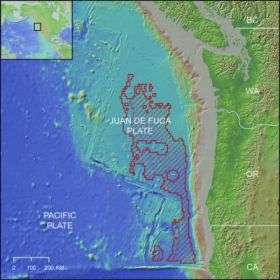
Deep-sea basalt region for CO2 burial. Red outline shows where water depth exceeds 2,700 meters and sediment thickness exceeds 200 meters; hatched areas show where sediment thickness exceeds 300 meters. Seamounts and areas near plate boundaries or continental shelf are excluded. Credit: Modified from Goldberg et al.

A group of scientists has used deep ocean-floor drilling and experiments to show that volcanic rocks off the West Coast and elsewhere might be used to securely imprison huge amounts of globe-warming carbon dioxide captured from power plants or other sources. In particular, they say that natural chemical reactions under 78,000 square kilometers (30,000 square miles) of ocean floor off California, Oregon, Washington and British Columbia could lock in as much as 150 years of U.S. CO2 production. The findings are published today in the Proceedings of the National Academy of Sciences.

Interest in so-called carbon sequestration is growing worldwide. However, no large-scale projects are yet off the ground, and other geological settings could be problematic. For instance, the petroleum industry has been pumping CO2 into voids left by old oil wells on a small scale, but some fear that these might eventually leak, putting gas back into the air and possibly endangering people nearby.

Lead author David Goldberg, a geophysicist at Columbia University's Lamont-Doherty Earth Observatory, called the study "the first good evidence that this kind of carbon burial is feasible."

"We are convinced that the sub-ocean floor is a significant part of the solution to the global climate problem," said Goldberg. "Basalt reservoirs are understudied. They are immense, accessible and well sealed--a huge prize in the search for viable options." One of the main advantages, he said, is a chemical process between basalt and pumped-in CO2 that would convert the carbon into a solid mineral.

In their paper, Goldberg and his colleagues Taro Takahashi and Angela Slagle used previous deep-ocean drilling studies of the Juan de Fuca plate, some 100 miles off the Pacific coast, to chart a vast basalt formation that they say could be suitable for such pumping. Basalt, the basic stuff of the ocean floors, is hardened lava erupted from undersea fissures and volcanoes. In this region, much of it lies under some 2,700 meters (8,850 feet) of water, and 200 meters (650 feet) or more of overlying fine-grained sediment. Drilling by the Integrated Ocean Drilling Program has shown the rock is honeycombed with watery channels and pores that would provide room for pressurized CO2. The scientists have mapped out specific areas that they say are isolated from earthquakes, hydrothermal vents or other factors that might upset the system.

Ongoing experiments by Lamont scientists on land have shown that when CO2 is combined with basalt, the gas and components of the rock naturally react to create a solid carbonate—basically, chalk. Later this year, a separate team headed by Lamont geochemist Juerg Matter will begin pumping CO2 into a landbound basalt formation at a power plant near Reykjavik, Iceland—the first such large-scale demonstration. Basalts lie at or near the surfaces of other land areas including the northeast United States; the Caribbean; north and south Africa; and southeast Asia.

Goldberg says that undersea basalts, which are widespread, may be bigger, and better, than ones on land. At the depths studied, any CO2 that does not react with the rock will be heavier than seawater, and thus unable to rise. And in places like the Juan de Fuca, even if some did escape the rock, it would hit the overlying impermeable cap of clayey sediment.

Skeptics point out that getting the CO2 to such sites could be expensive and tricky. But Goldberg says the West Coast formations should be close enough to the land for delivery by pipelines or tankers. He called on government to study the details of how the idea might work, and whether it would be economically feasible. The United States currently spends about $40 million a year studying carbon sequestration, but nearly all of that goes to land-based research. "Forty million is about the opening-day box office for Finding Nemo," said Goldberg. We need policy change now, to energize research beyond our coastlines."

Source: The Earth Institute at Columbia University


print this article email this article download pdf blog this article bookmark this article     Digg this Stumble it share on Facebook share on Reddit add to delicious save to Yahoo! bookmarks
3.5/5 after 4 votes

Rank Filter

Move the slider to adjust rank threshold, so that you can hide some of the comments.


Display comments: newest first

  • DuddleyFuddle - Jul 14, 2008
    • Rank: not rated yet
    Putting greenhouse gases underground is a great idea. Nature does it already. How about making a black gooey liquid containing hydrocarbons and put it in the vast reserves of oil that we are pumping out. Wait a minute is oil a hydrocarbon rich... errr.... never mind.....
  • NeilFarbstein - Jul 14, 2008
    • Rank: not rated yet
    It's a relatively low tech solution that will obviously work. They should do it asap.
  • GrayMouser - Jul 15, 2008
    • Rank: 1 / 5 (2)
    Time for an environmental impact study to shoot this down... I mean to protect the sea life at these locations from being exposed to green house gas pollution.

July 14th, 2008 all stories
Space & Earth / Earth Sciences

Comments: 3
Rank: 3.5/5 after 4 votes

  • Stumble this up

  • Digg this

  • Share it:
  • share on Facebook
  • share on MySpace
  • share on Slashdot
  • rss-newsfeed
  • share on Google
  • share on Reddit
  • add to delicious
  • save to Yahoo! bookmarks
  • share on Windows Live
  • Add to Mixx!
Rating: 3.5/5 after 4 votes

  • Related Stories

  • Geologists map rocks to soak CO2 from air
    created Mar 05, 2009 | popularity not rated yet | comments 0
  • Why is the Earth's mantle conductive?
    created Dec 04, 2008 | popularity not rated yet | comments 0
  • Supercritical CO2 boosts super optimism in sequestering greenhouse gas
    created Nov 17, 2008 | popularity not rated yet | comments 0
  • Rocks could be harnessed to sponge vast amounts of CO2 from air, says study
    created Nov 05, 2008 | popularity not rated yet | comments 0
  • Energy-Efficient Intelligent House that Can Learn our Routines
    created Jul 03, 2009 | popularity not rated yet | comments 0

Tags


  • Physicists Demonstrate Quantum Memory with Matter Qubits
    Physicists Demonstrate Quantum Memory with Matter Qubits
    Physics / General Physics
    created Jul 03, 2009 | popularity 4.4 / 5 (17) | comments 1
  • 'Holey' Nanosheets for Wastewater Dye Removal
    Nanotechnology / Nanomaterials
    created Jul 01, 2009 | popularity 5 / 5 (5) | comments 1
  • Jellyfish Robot Swims Like its Biological Counterpart
    Jellyfish Robot Swims Like its Biological Counterpart
    Electronics / Robotics
    created Jun 26, 2009 | popularity 4.4 / 5 (8) | comments 1
  • Could Maxwell's Demon Exist in Nanoscale Systems?
    Could Maxwell's Demon Exist in Nanoscale Systems?
    Physics / General Physics
    created Jun 24, 2009 | popularity 4.4 / 5 (18) | comments 29
  • Living Safely with Robots, Beyond Asimov's Laws
    Living Safely with Robots, Beyond Asimov's Laws
    Electronics / Robotics
    created Jun 22, 2009 | popularity 4.6 / 5 (53) | comments 40
  • Other News

    China environmental phenomena monitored from space

    Space & Earth / Earth Sciences

    created 47 minutes ago | popularity not rated yet | comments 0

    China is in a very seismically active area and has had many catastrophic earthquakes during its history. A joint European-Chinese team is using satellite radar data to monitor ground deformation across major continental faults ...


    California to require sun-blocking car windows

    Space & Earth / Environment

    created 2 hours ago | popularity 2.3 / 5 (3) | comments 4

    New cars sold in California must include windshields that block or absorb the sun's rays beginning in 2012, the state's Air Resources Board recently ruled.


    Scientists: Silent tremors may foretell next Big One

    Space & Earth / Earth Sciences

    created 2 hours ago | popularity not rated yet | comments 0

    The seismometer is snugged in its hole and tamped over with dirt. Now it's time for the stomp test.


    Steam billows from the cooling towers at a nuclear power generating station in Byron

    Tropical zone expanding due to climate change: study

    Space & Earth / Earth Sciences

    created 4 hours ago | popularity 3 / 5 (4) | comments 0

    Climate change is rapidly expanding the size of the world's tropical zone, threatening to bring disease and drought to heavily populated areas, an Australian study has found.


    The least sea ice in 800 years

    The least sea ice in 800 years

    Space & Earth / Earth Sciences

    created Jul 01, 2009 | popularity 4.1 / 5 (65) | comments 60

    New research, which reconstructs the extent of ice in the sea between Greenland and Svalbard from the 13th century to the present indicates that there has never been so little sea ice as there is now. The ...