Even toddlers get it: Data 'chunks' are easier to remember
July 14, 2008 Even toddlers get it: Data 'chunks' are easier to remember

Which is easier to remember: 4432879960 or 443-297-9960? The latter, of course. Adults seem to know automatically, in fact, that long strings of numbers are more easily recalled when divided into smaller "bite-sized chunks," which is why we break up our telephone and Social Security numbers in this way.

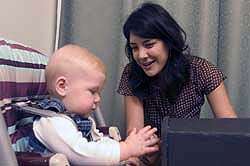
Now researchers at The Johns Hopkins University have discovered that children as young as 14 months old can – and do -- use the same technique to increase their working memories, indicating that "chunking" information in this way is not a learned strategy, but is, instead, a fundamental aspect of the human mind.

"Our work offers evidence of memory expansion based on conceptual knowledge in untrained, preverbal subjects," said Lisa Feigenson, assistant professor of psychological and brain sciences in the university's Krieger School of Arts and Sciences, who worked on the study with colleague Justin Halberda. "What we have basically done is show that very young children, who can usually only keep track of about three objects at once, can keep track of more if they use the kind of conceptual, linguistic, perceptual and spatial cues adults also use."

An article on this research appears in the July 14 issue of the Proceedings of the National Academy of Sciences.

In the team's experiment, the 14-month-olds were shown four toys which were then hidden in a box. The children then were allowed to search for the missing toys. Sometimes, two of the four toys were secretly withheld in another place. The researchers observed how long the youngsters continued to search the box, the idea being that they would search longer if they remembered there were more toys yet to be found.

The researchers found the children would search longer when the four toys consisted of two groups of two familiar objects, cats and cars, and one of each type had been withheld. That indicated that the youngsters were using mental chunking as a way to recall more items at a time.

The team also found that 14-month-olds can use spatial grouping cues (the researchers grouped six identical orange balls in three groups of two before hiding them) to expand memory, in the same way that adults group digits when remembering phone numbers. When provided with such cues, the little ones could remember up to six objects.

These results suggest that memory is not merely a passive storage system that makes a "carbon copy" of our experiences. Instead, Feigenson says, the results show that from at least early toddlerhood onward, memory is constantly being restructured and reorganized to maximize its efficiency. The researchers' results may have implications for educational strategies or for helping those who suffer short-term memory problems. But more directly, they show that the memory systems of young infants are surprisingly similar to those of adults.

Source: Johns Hopkins University/PhysOrg.com


print this article email this article download pdf blog this article bookmark this article     Stumble it Digg this share on Facebook retweet share on Reddit add to delicious
Rate this story - 4.7 /5 (6 votes)


July 14, 2008 all stories

Comments: 0

4.7 /5 (6 votes)
  • Stumble this up

  • Digg this

  • share this

  • hide
  • Related Stories

  • Beyond flash -- memories are made of this
    created Jul 22, 2009 | popularity not rated yet | comments 0
  • New project aims to boost performance on every chip
    created Apr 07, 2009 | popularity not rated yet | comments 0
  • What your mother did when she was young has an effect on your memory
    created Feb 03, 2009 | popularity not rated yet | comments 0
  • Unusual use of toys in infancy a clue to later autism
    created Nov 06, 2008 | popularity not rated yet | comments 0
  • Exercise and mental stimulation bothboost mouse memory late in life
    created Aug 06, 2007 | popularity not rated yet | comments 0


  • hide
  • Relevant PhysicsForums posts

Other News

Living buildings could mop up carbon dioxide

Living buildings could mop up carbon dioxide

Other Sciences / Other

created 7 hours ago | popularity 1 / 5 (1) | comments 0

(PhysOrg.com) -- Architecture could help us tackle climate change, if we start to design our buildings with 'living' materials, according to Dr Rachel Armstrong, UCL Bartlett School of Architecture.


Researcher: Faint writing seen on Shroud of Turin (AP)

Researcher: Faint writing seen on Shroud of Turin (Update)

Other Sciences / Archaeology & Fossils

created Nov 20, 2009 | popularity 2.3 / 5 (32) | comments 47

(AP) -- A Vatican researcher has rekindled the age-old debate over the Shroud of Turin, saying that faint writing on the linen proves it was the burial cloth of Jesus. Experts say the historian may be reading ...


Climate change could boost incidence of civil war in Africa

Other Sciences / Social Sciences

created Nov 23, 2009 | popularity 2.4 / 5 (16) | comments 10

Climate change could increase the likelihood of civil war in sub-Saharan Africa by over 50 percent within the next two decades, according to a new study led by a team of researchers at University of California, Berkeley, ...


Explained: The Discrete Fourier Transform

Explained: The Discrete Fourier Transform

Other Sciences / Mathematics

created Nov 25, 2009 | popularity 4.1 / 5 (27) | comments 8

(PhysOrg.com) -- In 1811, Joseph Fourier, the 43-year-old prefect of the French district of Isčre, entered a competition in heat research sponsored by the French Academy of Sciences. The paper he submitted ...


The skyline of Tokyo in Japan, where scientists have criticised the new government for plans to slash research budgets

Japan scientists attack govt research cut plans

Other Sciences / Other

created 22 hours ago | popularity 5 / 5 (3) | comments 0

Top Japanese scientists, including four Nobel laureates, have criticised the new government for plans to slash research budgets, warning the country will loose its high-tech edge.