Was it a bird or was it a plane?
July 15, 2008 Was it a bird or was it a plane?

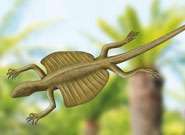
Mock up of a Kuehneosaur flying over a Triassic landscape. Photo by Simon Powell

A new study of extinct flying reptiles called kuehneosaurs, has shown that of the of the two genera found in Britain, Kuehneosuchus was a glider while Kuehneosaurus, with much shorter "wings," was a parachutist.

Archaeopteryx is famous as the world's oldest bird, but reptiles were flying about some 50 million years earlier than that (225 million years ago), even before large dinosaurs roamed the Earth.

A new study of extinct reptiles called kuehneosaurs, by scientists from the University of Bristol, England, shows that these early flyers used extraordinary extensions of their ribs to form large gliding surfaces on the side of the body. The results are published today (15 July) in Palaeontology.

Kuehneosaurs, up to 70 centimetres (two feet) long, were first found in the 1950s in an ancient cave system near Bristol. Their lateral 'wings' were always assumed to be some form of flying adaptation, but their aerodynamic capability had never been studied before.

Koen Stein, who did the work while a student studying for an MSc in palaeobiology at Bristol University, has shown that of the of the two genera found in Britain, Kuehneosuchus was a glider (it has elongate 'wings'), while Kuehneosaurus, with much shorter 'wings', was a parachutist. As the two forms are so alike in other respects, it is possible that they are males and females of the same animal.

Stein said: "We didn't think kuehneosaurs would have been very efficient in the air, but all the work up to now had been speculation, so we decided to build models and test them in the wind tunnel in the Department of Aerospace Engineering at Bristol.

"Surprisingly, we found that Kuehneosuchus was aerodynamically very stable. Jumping from a five-metre tree, it could easily have crossed nine metres distance before landing on the ground. The other form, Kuehneosaurus, was more of a parachutist than a glider."

So that Stein and his colleagues could work out how these creatures controlled their flight they had to model different skin flaps over the wing area."We also built webbed hands and feet and had an extra skin membrane between the legs on the models, but these made the flight of the animals unstable, suggesting that they probably did not have such features."

"This is a fantastic example of interdisciplinary research," said Professor Michael Benton, a member of the research team and Head of Department in Bristol. "Palaeontologists are keen to understand how all the amazing animals of the past operated and by collaborating with aerospace engineers we can be sure that model-making and calculations are more realistic."

Provided by University of Bristol


print this article email this article download pdf blog this article bookmark this article     Stumble it Digg this share on Facebook retweet share on Reddit add to delicious
Rate this story - 4.5 /5 (12 votes)


July 15, 2008 all stories

Comments: 0

4.5 /5 (12 votes)
  • Stumble this up

  • Digg this

  • share this

  • hide
  • Related Stories

  • Hearing on the wing: New structure discovered in butterfly ears
    created Oct 21, 2009 | popularity not rated yet | comments 0
  • Composites for energy
    created Jun 30, 2009 | popularity not rated yet | comments 0
  • A plane with wings of glass?
    created Jun 22, 2008 | popularity not rated yet | comments 0
  • Shaping the future -- from sleep to air travel
    created Nov 01, 2007 | popularity not rated yet | comments 0
  • How to catch a mosquito
    created Nov 09, 2006 | popularity not rated yet | comments 0


  • hide
  • Relevant PhysicsForums posts

  • This is a long shot...
    created 9 hours ago
  • How do I get an A in Bio AP if I know nothing about Biology?
    created 12 hours ago
  • Mutation
    created 17 hours ago
  • Incorrupt Bodies
    created Nov 09, 2009
  • More from Physics Forums - Biology

Other News

Scientists: New dinosaur species found in SAfrica (AP)

Scientists: New dinosaur species found in SAfrica

Other Sciences / Archaeology & Fossils

created 1hour ago | popularity not rated yet | comments 0

(AP) -- Scientists say they've discovered a new dinosaur species in South Africa that may help explain how the creatures evolved into the largest animals on land.


The Beatles Return to Mono

Other Sciences / Other

created 1hour ago | popularity not rated yet | comments 0

From the White Album to Yellow Submarine modern releases of the Beatles present their music in stereo sound. But this Christmas, hard-core Beatles fans will eagerly unwrap "The Beatles in Mono," an 11-CD box set designed ...


New Logistics Model Improves Forecast Accuracy of Retail and Packaged-Goods Orders

Other Sciences / Economics

created 1hour ago | popularity not rated yet | comments 0

(PhysOrg.com) -- Whether it’s dog food or iPods, tires or televisions, virtually every consumer has endured a frustrating out-of-stock experience. Retailers hate it as much as customers, perhaps more, because they lose money ...


Research shows avatars can negatively affect users

Other Sciences / Social Sciences

created 16 hours ago | popularity 3.7 / 5 (3) | comments 1

(PhysOrg.com) -- Although often seen as an inconsequential feature of digital technologies, one's self-representation, or avatar, in a virtual environment can affect the user's thoughts, according to research by a University ...


New fossil plant discovery links Patagonia to New Guinea in a warmer past

New fossil plant discovery links Patagonia to New Guinea in a warmer past

Other Sciences / Archaeology & Fossils

created 16 hours ago | popularity not rated yet | comments 0

Fossil plants are windows to the past, providing us with clues as to what our planet looked like millions of years ago. Not only do fossils tell us which species were present before human-recorded history, ...