The 700-year-old Mexican mummy with a tummy ache
July 15, 2008
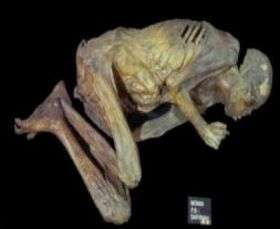
A mummy. Credit: Yolanda Lopez Vidal and Gonzalo Castillo-Rojas
Remnants of the bacterium that causes stomach ulcers, Helicobacter pylori, (H. pylori) have been discovered in gastric tissue from North American mummies. A study of human remains believed to predate Columbus' discovery of the New World has shown for the first time that H. pylori infection occurred in native populations, according to research published in BioMed Central's open access journal, BMC Microbiology.
Yolanda Lòpez-Vidal and colleagues from the National Autonomous University of Mexico studied the stomach, tongue-soft palate and brains of two naturally mummified corpses - one young boy and one adult male. The researchers looked for the presence of telltale fragments of H. pylori DNA in the remains after amplification by polymerase chain reaction (PCR). According to Lòpez-Vidal, "Our results show that H. pylori infections occurred around 1350AD in the area we now know as Mexico".
Although previous research has suggested that H. pylori was present in these communities, this is the first evidence that it caused gastric infections. Lòpez-Vidal explains, "It is only through the use of the stomach tissue of these incredible mummies that we were able to make this discovery. Infection is established when the micro-organism infiltrates the stomach lining and induces a local inflammatory response. This is unlike colonisation, which does not cause such a response and does not occur in the stomach".
As well as stomach ulcers, H. pylori causes gastritis, duodenitis, and cancer. It is a helix-shaped bacteria that is believed to be transmitted by the ingestion of food or water contaminated with faecal matter.
Source: BioMed Central
-
The pros and cons of Helicobacter pylori
Dec 27, 2011 |
4.6 / 5 (5) |
0
-
Closing in on an ulcer- and cancer-causing bacterium
Dec 07, 2011 |
5 / 5 (2) |
1
-
Ulcer-causing bacteria tamed by defect in cell-targeting ability
Nov 21, 2011 |
5 / 5 (2) |
0
-
Study discovers how cancer-causing bacterium spurs cell death
Nov 01, 2011 |
not rated yet |
1
-
Strawberries protect the stomach from alcohol
Oct 25, 2011 |
4.7 / 5 (19) |
2
-
Engineers build first sub-10-nm carbon nanotube transistor
Feb 01, 2012 |
4.9 / 5 (33) |
30
-
Something old, something new: Evolution and the structural divergence of duplicate genes
Jan 31, 2012 |
4.6 / 5 (7) |
1
-
The hidden nanoworld of ice crystals: Revealing the dynamic behavior of quasi-liquid layers
Jan 30, 2012 |
5 / 5 (4) |
1
-
Stock market network reveals investor clustering
Jan 27, 2012 |
3.9 / 5 (23) |
8
-
Of microchemistry and molecules: Electronic microfluidic device synthesizes biocompatible probes
Jan 26, 2012 |
5 / 5 (2) |
0
More news stories
A mitosis mystery solved: How chromosomes align perfectly in a dividing cell
Although the process of mitotic cell division has been studied intensely for more than 50 years, Whitehead Institute researchers have only now solved the mystery of how cells correctly align their chromosomes during symmetric ...
14 hours ago |
4.5 / 5 (22) |
0
|
Researchers find extensive RNA editing in human transcriptome
In a new study published online in Nature Biotechnology, researchers from BGI, the world's largest genomics organization, reported the evidence of extensive RNA editing in a human cell line by analysis of RNA-seq data, demons ...
14 hours ago |
5 / 5 (4) |
0
|
The proteins ensuring genome protection
Researchers from the University of Geneva (UNIGE), Switzerland, have discovered the crucial role of two proteins in developing a cell 'anti-enzyme shield'. This protection system, which operates at the level of molecular ...
14 hours ago |
5 / 5 (3) |
0
|
Entire genome of extinct human decoded from fossil
(PhysOrg.com) -- In 2010, Svante Pääbo and his colleagues presented a draft version of the genome from a small fragment of a human finger bone discovered in Denisova Cave in southern Siberia. The ...
Feb 07, 2012 |
4.7 / 5 (60) |
51
|
Why are there so few fish in the Earth's oceans?
(PhysOrg.com) -- A Stony Brook University researcher has found that, contrary to popular belief, there are not plenty of fish in the sea.
Feb 08, 2012 |
4.3 / 5 (19) |
27
|
Japan's Fukushima reactor may be reheating: operator
Temperature readings at one of the crippled Fukushima nuclear reactors have risen above Japan's stringent new safety standard but there was no immediate danger, its operator said Sunday.
Scientists discover molecular secrets of 2,000-year-old Chinese herbal remedy
For roughly two thousand years, Chinese herbalists have treated Malaria using a root extract, commonly known as Chang Shan, from a type of hydrangea that grows in Tibet and Nepal. More recent studies suggest that halofuginone, ...
New method to examine batteries -- MRI from the inside
There is an ever-increasing need for advanced batteries for portable electronics, such as phones, cameras, and music players, but also to power electric vehicles and to facilitate the distribution and storage of energy derived ...
Google might launch Drive for cloud storage soon
(PhysOrg.com) -- Google's next big move, according to the Wall Street Journal, is a cloud storage service called Drive. Hardly first to the plate, Google is simply catching up to introducing its cloud reposi ...
Lab study raises questions over nano-particle impact
Tests involving chickens have raised questions about the impact on health from engineered nano-particles, the ultra-fine grains commonly used in drugs and processed foods, scientists said on Sunday.
Starve a virus, feed a cure? Findings show how some cells protect themselves against HIV
A protein that protects some of our immune cells from the most common and virulent form of HIV works by starving the virus of the molecular building blocks that it needs to replicate, according to research published online ...