Getting many quantum states from one experimental setup
July 15, 2008 By Miranda Marquit Getting many quantum states from one experimental setup

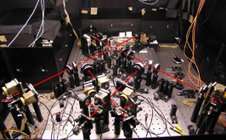
Linear optical setup for the experiment. Credit: Witlef Wieczorek.

(PhysOrg.com) -- “In the traditional approach to entanglement with linear optics, one designs a new setup for each single state that you want,” Witlef Wieczorek tells PhysOrg.com. “What we’ve done is to make a single setup that allows you to observe lots of different quantum states.”

Wieczorek is a scientist at the Max Planck Institute for Quantum Optics in Garching and Ludwig-Maximilians-Universität Munich, Germany. He is part of a team that not only figured out how it might work to use one linear optics setup for several quantum states, but also demonstrated that such a setup works.

His colleagues include Christian Schmid, Nikolai Kiesel, Reinhold Pohlner and Harald Weinfurter at the Max Planck Institute and Ludwig-Maximilians-Universität, as well as Otfried Gühne at the Institute for Quantum Optics and Quantum Information in Innsbruck, Austria. Their work is reported in Physical Review Letters: “Experimental Observation of an Entire Family of Four-Photon Entangled States.”

“It is inefficient to have to keep changing the entire setup for each quantum state,” Wieczorek explains. “But now we’ve shown that you can have one setup, and if you change a parameter, you can get a different quantum state. You no longer have to design a different setup for each state.”

Wieczorek and his peers call the states “families” because they are “related” through the experimental setup, and only require the changing of an experimental parameter to get a new state. “We have a group of states that are connected to this one setup.” One of the most exciting things, however, is that this particular family includes five quantum states that are known to have applications in the field of quantum information.

“These quantum states are useful for different tasks,” Wieczorek says. “Our one setup produces states that can be used for decoherence-free communication, secret sharing of information, telecloning and getting different kinds of three qubit inequivalent entangled states.”

Known states are nice, but Wieczorek and his colleagues also found states not discussed before. While the unknown quantum states in this particular family do not have any known practical application right now, they can contribute to the overall knowledge of entanglement. “We can characterize the family better by studying particular properties, as, for example, entanglement robustness or persistency, of the family of states in more detail. And, who knows? Maybe these unknown states will have applications in the future.”

The current work is done with four photon entangled states, but Wieczorek hopes to expand the idea to six photon entangled states. “Next, we want to go for six photons,” he says. “And we have an idea of how we can apply it to the setup.”

For the most part, Wieczorek and his peers confined themselves to looking at only a small fraction of states. However, it is possible that any number of states could be achieved. “In principle, you could see a different state for each parameter you change. You could see infinetely many states.”

But for now, Wieczorek is happy with the results of what has been accomplished so far. “This makes it easier. We can say we want a state for a particular application, and we just set the parameter. When we’re ready to do something else, all we do is change the parameter.”

Copyright 2008 PhysOrg.com.
All rights reserved. This material may not be published, broadcast, rewritten or redistributed in whole or part without the express written permission of PhysOrg.com.


print this article email this article download pdf blog this article bookmark this article     Stumble it Digg this share on Facebook retweet share on Reddit add to delicious
Rate this story - 4.3 /5 (35 votes)

Rank Filter

Move the slider to adjust rank threshold, so that you can hide some of the comments.


Display comments: newest first

  • earls - Jul 15, 2008
    • Rank: 3 / 5 (2)
    More Info Plz.
  • alexxx - Jul 16, 2008
    • Rank: 1 / 5 (1)
    when we will get something usefull and working from these "quantum states" ?

July 15, 2008 all stories

Comments: 2

4.3 /5 (35 votes)
  • Stumble this up

  • Digg this

  • share this

  • hide
  • Related Stories

  • LCLS: The World's Largest Laser Writer?
    created Oct 20, 2009 | popularity not rated yet | comments 0
  • Physicists Measure Elusive 'Persistent Current' That Flows Forever
    created Oct 08, 2009 | popularity not rated yet | comments 0
  • To peer inside a living cell
    created Oct 06, 2009 | popularity not rated yet | comments 0
  • Physicists Explain How Human Eyes Can Detect Quantum Effects
    created Sep 29, 2009 | popularity not rated yet | comments 0
  • Portable and precise gas sensor could monitor pollution and detect disease
    created Sep 25, 2009 | popularity not rated yet | comments 0


  • hide
  • Relevant PhysicsForums posts

  • Bodies in motionÂ…..
    created 35 minutes ago
  • Refraction optics help
    created 35 minutes ago
  • A basketball Jump Shot
    created 53 minutes ago
  • help with accelerometer
    created 2 hours ago
  • More from Physics Forums - General Physics

Other News

The LHC tunnel

Peckish bird briefly downs big atom smasher

Physics / General Physics

created 10 hours ago | popularity 3.8 / 5 (9) | comments 11

A peckish bird briefly knocked out part of the world's biggest atom smasher by causing a chain reaction with a piece of bread, the European Organisation for Nuclear Research (CERN) said Monday.


First Bose-Einstein condensation of strontium

First Bose-Einstein condensation of strontium

Physics / Quantum Physics

created 3 hours ago | popularity 5 / 5 (4) | comments 0

In an international first, scientists from the Institute of Quantum Optics and Quantum Information (IQOQI, Austria) produced a Bose-Einstein condensate of the alkaline-earth element strontium, thus narrowly ...


Plasma-in-a-bag for sterilizing devices

Physics / General Physics

created 1hour ago | popularity not rated yet | comments 0

The practice of sterilizing medical tools and devices helped revolutionize health care in the 19th century because it dramatically reduced infections associated with surgery. Through the years, numerous ways of sterilization ...


Ginzburg helped develop the Soviet Union's hydrogen bomb in the late 1940s and early 1950s

Russian bomb physicist Ginzburg dead at 93

Physics / General Physics

created 12 hours ago | popularity 5 / 5 (4) | comments 0

Nobel Physics prize winner Vitaly Ginzburg, who helped develop the Soviet hydrogen bomb, has died at age 93, the Russian Academy of Sciences said Monday.


Stars Fueled by Dark Matter Could Hold Secrets to the Universe

Stars Fueled by Dark Matter Could Hold Secrets to the Universe

Physics / General Physics

created Nov 03, 2009 | popularity 4.5 / 5 (52) | comments 43

(PhysOrg.com) -- The first stars in the universe may have been very different from the stars we see today, yet they may hold clues to understanding some of the mysterious features of the universe. These "dark ...