Study: Future snowmelt in West twice as early as expected; threatens ecosystems and water reserves
July 15, 2008
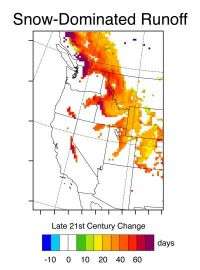
The figure shows projected future changes in the timing of runoff in snow-dominated areas of the western United States. The timing of runoff shifts earlier in almost all areas as greenhouse gas concentrations increase. These snow-dominated areas currently act as natural reservoirs, with melting in the spring and summer providing critical fresh water throughout the western United States. A shift to earlier runoff could pose challenges for human consumption, agriculture, wildfire management and sensitive ecosystems. Purdue University image/Diffenbaugh Laboratory
According to a new study, global warming could lead to larger changes in snowmelt in the western United States than was previously thought, possibly increasing wildfire risk and creating new water management challenges for agriculture, ecosystems and urban populations.
Researchers, including a Purdue University professor of earth and atmospheric sciences, discovered that a critical surface temperature feedback is twice as strong as what had been projected by earlier studies.
The high-resolution climate model used by the team was better able to reproduce the complex topography of the western United States and capture details of the effect of snow cover on the climate system, as well as the historical record of runoff.
The findings will be published in an upcoming issue of Geophysical Research Letters and are now available online at the journal's Web site.
Noah Diffenbaugh, senior author of the paper and an associate professor of earth and atmospheric sciences at Purdue, said the influence of melting snow on regional climate is far greater than that of increased greenhouse gases alone.
"The heat trapping from elevated greenhouse gases triggers the warming, but the additional warming caused by the loss of snow is what really creates the big changes in surface runoff," said Diffenbaugh, who also is a member of Purdue's Climate Change Research Center. "Scientists have known about this general effect for years. The big surprise here is how much the complex topography plays a role, essentially doubling the threat to water resources in the West."
Sara A. Rauscher, visiting scientist at the Abdus Salam International Centre for Theoretical Physics in Trieste, Italy, and lead author on the paper, said the melting snow contributes to a feedback loop that accelerates warming.
"Because snow is more reflective than the ground or vegetation beneath it, it keeps the surface temperatures lower by reflecting energy from the sun," Rauscher said. "When snow melts or does not accumulate in the first place, more solar energy is absorbed by the ground, warming the surface. A feedback loop is created because the warmer ground then makes it more difficult for snow to accumulate and perpetuates the effect."
The amount and timing of the runoff from snowmelt is critical to the success of water management in the western United States. Water resources for the area are reliant on snow acting as a natural reservoir during the cold season that melts and releases water in the warm season.
Changes in this timing could create problems in meeting the increasing demand for water in large urban and agricultural areas during the hottest summer months, Diffenbaugh said.
"If the snow melts earlier or if it comes as rainfall instead, it would create a strain on infrastructure," he said. "The current system relies on water being stored in the mountains as snow. So earlier runoff could mean too much water for the reservoirs early in the year and not enough available later in the year."
Gregg M. Garfin, deputy director for science translation and outreach at the Institute for the Study of Planet Earth at the University of Arizona, said dry summers could lead to more severe wildfires and changes in the ecosystems of the West.
"Early snowmelt and warmer soil temperatures could result in further massive forest mortality and an increased risk of wildfire activity," Garfin said. "If these projections become reality, then the ecosystems of the northern and central Rockies will undergo dramatic changes with ramifications for wildlife habitat, fire potential, soil erosion and tourism."
The study suggests a substantial change in the runoff season, with the peak date more than two months earlier than today in some regions, Diffenbaugh said.
"During the past 50 years, the peak runoff time has moved 10 to 15 days earlier," he said. "It is not surprising that as we look to the future, the projected changes are much greater than the historical changes. The increase in greenhouse gas emissions has been relatively small for the past 50 years compared with where we are headed over the next several decades if substantial changes in energy technology and population growth do not occur."
The researchers also compared the climate model to historical records and found that it had a high level of agreement with historical data and observed trends.
"One of the most important contributions of this work is the remarkable agreement between the climate model and the observations of the recent past," Diffenbaugh said. "This agreement should increase confidence not only in these particular projections of future changes, but also of climate model projections in general."
Source: Purdue University
-
High planetary tilt lowers odds for life?
Feb 06, 2012 |
4.8 / 5 (12) |
14
-
NASA's GCPEX mission: What we don't know about snow
Feb 01, 2012 |
3 / 5 (1) |
0
-
The hidden nanoworld of ice crystals: Revealing the dynamic behavior of quasi-liquid layers
Jan 30, 2012 |
5 / 5 (3) |
1
-
Cloud streets off of the Aleutian Islands
Jan 30, 2012 |
5 / 5 (1) |
0
-
Study finds a better way to gauge the climate costs of land use changes
Jan 08, 2012 |
4.2 / 5 (5) |
5
-
Engineers build first sub-10-nm carbon nanotube transistor
Feb 01, 2012 |
4.9 / 5 (33) |
30
-
Something old, something new: Evolution and the structural divergence of duplicate genes
Jan 31, 2012 |
4.6 / 5 (7) |
1
-
The hidden nanoworld of ice crystals: Revealing the dynamic behavior of quasi-liquid layers
Jan 30, 2012 |
5 / 5 (5) |
1
-
Stock market network reveals investor clustering
Jan 27, 2012 |
3.9 / 5 (23) |
8
-
Of microchemistry and molecules: Electronic microfluidic device synthesizes biocompatible probes
Jan 26, 2012 |
5 / 5 (2) |
0
-
Do some geologists actually act a lot like Randy Marsh?
Feb 11, 2012
-
Discrepancy between oxygen and carbon-dioxide levels
Feb 09, 2012
-
where gems are found in the world
Feb 09, 2012
-
Wind Waves in Reservoir ~ Wind run-up and Wind set-up
Feb 08, 2012
-
Balance of oxygen in the atmosphere
Feb 01, 2012
-
The case for a methanol-based economy
Jan 30, 2012
- More from Physics Forums - Earth
More news stories
Climate change causes harmful algal blooms in North Atlantic: study
Warming oceans and increases in windiness could be causing of an abundance of harmful algal blooms in the North Atlantic Ocean and North Sea, according to new research.
2 hours ago |
not rated yet |
0
New European rocket lifts off on maiden flight
A new lightweight rocket, Vega, lifted off from Europe's space base Monday carrying nine satellites on its inaugural flight, mission control said.
Space & Earth / Space Exploration
55 minutes ago |
5 / 5 (2) |
1
Salvage workers begin pumping fuel from Italian shipwreck
Salvage workers Sunday began pumping fuel from the shipwrecked Italian cruise liner Costa Concordia, a day ahead of schedule, officials said.
17 hours ago |
5 / 5 (2) |
0
NASA budget will axe Mars deal with Europe: scientists
US President Barack Obama's budget proposal to be submitted next week for 2013 will cut NASA's budget by 20 percent and eliminate a major partnership with Europe on Mars exploration, scientists said Thursday.
Space & Earth / Space Exploration
Feb 10, 2012 |
5 / 5 (4) |
59
Humans may have helped the decline of African rainforests 3000 years ago
(PhysOrg.com) -- Large areas of rainforests in Central Africa mysteriously disappeared over three thousand years ago, to be replaced by savannas. The prevailing theory has been that the cause was a change ...
New molecule has potential to help treat genetic diseases and HIV
(PhysOrg.com) -- Chemists at The University of Texas at Austin have created a molecule that's so good at tangling itself inside the double helix of a DNA sequence that it can stay there for up to 16 days before ...
Social psychologist: Lust makes you smarter and evidence that seven deadly sins are good for you
(Medical Xpress) -- Good news for lovers on Valentine’s Day - the seven deadly sins, including Lust, are good for you. University of Melbourne social psychologist Dr Simon Laham uses modern research to make a compelling ...
The joy of cheques
An electronic cheque which eliminates the need for costly processing by banks but preserves the simplicity and ease of a traditional cheque book has been designed by a team of academics in the UK.
Research finds injuries to professional athletes from routine play or practice often reported as 'freak accidents' in me
(Medical Xpress) -- A new report from the Johns Hopkins Center for Injury Research and Policy finds injuries to professional athletes from routine play or practice are often characterized as freak accidents in ...
Researchers' paper wins Best Paper Award for 2011
A paper written by Dr. Paul Gratz and his graduate student, Reena Panda, from the Department of Electrical and Computer Engineering at Texas A&M University was selected as one of the best papers from IEEE Computer Architecture ...
Low levels of amplitude-modulated electromagnetic fields elicit therapeutic responses cancer patients
Ryne Ramaker, a senior UALR Donaghey Scholar and University Science Scholar with a double major in biology and chemistry, is a co-author of a cancer research paper creating excitement among other researchers. The article ...