Pollination habits of endangered Texas rice revealed to help preservation
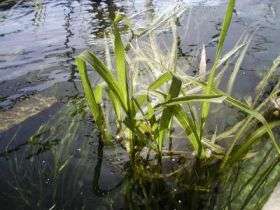
A type of wild rice that only grows in a small stretch of the San Marcos River is likely so rare because it plays the sexual reproduction game poorly, a study led by the Lady Bird Johnson Wildflower Center at The University of Texas at Austin has revealed.
The first study of breeding habits of this endangered, aquatic grass (Zizania texana) found that the pollen of Texas wild-rice can only travel about 30 inches away from a parent plant. If pollen doesn't land on a receptive female flower within that distance, no seeds will be produced. No seeds means no new plants to replenish a population that faces other survival threats.
"It would be great to introduce more of these plants into the San Marcos River so that we can build up its population, said Flo Oxley, conservation director at the Wildflower Center, and lead author of the study.
"This information will be useful when reintroduction efforts begin, because we now know that lots of new plants must be planted close together in order for seeds to be produced."
The findings were published in June in The Southwestern Naturalist journal of the Southwestern Association of Naturalists, and shared with staff at the U.S. Fish and Wildlife Service and the Texas Parks and Wildlife Department.
The U.S. Fish and Wildlife Service is the principal federal agency responsible for federally listed species conservation. Texas has about 25 percent of the plant biodiversity nationally, including 23 endangered and five threatened plant species.
Texas wild-rice prefers the clean, clear water of the San Marcos River and is not found anywhere else. The plant spends most of its life submerged, emerging only to flower. Recreation on the river can stir up sediments that prevent sunlight from reaching the plants, and swimmers, tubers and canoers often submerge the plants' flowers so they can't pollinate. This foot traffic isn't expected to go away soon, and the flow of underground water into springs that feed the river is also decreasing as the Central Texas population expands and drinking water needs increase.
"Nobody intends to shut down access to the river because of these plants" Oxley said, "and I've been surprised at how respectful of the plant people are when they learn that it is an endangered species that grows only in the San Marcos River and nowhere else in the world. Texans are very proud and protective of their natural history, and I believe they will take care of Texas wild-rice if we just let them know about it."
It doesn't hurt, she added, that Texas wild-rice serves as home for tiny invertebrates that have nasty feeding habits.
"People who swim through Texas wild-rice risk picking up these aquatic hitchhikers and may end up with itchy behinds for their efforts," she said.
Texas wild-rice is a food source and home for endangered fish called fountain darters, and is a cousin to several rice species cultivated for food purposes. But it is among more than 200 plant species of concern in Texas whose fundamental value isn't understood because so little information has been available to guide conservation or other decisions.
"We don't know what overall purpose this plant serves in the ecosystem, and we don't know what's going to happen if this plant goes away," Oxley said.
Source: University of Texas at Austin


