Brightest Star in the Galaxy Has New Competition
July 15, 2008
Brightest Star in the Galaxy Has New Competition

Enlarge

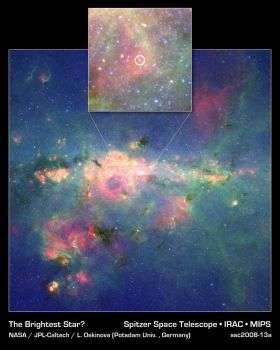
The 'Peony nebula' star, circled, is now the second-brightest star in our galaxy. Image credit: NASA/JPL-Caltech/Potsdam Univ.

(PhysOrg.com) -- A contender for the title of brightest star in our Milky Way galaxy has been unearthed in the dusty metropolis of the galaxy's center.

Nicknamed the "Peony nebula star," the bright stellar bulb was revealed by NASA's Spitzer Space Telescope and other ground-based telescopes. It blazes with the light of an estimated 3.2 million suns.

The reigning "brightest star" champion is Eta Carina, with a whopping solar wattage of 4.7 million suns. But according to astronomers, it's hard to pin down an exact brightness, or luminosity, for these scorching stars, so they could potentially shine with a similar amount of light.

"The Peony nebula star is a fascinating creature. It appears to be the second-brightest star that we now know of in the galaxy, and it's located deep into the galaxy's center," said Lidia Oskinova of Potsdam University in Germany. "There are probably other stars just as bright if not brighter in our galaxy that remain hidden from view." Oskinova is principal investigator for the research and second author of a paper appearing in a future issue of the journal Astronomy and Astrophysics.

Scientists already knew about the Peony nebula star, but because of its sheltered location in the dusty central hub of our galaxy, its extreme luminosity was not revealed until now. Spitzer's dust-piercing infrared eyes can see straight into the heart of our galaxy, into regions impenetrable by visible light. Likewise, infrared data from the European Southern Observatory's New Technology Telescope in Chile were integral in calculating the Peony nebula star's luminosity.

"Infrared astronomy opens extraordinary views into the environment of the central region of our galaxy," said Oskinova.

The brightest stars in the universe are also the biggest. Astronomers estimate the Peony nebula star kicked off its life with a hefty mass of roughly 150 to 200 times that of our sun. Stars this massive are rare and puzzle astronomers because they push the limits required for stars to form. Theory predicts that if a star starts out too massive, it can't hold itself together and must break into a double or multiple stars instead.

Not only is the Peony nebula star hefty, it also has a wide girth. It is a type of giant blue star called a Wolf-Rayet star, with a diameter roughly 100 times that of our sun. That means this star, if placed where our sun is, would extend out to about the orbit of Mercury.

With so much mass, the star barely keeps itself together. It sheds an enormous amount of stellar matter in the form of strong winds over its relatively short lifetime of a few million years. This matter is pushed so hard by strong radiation from the star that the winds speed up to about 1.6 million kilometers per hour (one million miles per hour) in only a few hours.

Ultimately, the Peony nebula star will blow up in a fantastic explosion of cosmic proportions called a supernova. In fact, Oskinova and her colleagues say that the star is ripe for exploding soon, which in astronomical terms mean anytime from now to millions of years from now.

"When this star blows up, it will evaporate any planets orbiting stars in the vicinity," said Oskinova. "Farther out from the star, the explosion could actually trigger the birth of new stars."

In addition to the star itself, the astronomers noted a cloud of dust and gas, called a nebula, surrounding the star. The team nicknamed this cloud the Peony nebula because it resembles the ornate flower.

"The nebula was probably created from the spray of dust leaking off the massive Peony nebula star," said Andreas Barniske of Potsdam University, lead author of the study.

Wolf-Rainer Hamann, also of Potsdam University, is another co-author of the paper and the principal investigator of a Spitzer program enabling this research.

Provided by Jet Propulsion Laboratory

4.4 /5 (16 votes)  

Rank 4.4 /5 (16 votes)
Related Stories
Relevant PhysicsForums posts
  • Never ending outer space.....
    createdFeb 11, 2012
  • Neutron Star fragments?
    createdFeb 11, 2012
  • stationary or not?
    createdFeb 11, 2012
  • Scale of the Universe
    createdFeb 10, 2012
  • Titan's lack of impact craters
    createdFeb 09, 2012
  • Real pictures of black hole eating a star?
    createdFeb 08, 2012
  • More from Physics Forums - General Astronomy

More news stories

Salvage workers begin pumping fuel from Italian shipwreck

Salvage workers Sunday began pumping fuel from the shipwrecked Italian cruise liner Costa Concordia, a day ahead of schedule, officials said.

Space & Earth / Environment

created 10 hours ago | popularity 5 / 5 (2) | comments 0

Latin America mining boom clashes with conservation

Latin America is experiencing a mining boom as prices rise fuelled by a hike in global demand, but the region is also being hit by a wave of violent protests, strikes and rallies by environmentalists.

Space & Earth / Environment

created 18 hours ago | popularity 5 / 5 (1) | comments 1

Political leaders play key role in how worried Americans are by climate change: study

More than extreme weather events and the work of scientists, it is national political leaders who influence how much Americans worry about the threat of climate change, new research finds.

Space & Earth / Environment

created Feb 06, 2012 | popularity 5 / 5 (8) | comments 75

NASA budget will axe Mars deal with Europe: scientists

US President Barack Obama's budget proposal to be submitted next week for 2013 will cut NASA's budget by 20 percent and eliminate a major partnership with Europe on Mars exploration, scientists said Thursday.

Space & Earth / Space Exploration

created Feb 10, 2012 | popularity 5 / 5 (3) | comments 58

Humans may have helped the decline of African rainforests 3000 years ago

(PhysOrg.com) -- Large areas of rainforests in Central Africa mysteriously disappeared over three thousand years ago, to be replaced by savannas. The prevailing theory has been that the cause was a change ...

Space & Earth / Environment

created Feb 10, 2012 | popularity 4.1 / 5 (14) | comments 21 | with audio podcast report


Scientists discover molecular secrets of 2,000-year-old Chinese herbal remedy

For roughly two thousand years, Chinese herbalists have treated Malaria using a root extract, commonly known as Chang Shan, from a type of hydrangea that grows in Tibet and Nepal. More recent studies suggest that halofuginone, ...

New method to examine batteries -- MRI from the inside

There is an ever-increasing need for advanced batteries for portable electronics, such as phones, cameras, and music players, but also to power electric vehicles and to facilitate the distribution and storage of energy derived ...

Google might launch Drive for cloud storage soon

(PhysOrg.com) -- Google's next big move, according to the Wall Street Journal, is a cloud storage service called Drive. Hardly first to the plate, Google is simply catching up to introducing its cloud reposi ...

A mitosis mystery solved: How chromosomes align perfectly in a dividing cell

Although the process of mitotic cell division has been studied intensely for more than 50 years, Whitehead Institute researchers have only now solved the mystery of how cells correctly align their chromosomes during symmetric ...

Lab study raises questions over nano-particle impact

Tests involving chickens have raised questions about the impact on health from engineered nano-particles, the ultra-fine grains commonly used in drugs and processed foods, scientists said on Sunday.

Starve a virus, feed a cure? Findings show how some cells protect themselves against HIV

A protein that protects some of our immune cells from the most common and virulent form of HIV works by starving the virus of the molecular building blocks that it needs to replicate, according to research published online ...