Researchers reveal widespread, hardworking water on ancient Mars
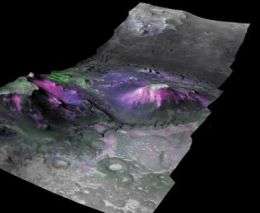
July 16th, 2008 Water-Rich Terrain on Mars

Enlarge

This three-dimensional image of a trough in the Nili Fossae region of Mars shows phyllosilcates (in magenta and blue hues) concentrated on the slopes of mesas and along canyon walls. The abundance of phyllosilcates show that water played a sizable role in changing the minerals of a variety of terrains in Mars's early history. Credit: NASA/JPL/JHUAPL/University of Arizona/Brown University

(PhysOrg.com) -- For decades, scientists have theorized – romanticized, even – that Mars has harbored water. The evidence has grown stronger as recent missions to the Red Planet have revealed in stunning detail Martian topography, mineralogy and clues to past climate. But how much water, where it was or is located and what it was doing have been hard to pin down.

"We've seen all this evidence of water on Mars," said John Mustard, a Brown professor of planetary geology, "but did it do any work?"

Now, papers by Mustard and Brown graduate student Bethany Ehlmann provide some key insights into these questions.

Reporting for the first time results obtained from an instrument aboard the Mars Reconnaissance Orbiter (MRO), Mustard and colleagues have found that vast regions of the ancient southern highlands of Mars hosted a water-rich environment. In a paper that appears in the July 17 issue of Nature, Mustard's team found evidence that water played a sizable role in changing the minerals of a variety of terrains in the Noachian period – about 4.6 billion to 3.8 billion years ago.

To support the claim, Mustard's team relied on data supplied by the Compact Reconnaissance Imaging Spectrometer for Mars (CRISM), the instrument for which he is the deputy principal investigator. The researchers investigated the pervasive presence of phyllosilicates, clay-like minerals that preserve a record water's interaction with rocks.

Mustard homed in on intriguing phyllosilicate deposits in localized spots such as craters, valleys and dunes all over the planet. Among the highlights, he detected the clay-like minerals in fans and deltas within three regions, most notably the Jezero crater. That discovery marks the first time hydrated silicates have been found in sediments "clearly lain by water," Mustard wrote as lead author of the paper, in which scientists from 13 other institutions participated.

The team also found phyllosilicate deposits in thousands of places in and around craters, including the pointed peaks located at the center of some of the depressions. The latter example suggests that water was present 4-5 kilometers below the ancient Martian surface, the team wrote, due to the generally accepted principle that crater-causing collisions excavate underground minerals that are then exposed on the crater peaks.

"Water must have been creating minerals at depth to get the signatures we see," Mustard said.

The clay minerals were formed at low temperatures (100-200°C) – an important clue to understanding the Red Planet's potential for habitability during the Noachian period.

"What does this mean for habitability? It's very strong," Mustard said. "It wasn't this hot, boiling cauldron. It was a benign, water-rich environment for a long period of time."

In a companion paper published June 2 in Nature Geoscience, Ehlmann and colleagues from Brown and other institutions analyzed sediment deposits in two exquisitely preserved deltas in the Jezero crater, which held an ancient lake slightly larger than Lake Tahoe. The deltas suggest a flow from rivers carrying the clay-like minerals from an approximate 15,000-square kilometer watershed during the Noachian period.

Ehlmann said scientists cannot determine whether the river flow was sporadic or sustained, but they do know it was intense and involved a lot of water.

"So not only was water active in this region to weather the rocks, but there was enough of it to run through the beds, transport the clays and run into the lake and form the delta," said Ehlmann, who has a National Science Foundation Graduate Research Fellowship.

The deltas appear to be excellent candidates for finding stored organic matter, Ehlmann said, because the clays brought in from the watershed and deposited in the lake would have trapped any organisms, leaving in essence a cemetery of microbes.

"If any microorganisms existed on ancient Mars, the watershed would have been a great place to live," Ehlmann said.

Provided by Brown University


print this article email this article download pdf blog this article bookmark this article     Digg this Stumble it share on Facebook share on Reddit add to delicious save to Yahoo! bookmarks
4.7/5 after 27 votes

Rank Filter

Move the slider to adjust rank threshold, so that you can hide some of the comments.


Display comments: newest first

  • rkolter - Jul 16, 2008
    • Rank: 5 / 5 (3)
    The subsurface phytosillicates were formed at relatively low temperatures, of between 100 and 200 degrees Celsius (212-392 degrees Fahrenheit), which implies that Mars was not only wet but also relatively temperate at the time.

    "What does this mean for habitability? It's very strong," Mustard said. "It wasn't this hot, boiling cauldron. It was a benign, water-rich environment for a long period of time."

    Ok, I know what they mean, but this is a confusing two paragraphs. I'm pretty sure that 212 - 350 degrees Farenheight is in fact, a "hot, boiling cauldron".
  • Jake1730 - Jul 16, 2008
    • Rank: 5 / 5 (3)
    212 %u2013 350ş Fahrenheit is most definitely a %u201Chot boiling cauldron%u201D and I also was confused by the two contradicting paragraphs.
  • Mercury_01 - Jul 16, 2008
    • Rank: 2.5 / 5 (2)
    Maybe in the shade it was a bit cooler. More like a mild boiling pot of spaghetti. Perhaps habitable to asbestos fungus or nomex gnomes.
  • out7x - Jul 17, 2008
    • Rank: 1 / 5 (1)
    boiling water can be produced with volcanism also. What types of clays were observed?
  • seanpu - Jul 17, 2008
    • Rank: not rated yet
    this must imply atmospheric preasure back then was much higher than now. 150 degree boiling water?? mars must have lost a lot of atmosphere, or those clays made deep underground and somehow came to the surface.
  • Mercury_01 - Jul 17, 2008
    • Rank: not rated yet
    I bet before mars' core went limp, it had a nice thick atmosphere, only to be later blown away by the solar wind.

July 16th, 2008 all stories
Space & Earth / Space Exploration

Comments: 6
Rank: 4.7/5 after 27 votes

  • Stumble this up

  • Digg this

  • Share it:
  • share on Facebook
  • share on MySpace
  • share on Slashdot
  • rss-newsfeed
  • share on Google
  • share on Reddit
  • add to delicious
  • save to Yahoo! bookmarks
  • share on Windows Live
  • Add to Mixx!
Rating: 4.7/5 after 27 votes

  • Related Stories

  • Searching For Aliens
    created Jul 28, 2006 | popularity not rated yet | comments 0
  • Martian snow source of tropical glaciers
    created Jan 19, 2006 | popularity not rated yet | comments 0
  • Prospecting for Lunar Water
    created Apr 29, 2005 | popularity not rated yet | comments 0
  • Mars data published in Science this week
    created Jul 02, 2009 | popularity not rated yet | comments 0
  • Many characteristics of Mars, including ice, are similar to Earth
    created Jul 02, 2009 | popularity not rated yet | comments 0

Tags


  • Physicists Demonstrate Quantum Memory with Matter Qubits
    Physicists Demonstrate Quantum Memory with Matter Qubits
    Physics / General Physics
    created Jul 03, 2009 | popularity 4.4 / 5 (17) | comments 1
  • 'Holey' Nanosheets for Wastewater Dye Removal
    Nanotechnology / Nanomaterials
    created Jul 01, 2009 | popularity 5 / 5 (5) | comments 1
  • Jellyfish Robot Swims Like its Biological Counterpart
    Jellyfish Robot Swims Like its Biological Counterpart
    Electronics / Robotics
    created Jun 26, 2009 | popularity 4.4 / 5 (8) | comments 1
  • Could Maxwell's Demon Exist in Nanoscale Systems?
    Could Maxwell's Demon Exist in Nanoscale Systems?
    Physics / General Physics
    created Jun 24, 2009 | popularity 4.4 / 5 (18) | comments 29
  • Living Safely with Robots, Beyond Asimov's Laws
    Living Safely with Robots, Beyond Asimov's Laws
    Electronics / Robotics
    created Jun 22, 2009 | popularity 4.6 / 5 (52) | comments 40
  • Other News

    Forty years ago man first walked on the moon

    Space & Earth / Space Exploration

    created 14 hours ago | popularity 5 / 5 (2) | comments 1

    Forty years ago on July 20, 1969, American astronaut Neil Armstrong realized the oldest dream of human civilizations when he became the first man to walk on the moon.


    The least sea ice in 800 years

    The least sea ice in 800 years

    Space & Earth / Earth Sciences

    created Jul 01, 2009 | popularity 4.2 / 5 (62) | comments 54

    New research, which reconstructs the extent of ice in the sea between Greenland and Svalbard from the 13th century to the present indicates that there has never been so little sea ice as there is now. The ...


    Gas around young galaxy

    Intense heat killed the Universe's would-be galaxies, researchers say

    Space & Earth / Astronomy

    created Jul 01, 2009 | popularity 3.3 / 5 (20) | comments 27

    (PhysOrg.com) -- Our Milky Way galaxy only survived because it was already immersed in a large clump of dark matter which trapped gases inside it, scientists led by Durham University's Institute for Computational ...


    Scientists' Drill Hits Magma: Only Third Time on Record

    Scientists' Drill Hits Magma: Only Third Time on Record

    Space & Earth / Earth Sciences

    created Jun 29, 2009 | popularity 4.7 / 5 (22) | comments 19

    (PhysOrg.com) -- Scientists drilling a borehole deep into Iceland’s rocky crust to explore new methods of using geothermal energy hit a major roadblock on Thursday: Their drill ran into molten rock at a depth ...


    NASA manager pitches a cheaper return-to-moon plan

    Space & Earth / Space Exploration

    created Jun 30, 2009 | popularity 4 / 5 (7) | comments 18

    (AP) -- Like a car salesman pushing a luxury vehicle that the customer no longer can afford, NASA has pulled out of its back pocket a deal for a cheaper ride to the moon.