New approach sheds light on ways Circadian disruption affects human health
July 16, 2008
Daysimeter

Enlarge

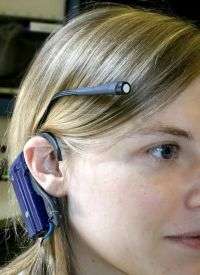
The Daysimeter, shown above, measures an individual’s daily rest and activity patterns, as well as exposure to circadian light -- short --wavelength light, particularly natural light from the blue sky, that stimulates the circadian system. Credit: Rensselaer/Dennis Guyon

Growing evidence indicates that exposure to irregular patterns of light and darkness can cause the human circadian system to fall out of synchrony with the 24-hour solar day, negatively affecting human health — but scientists have been unable to effectively study the relationship between circadian disruptions and human maladies.

A study by researchers in Rensselaer Polytechnic Institute's Lighting Research Center (LRC) provides a new framework for studying the effects of circadian disruption on breast cancer, obesity, sleep disorders, and other health problems.

Light and dark patterns are the major synchronizer of circadian rhythms — the biological cycles that repeat approximately every 24 hours — to the solar day. Inadequate or irregular light exposure can cause circadian rhythm disruptions that are believed to manifest into a variety of health ailments. However, ecological studies to measure human light exposure are virtually nonexistent, making it difficult to determine if, in fact, light-induced circadian disruption directly affects human health.

LRC researchers have created a small, head-mounted device to measure an individual's daily rest and activity patterns, as well as exposure to circadian light — short-wavelength light, particularly natural light from the blue sky, that stimulates the circadian system. The device, called the Daysimeter, was sent to 43 female nurses across the country to measure their daily exposure to circadian light, according to Mark Rea, director of the LRC and principal investigator on the project.

The Daysimeter was worn for seven days by both day-shift and rotating shift nurses and then returned to the LRC for analysis. Simultaneously, Rea and his colleagues studied the effect of irregular light exposure to the circadian system of 40 rats, in order to determine if the relationship between circadian disruption and health outcomes could be uncovered using rodent models.

Twenty rats were exposed to a consistently repeating pattern of 12 hours of light followed by 12 hours of dark, to mimic the light exposure experienced by day-shift workers. The remaining rodents were exposed to irregular 12-hour patterns of light and darkness.

For the nurses, circadian entrainment and disruption was measured by comparing exposure light and darkness with each individual's rest and activity patterns. Wheel running was used to measure rat rest and activity patterns.

A quantitative measure of circadian behavioral entrainment or disruption for day-shift and rotating shift workers was developed based on the circular cross-correlations of activity and light exposure data from both the nurses and the rats. An analysis technique commonly utilized in the field of signal processing, circular
cross-correlation involves the concept of time-shifting one signal relative to another to determine relationships between signals that might otherwise be obscured due to timing differences.

"We found that the circadian entrainment and disruption patterns for day-shift and rotating shift nurses were remarkably different from each other, but remarkably similar to the patterns for the two parallel groups of nocturnal rodents," says Rea. "The marked differences within species, together with the marked similarities across species, in addition to the new method of quantifying circadian entrainment or disruption suggests that health-related problems associated with circadian disruption in humans can be parametrically studied using animal models."

"This ability to quantitatively define circadian light and dark for humans and for animals will allow a new class of meaningful studies of light as a stimulus for circadian entrainment or disruption to be undertaken, not only in humans, but in nocturnal rodents as well – which, until now, has been impossible," says Rea. "Additionally, studies of circadian disruption employing animal models for human disease can now be designed and conducted to more accurately reflect their relevance to the actual living conditions in humans."

The study is published online in the Journal of Circadian Rhythms and can be viewed in its entirety at: http://www.jcircad … ontent/6/1/7 .

Source: Rensselaer Polytechnic Institute

3.1 /5 (7 votes)  

Filter


Move the slider to adjust rank threshold, so that you can hide some of the comments.


Display comments: newest first

Mercury_01
Jul 17, 2008

Rank: not rated yet
Id like to get into a circadian rhythm with that cutie up there.
Rank 3.1 /5 (7 votes)
Related Stories
Relevant PhysicsForums posts

More news stories

Starve a virus, feed a cure? Findings show how some cells protect themselves against HIV

A protein that protects some of our immune cells from the most common and virulent form of HIV works by starving the virus of the molecular building blocks that it needs to replicate, according to research published online ...

Medicine & Health / Research

created 13 hours ago | popularity 5 / 5 (3) | comments 0 | with audio podcast

Overeating may double risk of memory loss

New research suggests that consuming between 2,100 and 6,000 calories per day may double the risk of memory loss, or mild cognitive impairment (MCI), among people age 70 and older. The study was released today and will be ...

Medicine & Health / Neuroscience

created 10 hours ago | popularity 5 / 5 (2) | comments 0 | with audio podcast

Declining health-care productivity in England: Who says so?

Reports that the National Health Service in England has been declining in productivity in the last decade appear to have been accepted as fact. However, a Viewpoint published Online First by The Lancet disputes this. The Vi ...

Medicine & Health / Health

created 8 hours ago | popularity 1 / 5 (1) | comments 1

Injured boomers beware: Know when to see doctor

(AP) -- It happened to nurse Jane Byron years after an in-line skating fall, business owner Haralee Weintraub while doing "men's" push-ups, and avid cyclist Gene Wilberg while lifting a heavy box.

Medicine & Health / Health

created 15 hours ago | popularity 5 / 5 (1) | comments 0

FDA-approved drug rapidly clears amyloid from the brain, reverses Alzheimer's symptoms in mice

Neuroscientists at Case Western Reserve University School of Medicine have made a dramatic breakthrough in their efforts to find a cure for Alzheimer's disease. The researchers' findings, published in the journal Science, show t ...

Medicine & Health / Neuroscience

created Feb 09, 2012 | popularity 4.9 / 5 (58) | comments 17 | with audio podcast


Scientists discover molecular secrets of 2,000-year-old Chinese herbal remedy

For roughly two thousand years, Chinese herbalists have treated Malaria using a root extract, commonly known as Chang Shan, from a type of hydrangea that grows in Tibet and Nepal. More recent studies suggest that halofuginone, ...

New method to examine batteries -- MRI from the inside

There is an ever-increasing need for advanced batteries for portable electronics, such as phones, cameras, and music players, but also to power electric vehicles and to facilitate the distribution and storage of energy derived ...

Google might launch Drive for cloud storage soon

(PhysOrg.com) -- Google's next big move, according to the Wall Street Journal, is a cloud storage service called Drive. Hardly first to the plate, Google is simply catching up to introducing its cloud reposi ...

A mitosis mystery solved: How chromosomes align perfectly in a dividing cell

Although the process of mitotic cell division has been studied intensely for more than 50 years, Whitehead Institute researchers have only now solved the mystery of how cells correctly align their chromosomes during symmetric ...

Lab study raises questions over nano-particle impact

Tests involving chickens have raised questions about the impact on health from engineered nano-particles, the ultra-fine grains commonly used in drugs and processed foods, scientists said on Sunday.

Researchers find extensive RNA editing in human transcriptome

In a new study published online in Nature Biotechnology, researchers from BGI, the world's largest genomics organization, reported the evidence of extensive RNA editing in a human cell line by analysis of RNA-seq data, demons ...