A new way to weigh giant black holes
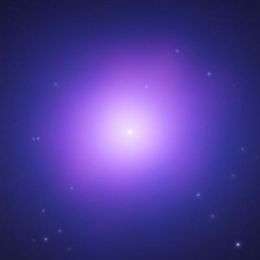
July 16th, 2008 X-ray and Optical Image of NGC 4649

Enlarge

A composite image from NASA's Chandra X-ray Observatory (shown in purple) and Hubble Space Telescope (blue) shows the giant elliptical galaxy NGC 4649. By applying a new technique, scientists used Chandra data to measure the black hole at its center to be about 3.4 billion times more massive than the Sun. The value from this X-ray technique is consistent with a more traditional method using the motions of stars near the black hole. NGC 4649 is now one of only a handful of galaxies for which the mass of a supermassive black hole has been measured with two different methods. Credit: X-ray: NASA/CXC/Univ. of California Irvine/P.Humphrey et al.; Optical: NASA/STScI

How do you weigh the biggest black holes in the universe? One answer now comes from a completely new and independent technique that astronomers have developed using data from NASA's Chandra X-ray Observatory.

By measuring a peak in the temperature of hot gas in the center of the giant elliptical galaxy NGC 4649, scientists have determined the mass of the galaxy's supermassive black hole. The method, applied for the first time, gives results that are consistent with a traditional technique.

Astronomers have been seeking out different, independent ways of precisely weighing the largest supermassive black holes, that is, those that are billions of times more massive than the Sun. Until now, methods based on observations of the motions of stars or of gas in a disk near such large black holes had been used.

"This is tremendously important work since black holes can be elusive, and there are only a couple of ways to weigh them accurately," said Philip Humphrey of the University of California at Irvine, who led the study. "It's reassuring that two very different ways to measure the mass of a big black hole give such similar answers."

NGC 4649 is now one of only a handful of galaxies for which the mass of a supermassive black hole has been measured with two different methods. In addition, this new X-ray technique confirms that the supermassive black hole in NGC 4649 is one of the largest in the local universe with a mass about 3.4 billion times that of the Sun, about a thousand times bigger than the black hole at the center of our galaxy.

The new technique takes advantage of the gravitational influence the black hole has on the hot gas near the center of the galaxy. As gas slowly settles towards the black hole, it gets compressed and heated. This causes a peak in the temperature of the gas right near the center of the galaxy. The more massive the black hole, the bigger the temperature peak detected by Chandra.

This effect was predicted by two of the co-authors -- Fabrizio Brighenti from the University of Bologna, Italy, and William Mathews from the University of California at Santa Cruz -- almost 10 years ago, but this is the first time it has been seen and used.

"It was wonderful to finally see convincing evidence of the effects of the huge black hole that we expected," said Brighenti. "We were thrilled that our new technique worked just as well as the more traditional approach for weighing the black hole."

The black hole in NGC 4649 is in a state where it does not appear to be rapidly pulling in material towards its event horizon, nor generating copious amounts of light as it grows. So, the presence and mass of the central black hole has to be studied more indirectly by tracking its effects on stars and gas surrounding it. This technique is well suited to black holes in this condition.

"Monster black holes like this one power spectacular light shows in the distant, early universe, but not in the local universe," said Humphrey. "So, we can't wait to apply our new method to other nearby galaxies harboring such inconspicuous black holes."

These results will appear in an upcoming issue of The Astrophysical Journal.

Source: Chandra X-ray Center


print this article email this article download pdf blog this article bookmark this article     Digg this Stumble it share on Facebook share on Reddit add to delicious save to Yahoo! bookmarks
4.6/5 after 23 votes

Rank Filter

Move the slider to adjust rank threshold, so that you can hide some of the comments.


Display comments: newest first

  • thales - Jul 16, 2008
    • Rank: 1 / 5 (1)
    This method, which apparently only requires one observation, sounds like it's WAY faster than measuring star motions, which requires multiple observations. I'd bet we'll suddenly start hearing about the masses of all kinds of black holes, and the records of the biggest and smallest will soon be broken.
  • jamesrm - Jul 16, 2008
    • Rank: 3 / 5 (2)
    This might change their views?
    http://www.theoni...evidence

    Regards
    James
  • brant - Jul 16, 2008
    • Rank: 1 / 5 (1)
    Baloney. The HSK is good science!!!
  • out7x - Jul 17, 2008
    • Rank: 1 / 5 (1)
    weight and temperatures do not distinguish between a blackhole and many stars orbiting each other.

July 16th, 2008 all stories
Space & Earth / Astronomy

Comments: 4
Rank: 4.6/5 after 23 votes

  • Stumble this up

  • Digg this

  • Share it:
  • share on Facebook
  • share on MySpace
  • share on Slashdot
  • rss-newsfeed
  • share on Google
  • share on Reddit
  • add to delicious
  • save to Yahoo! bookmarks
  • share on Windows Live
  • Add to Mixx!
Rating: 4.6/5 after 23 votes

  • Related Stories

  • Astronomer's new guide to the galaxy: Largest map of cold dust revealed
    created Jul 01, 2009 | popularity not rated yet | comments 0
  • Baby Stars Finally Found in Jumbled Galactic Center
    created Jun 10, 2009 | popularity not rated yet | comments 0
  • Keck Study Sheds New Light on "Dark" Gamma-ray Bursts
    created Jun 08, 2009 | popularity not rated yet | comments 0
  • Network creates virtual super-telescope
    created Jun 08, 2009 | popularity not rated yet | comments 0
  • A new class of dim supernovae
    created Jun 05, 2009 | popularity not rated yet | comments 0


  • Physicists Demonstrate Quantum Memory with Matter Qubits
    Physicists Demonstrate Quantum Memory with Matter Qubits
    Physics / General Physics
    created Jul 03, 2009 | popularity 4.4 / 5 (17) | comments 1
  • 'Holey' Nanosheets for Wastewater Dye Removal
    Nanotechnology / Nanomaterials
    created Jul 01, 2009 | popularity 5 / 5 (5) | comments 1
  • Jellyfish Robot Swims Like its Biological Counterpart
    Jellyfish Robot Swims Like its Biological Counterpart
    Electronics / Robotics
    created Jun 26, 2009 | popularity 4.4 / 5 (8) | comments 1
  • Could Maxwell's Demon Exist in Nanoscale Systems?
    Could Maxwell's Demon Exist in Nanoscale Systems?
    Physics / General Physics
    created Jun 24, 2009 | popularity 4.4 / 5 (18) | comments 29
  • Living Safely with Robots, Beyond Asimov's Laws
    Living Safely with Robots, Beyond Asimov's Laws
    Electronics / Robotics
    created Jun 22, 2009 | popularity 4.6 / 5 (52) | comments 40
  • Other News

    Forty years ago man first walked on the moon

    Space & Earth / Space Exploration

    created 15 hours ago | popularity 5 / 5 (2) | comments 1

    Forty years ago on July 20, 1969, American astronaut Neil Armstrong realized the oldest dream of human civilizations when he became the first man to walk on the moon.


    The least sea ice in 800 years

    The least sea ice in 800 years

    Space & Earth / Earth Sciences

    created Jul 01, 2009 | popularity 4.2 / 5 (62) | comments 57

    New research, which reconstructs the extent of ice in the sea between Greenland and Svalbard from the 13th century to the present indicates that there has never been so little sea ice as there is now. The ...


    Gas around young galaxy

    Intense heat killed the Universe's would-be galaxies, researchers say

    Space & Earth / Astronomy

    created Jul 01, 2009 | popularity 3.4 / 5 (21) | comments 27

    (PhysOrg.com) -- Our Milky Way galaxy only survived because it was already immersed in a large clump of dark matter which trapped gases inside it, scientists led by Durham University's Institute for Computational ...


    Scientists' Drill Hits Magma: Only Third Time on Record

    Scientists' Drill Hits Magma: Only Third Time on Record

    Space & Earth / Earth Sciences

    created Jun 29, 2009 | popularity 4.7 / 5 (22) | comments 19

    (PhysOrg.com) -- Scientists drilling a borehole deep into Iceland’s rocky crust to explore new methods of using geothermal energy hit a major roadblock on Thursday: Their drill ran into molten rock at a depth ...


    NASA manager pitches a cheaper return-to-moon plan

    Space & Earth / Space Exploration

    created Jun 30, 2009 | popularity 4 / 5 (7) | comments 18

    (AP) -- Like a car salesman pushing a luxury vehicle that the customer no longer can afford, NASA has pulled out of its back pocket a deal for a cheaper ride to the moon.