Balance problems? Step into the iShoe
July 16, 2008
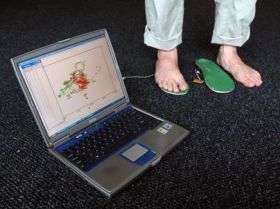
The iShoe insole would measure and analyze the pressure distribution of the patient's foot and report back to their doctor. Photo / Donna Coveney
(PhysOrg.com) -- Your grandmother might have little in common with an astronaut, but both could benefit from a new device an MIT graduate student is designing to test balancing ability.
The iShoe insole could help doctors detect balance problems before a catastrophic fall occurs, says Erez Lieberman, a graduate student in the Harvard-MIT Division of Health Sciences and Technology who developed the technology as an intern at NASA.
Falls among the elderly are common and can be deadly: In 2005, nearly 300,000 Americans suffered hip fractures after a fall, and an average of 24 percent of hip-fracture patients aged 50 and over die in the year following their fracture, according to the National Osteoporosis Foundation.
Lieberman is now testing the iShoe technology in a small group of patients. The current model is equipped to diagnose balance problems, but future versions could help correct such problems, by providing sensory stimulation to the feet when the wearer is off-kilter.
"By doing that we can replace the sense and thus improve people's balance," Lieberman says.
Lieberman and other iShoe team members have applied for a patent on the technology, to be jointly held by MIT, Harvard and NASA. In April, the company won a $50,000 grant from the Lunar Ventures Competition to help with start-up costs.
Lieberman originally developed the technology to help NASA monitor balance problems in astronauts returning from space.
Zero gravity environments wreak havoc on the vestibular system, one of three body systems that control balance. (The others are vision and sensory receptors called proprioceptors, which tell you where your body parts are in relation to other body parts and the outside world.)
"The change in gravity really screws with their sense of balance. They're falling all over the place," says Lieberman, who is a Hertz Fellow and also receives funding from the National Science Foundation and Department of Defense.
The effect usually lasts about 10 days, but NASA tests astronauts' balance for 16 days after their return. Astronauts go into a phone-booth-like box, where they undergo a series of balance tests such as platform shifts and wall shifts.
While at NASA, Lieberman developed a new system for gathering data and an algorithm to analyze the data.
"We've developed the first algorithm that is really capable of not just looking at the pressure distribution of proprioceptors on the feet but also analyzing what that's saying," he says.
Lieberman soon realized that the technology could reach a wider audience than just astronauts. His own grandmother suffered a bad fall several years ago, and he theorized that a balance diagnostic could help doctors catch balance problems before such a fall occurs.
"You have a gradual progression of loss of balance, osteoporosis, and other factors that can lead to the fall," Lieberman says.
The iShoe insole would measure and analyze the pressure distribution of the patient's foot and report back to their doctor. The device could also be outfitted with an alarm that would alert family members when a fall has occurred.
Lieberman and his colleagues are now testing the device in about 60 people, hoping to generate data that will help them create a model to predict the risk of a fall.
Other members of the iShoe team are Katherine Forth, a former NASA postdoctoral associate; Ricardo Piedrahita, a graduate of University of California at San Diego; and Qian Yang, a Harvard undergraduate.
Provided by MIT
-
Should the Internet have an 'off' switch?
Feb 21, 2011 |
4.3 / 5 (3) |
39
-
Regulatory molecule for tumor formation or suppression identified
Mar 17, 2009 |
not rated yet |
0
-
Health researchers explore how to take interactive video games to the next level
May 30, 2008 |
not rated yet |
0
-
Sides agree on DTV transition requirement
Jul 14, 2005 |
not rated yet |
0
-
Fast photon control brings quantum photonic technologies closer
1 hour ago |
5 / 5 (2) |
0
-
Engineers build first sub-10-nm carbon nanotube transistor
Feb 01, 2012 |
4.9 / 5 (33) |
30
-
Something old, something new: Evolution and the structural divergence of duplicate genes
Jan 31, 2012 |
4.6 / 5 (7) |
1
-
The hidden nanoworld of ice crystals: Revealing the dynamic behavior of quasi-liquid layers
Jan 30, 2012 |
5 / 5 (5) |
1
-
Stock market network reveals investor clustering
Jan 27, 2012 |
3.9 / 5 (23) |
8
-
How to tilt a object
14 hours ago
-
How to calculate total compressibility in liquid porous solid system
19 hours ago
-
Need help reading 3-D
Feb 11, 2012
-
A way to send and receive wireless data
Feb 11, 2012
-
Calling function with no input argument
Feb 10, 2012
-
Force free body diagram problem on gym equipment
Feb 10, 2012
- More from Physics Forums - General Engineering
More news stories
Independent group inspects Apple supplier
(AP) -- An independent group, the Fair Labor Association, has started auditing Apple Inc.'s Chinese supplier Foxconn after a request by Apple.
59 minutes ago |
not rated yet |
0
Teaching teens safety in the virtual world
A new cyber safety program on the dangers of social networking is being developed by Flinders University, in light of an alarming report which shows children as young as 12 are meeting internet strangers in ...
1 hour ago |
not rated yet |
0
Microsoft India retail site down after 'cyber attack'
Microsoft said Monday it was investigating an attack by hackers on its Indian retail website, reportedly carried out by a Chinese group called the "Evil Shadow Team."
4 hours ago |
not rated yet |
0
Chinese city seizes Apple iPads in name dispute
(AP) -- Authorities have seized Apple iPads from retailers in a city in northern China due to a dispute with a domestic company that says it owns the iPad name, an official said Monday. The Chinese company said it is asking ...
4 hours ago |
not rated yet |
0
AT&T customers surprised by 'unlimited data' limit
(AP) -- Mike Trang likes to use his iPhone 4 as a GPS device, helping him get around in his job. Now and then, his younger cousins get ahold of it, and play some YouTube videos and games.
6 hours ago |
5 / 5 (2) |
3
Planck mission steps closer to the cosmic blueprint
(PhysOrg.com) -- ESA's Planck mission has revealed that our Galaxy contains previously undiscovered islands of cold gas and a mysterious haze of microwaves. These results give scientists new treasure to mine ...
Slowing ocean current caused Earth to spin faster
(PhysOrg.com) -- Most people probably didn’t notice it, but back in 2009, the Earth spun around on its axis a tiny bit faster than usual, making for some slightly shorter days. It only happened for a ...
Fast photon control brings quantum photonic technologies closer
(PhysOrg.com) -- Using photons instead of electrons to transmit information could lead to faster and more secure ways to communicate, among other advantages. Now a team of physicists has taken another step toward realizing ...
New ability to regrow blood vessels holds promise for treatment of heart disease
(Medical Xpress) -- University of Texas at Austin researchers have demonstrated a new and more effective method for regrowing blood vessels in the heart and limbs a research advancement that could have ...
New European rocket lifts off on maiden flight
Europe on Monday successfully launched a new lightweight rocket carrying a test payload, culminating a more than 12-year quest to master the entire range of space launchers.
New molecule has potential to help treat genetic diseases and HIV
(PhysOrg.com) -- Chemists at The University of Texas at Austin have created a molecule that's so good at tangling itself inside the double helix of a DNA sequence that it can stay there for up to 16 days before ...