Phoenix Rasps Frozen Layer, Collects Sample
July 16, 2008 Phoenix Rasps Frozen Layer, Collects Sample

Enlarge

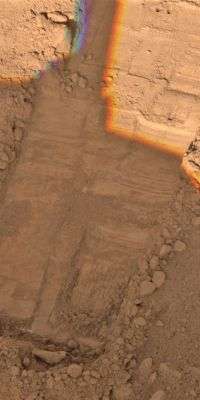
This image, taken by NASA's Phoenix Mars Lander's Surface Stereo Imager on Sol 50, or the 50th day of the mission, July 15, 2008, shows two holes at the top created by the lander's Robotic Arm's motorized rasp tool. Image: NASA

(PhysOrg.com) -- A powered rasp on the back of the robotic arm scoop of NASA's Phoenix Mars Lander successfully drilled into the frozen soil and loosened material that was collected in the lander's scoop.

Images and data sent from Phoenix early Wednesday indicated the shaved material in the scoop had changed slightly over time during the hours after it was collected.

The motorized rasp -- located on the back of the lander's robotic arm scoop -- made two distinct holes in a trench informally named "Snow White." The material loosened by the rasp was collected in the scoop and documented by the Robotic Arm Camera. The activity was a test of the rasping method of gathering an icy sample, in preparation for using that method in coming days to collect a sample for analysis in an oven of Phoenix's Thermal and Evolved-Gas Analyzer.

"This was a trial that went really well," said Richard Morris, a Phoenix science team member from NASA's Johnson Space Center, Houston. "While the putative ice sublimed out of the shavings over several hours, this shows us there will be a good chance ice will remain in a sample for delivery" to Phoenix's laboratory ovens.

Phoenix on Wednesday will be commanded to continue scraping and enlarging the "Snow White" trench and to conduct another series of rasp tests. The lander's cameras will again be used to monitor the sample in the scoop after its collection.

Provided by NASA


print this article email this article download pdf blog this article bookmark this article     Stumble it Digg this share on Facebook retweet share on Reddit add to delicious
Rate this story - 4.4 /5 (19 votes)

Rank Filter

Move the slider to adjust rank threshold, so that you can hide some of the comments.


Display comments: newest first

  • Mombo_Dogface - Jul 16, 2008
    • Rank: 3 / 5 (2)
    Is the Phoenix Lander mobile at all? It doesn't seem so.
  • holmstar - Jul 16, 2008
    • Rank: 3.7 / 5 (3)
    no it is not.
  • Mercury_01 - Jul 16, 2008
    • Rank: 3 / 5 (2)
    Whens the big new coming on all the remaining data?
  • DoctorKnowledge - Jul 17, 2008
    • Rank: 3.5 / 5 (2)
    Right, it's not mobile. It's cheaper that way. And to quote the official site: "The Phoenix lander is going to an area of Mars where water is believed to exist in the form of ice just below the surface. This water ice is probably spread fairly uniformly throughout the northern plains so the lander should be able to uncover ice wherever it lands." http://phoenix.lp.../faq.php
    There's a lot of interesting info, there.
  • out7x - Jul 17, 2008
    • Rank: 1 / 5 (2)
    How deep did it drill? Is there intelligent life on earth?
  • runninglate - Jul 17, 2008
    • Rank: not rated yet
    Is there intelligent life on earth?


    lol. no.

July 16, 2008 all stories

Comments: 6

4.4 /5 (19 votes)
  • Stumble this up

  • Digg this

  • share this

  • hide
  • Related Stories

  • Next Mars Soil Scoop Slated for Last of Lander's Wet Lab Cells
    created Sep 10, 2008 | popularity not rated yet | comments 0
  • Phoenix Mars Lander Working With Sticky Soil
    created Jul 29, 2008 | popularity not rated yet | comments 0
  • Phoenix Revises Method to Deliver Icy Sample
    created Jul 28, 2008 | popularity not rated yet | comments 0
  • Trench on Mars Ready for Next Sampling by NASA Lander
    created Jul 24, 2008 | popularity not rated yet | comments 0
  • Phoenix Mars Lander Continues Tests With Rasp
    created Jul 18, 2008 | popularity not rated yet | comments 0


  • hide
  • Relevant PhysicsForums posts

  • The shape of our solar system's orbits.
    created 20 hours ago
  • Above or Below the Line of Nodes
    created Nov 07, 2009
  • Supernova vs. Nova?
    created Nov 07, 2009
  • Supernova's Gamma Rays and Comets
    created Nov 06, 2009
  • More from Physics Forums - General Astronomy

Other News

Deep creep means milder, more frequent earthquakes along Southern California's San Jacinto fault

Deep creep means milder, more frequent earthquakes along Southern California's San Jacinto fault

Space & Earth / Earth Sciences

created 6 hours ago | popularity 4.7 / 5 (3) | comments 0

With an average of four mini-earthquakes per day, Southern California's San Jacinto fault constantly adjusts to make it a less likely candidate for a major earthquake than its quiet neighbor to the east, the ...


Success in 'space elevator' competition (AP)

Success in 'space elevator' competition (Update 3)

Space & Earth / Space Exploration

created Nov 05, 2009 | popularity 4.3 / 5 (33) | comments 50

(AP) -- A robot powered by a ground-based laser beam climbed a long cable dangling from a helicopter on Wednesday to qualify for prize money in a $2 million competition to test the potential reality of the ...


'Dropouts' pinpoint earliest galaxies

'Dropouts' pinpoint earliest galaxies

Space & Earth / Astronomy

created Nov 06, 2009 | popularity 4.2 / 5 (10) | comments 12

Astronomers, conducting the broadest survey to date of galaxies from about 800 million years after the Big Bang, have found 22 early galaxies and confirmed the age of one by its characteristic hydrogen signature ...


Space hotel taking bookings for 2012 opening

Space hotel taking bookings for 2012 opening

Space & Earth / Space Exploration

created Nov 05, 2009 | popularity 4.4 / 5 (20) | comments 11

(PhysOrg.com) -- The first orbiting space hotel is on track to open for its first customers in 2012, but hurry, as bookings are filling fast.


In a Galaxy Far, Far Away...

In a Galaxy Far, Far Away...

Space & Earth / Astronomy

created Nov 06, 2009 | popularity 4.8 / 5 (5) | comments 13

(PhysOrg.com) -- Astronomers have published the discovery of the farthest known object in the cosmos: a star that exploded when the universe was only 630 million years old -- only 4.6% of its current age. ...