Toshiba Launches 400GB 2.5-inch HDD Introduces New Line-up of 7,200rpm Drives
July 16, 2008
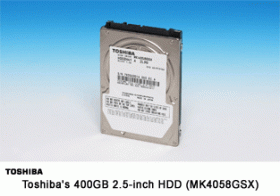
Toshiba today announced a new line-up of high performance 2.5-inch HDDs, including a low-noise flagship model that boosts areal density to 477Mbit/mm2 (308Gbpsi) to achieve a capacity of 400GB on just two platters, plus five drives that bring new levels of performance and 7,200rpm rotational speeds to the company’s full range of storage capacities.
Mass production of the 400GB MK4058GSX will start from September, targeting notebook PC and consumer electronic applications. Mass production of the 7,200rpm drives will start in August. The line-up includes the 320GB MK3254GSY and models with 80, 120, 160 and 250GB capacities.
Toshiba will feature the new drives at DISKCON JAPAN 2008, organized by The International Disk Drive Equipment and Materials Association (IDEMA), which will be held in Tokyo, Japan, from July 22 to 23, and at IFA 2008, one of the world’s largest consumer electronics trade fairs, which will be held in Berlin, Germany, from August 29 to September 3.
The MK4058GSX uses an improved read-write head and enhanced magnetic layer to boost areal density to 477Mbit/mm2 and achieve a capacity of 400GB on only two platters, the highest data density of any of Toshiba’s 2.5-inch HDD. A further plus is that acoustic noise during data seek has been reduced by 2 decibels (dB), compared to the company’s current top-of-the-line 320GB MK3252GSX, making operation almost inaudible. As a result, the new 400GB drive is ideally suited for noise-free playback of movies and music on notebook PCs and digital products. These advances are complemented by an improved energy consumption efficiency that makes the MK4058GSX approximately 20% more efficient than Toshiba’s current top-of-the-line MK3252GSX.
The five other drives that Toshiba has added to its line-up take full advantage of a 7,200rpm rotation speed to boost performance. Compared to the current 200GB model (MK2049GSY), the 320GB MK3254GSY improves maximum internal data transfers rate by approximately 14% to support high-speed processing of high volume data, meeting demand for notebook and desktop PCs offering faster performance. The 320GB drives is also 37% more efficient than the MK2049GSY in terms of energy consumption efficiency. All of the drives, available in a line-up of 80, 120, 160, 250 and 320GB capacities, support an optional Free Fall Sensor function, that detects a falling HDD and parks the head before impact.
All the new drives comply with the European Union’s RoHS directive for eliminating use of six hazardous substances in electrical and electronic equipment, and the MK4058GSX is Toshiba’s first halogen-free 2.5-inch HDD.
2.5-inch hard disk drives are now found in many and diverse applications, from desktop and mobile PCs to other digital consumer products. The market has a voracious appetite for larger data capacities, as more powerful networks and applications bring audio-visual capabilities to more products. Toshiba will sustain the industry’s ability to meet customer needs by providing cutting-edge technologies that add to areal density, operating speed and overall drive performance.
Source: Toshiba
-
Engineers build first sub-10-nm carbon nanotube transistor
Feb 01, 2012 |
4.9 / 5 (33) |
30
-
Something old, something new: Evolution and the structural divergence of duplicate genes
Jan 31, 2012 |
4.6 / 5 (7) |
1
-
The hidden nanoworld of ice crystals: Revealing the dynamic behavior of quasi-liquid layers
Jan 30, 2012 |
5 / 5 (4) |
1
-
Stock market network reveals investor clustering
Jan 27, 2012 |
3.9 / 5 (23) |
8
-
Of microchemistry and molecules: Electronic microfluidic device synthesizes biocompatible probes
Jan 26, 2012 |
5 / 5 (2) |
0
-
How to calculate total compressibility in liquid porous solid system
5 hours ago
-
Need help reading 3-D
Feb 11, 2012
-
A way to send and receive wireless data
Feb 11, 2012
-
Calling function with no input argument
Feb 10, 2012
-
Force free body diagram problem on gym equipment
Feb 10, 2012
-
Empirical data regarding shower heads and water
Feb 10, 2012
- More from Physics Forums - General Engineering
More news stories
Japan scientist makes 'Avatar' robot
A Japanese-developed robot that mimics the movements of its human controller is bringing the Hollywood blockbuster "Avatar" one step closer to reality.
Feb 10, 2012 |
5 / 5 (9) |
12
Intel packs performance and reliability into its latest SSD 520 series
Intel Corporation announced today its fastest, most robust client/consumer solid-state drive (SSD) to date, the Intel Solid-State Drive 520 Series (Intel SSD 520), a 6 gigabit-per-second (gbps) SATA III SSD ...
Feb 07, 2012 |
5 / 5 (1) |
4
Google rumored to have built Heads-Up-Display glasses prototype
(PhysOrg.com) -- 9to5Google is reporting that they have received a tip from someone they believe to be a reliable source saying that Google is working on a Heads-Up-Display (HUD) pair of eye-glasses. The per ...
New Kindle Touch is an impressive e-reader
When it comes to reading digital books, tablets are all the rage. But there's a lot to like about simple e-readers, which over the past year have become both a lot cheaper and a lot less clunky.
Electronics / Consumer & Gadgets
Feb 09, 2012 |
5 / 5 (4) |
1
Apple to debut 'iPad 3' in March: report
Apple will unveil a new version of its market-ruling iPad table computer in March, according to a report in Dow Jones-owned technology blog All Things D.
Electronics / Consumer & Gadgets
Feb 09, 2012 |
1.9 / 5 (21) |
0
Scientists discover molecular secrets of 2,000-year-old Chinese herbal remedy
For roughly two thousand years, Chinese herbalists have treated Malaria using a root extract, commonly known as Chang Shan, from a type of hydrangea that grows in Tibet and Nepal. More recent studies suggest that halofuginone, ...
New method to examine batteries -- MRI from the inside
There is an ever-increasing need for advanced batteries for portable electronics, such as phones, cameras, and music players, but also to power electric vehicles and to facilitate the distribution and storage of energy derived ...
A mitosis mystery solved: How chromosomes align perfectly in a dividing cell
Although the process of mitotic cell division has been studied intensely for more than 50 years, Whitehead Institute researchers have only now solved the mystery of how cells correctly align their chromosomes during symmetric ...
Overeating may double risk of memory loss
New research suggests that consuming between 2,100 and 6,000 calories per day may double the risk of memory loss, or mild cognitive impairment (MCI), among people age 70 and older. The study was released today and will be ...
Lab study raises questions over nano-particle impact
Tests involving chickens have raised questions about the impact on health from engineered nano-particles, the ultra-fine grains commonly used in drugs and processed foods, scientists said on Sunday.
Google might launch Drive for cloud storage soon
(PhysOrg.com) -- Google's next big move, according to the Wall Street Journal, is a cloud storage service called Drive. Hardly first to the plate, Google is simply catching up to introducing its cloud reposi ...