Virtual world is sign of future for scientists, engineers
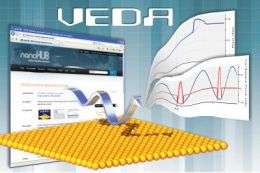
Purdue University is operating a virtual environment that enables scientists and engineers to interpret raw data collected with powerful instruments called dynamic atomic force microscopes.
The online tools, believed to be the first of their kind for the instruments, represent a research trend, with tools for other applications also being developed, said Arvind Raman, a Purdue professor of mechanical engineering.
"We will see more and more of this sort of thing for many other types of instruments that are being used around the world," he said. "This allows researchers to spend more time doing research and less time and money developing simulations."
More than 300 researchers from around the world have used the "virtual environment for dynamic atomic force microscopy," or VEDA, since it went online about a year ago.
The virtual environment is described in a research article featured as a cover story in the June issue of the journal Review of Scientific Instruments, published by the American Institute of Physics. The article focuses on two simulation tools needed for atomic force microscopes.
"This is a hardware-based journal and they put a virtual instrument on the cover, which should tell you that people regard this as a practical tool," Raman said. "I think it shows that even in that community there is a feeling that the cyberinfrastructure can really be used in beneficial ways for the experimental scientific community."
The online tools are provided through the nanoHub, operated by the Network for Computational Nanotechnology at Purdue, led by Mark Lundstrom, Purdue's Scifres Distinguished Professor of Electrical and Computer Engineering.
"These are the first Web-based simulation tools for atomic force microscopy available online," Raman said. "There are a dozen or so research groups around the world with the capability of doing accurate simulations the way we do for dynamic atomic force microscopy, but there are hundreds of researchers who need these tools."
The research article was written by mechanical engineering graduate student John Melcher, recently graduated doctoral student Shuiqing Hu and Raman.
The nanoHub uses a high-speed fiberoptic network called the Teragrid and is an example of the cyberinfrastructure being developed for researchers.
The online simulation tools, funded by the Network for Computational Nanotechnology and the National Science Foundation, are proving popular for researchers who otherwise would have to either purchase or create their own complex software to interpret data from the microscopes.
The tools are needed for demanding models and simulations, using computer clusters that are equivalent to 100 personal computers provided through the nanoHub, which is housed in Purdue's Birck Nanotechnology Center at the university's Discovery Park.
Researchers may access lectures and various simulation tools at http://www.nanohub.org.
A dynamic atomic force microscope uses a tiny vibrating probe to yield information about materials and surfaces on the scale of nanometers, or billionths of a meter. Forces between atoms influence how the probe's vibration pattern changes.
Researchers need specialized software to interpret data regarding the probe's changing amplitude, or how far it moves toward and away from a surface, and its phase, or how its vibration timing is altered by atomic forces.
Without the interpretation, the vibration-pattern data are meaningless, Melcher said.
Researchers use the microscopes to learn about a material's magnetic, electrical and physical properties, the contours of surfaces and shapes of objects, including biological molecules.
The nanoHub enables researchers to use the simulations with an ordinary Web browser on their personal computer.
"Say a physicist is operating an atomic force microscope in Japan," Raman said. "They do their experiment and then go online and access our tools to learn what the data mean. Users don't need to download software on their own computers. All they need is a browser, which they could have on their cell phones if they want. So they could take the cell phones with a browser, go to the nanoHub, go to the VEDA tools, enter the simulation data they want for simulating the atomic force microscope scanning across a certain surface, and hit go."
Researchers developed the simulation tools over the past five years.
"We are always updating the software and making new tools available," Raman said.
The simulations also enable researchers to learn ahead of time how to best use their atomic force microscopes for specific experiments.
"That means the simulations save them time by predicting the proper parameters to use before they even begin their experiments," Raman said.
Source: Purdue University


