Molecular Hula Hoop: Spinning motion of a molecular rotor detected
July 17, 2008 Molecular Hula Hoop: Spinning motion of a molecular rotor detected

Enlarge

(PhysOrg.com) -- Humans have long been trying to make the dream of nanoscopic robots come true. The dream is, in fact, taking on some aspects of reality. Nanoscience has produced components for molecular-scale machines. One such device is a rotor, a movable component that rotates around an axis.

Trying to observe such rotational motion on the molecular scale is an extremely difficult undertaking. Japanese researchers at the Universities of Osaka and Kyoto have now met this challenge. As Akira Harada and his team report in the journal Angewandte Chemie, they were able to get “snapshots” of individual molecular rotors caught in motion.

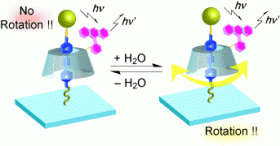
As the subject of their study the researchers chose a rotaxane. This is a two-part molecular system: A rod-shaped molecule is threaded by a second, ring-shaped molecule like a cuff while a stopper at the end of the rod prevents the ring from coming off. The researchers attached one end of the rod to a glass support. To observe the rotational motions of the cuff around the sleeve, the scientists attached a fluorescing side chain to the cuff as a probe.

To observe the rotation of the ring around the rod, the researchers used a microscopic technique called defocused wide-field total internal reflection fluorescence microscopy. This gave snapshots of individual rotaxane molecules in the form of emission patterns. In simplified terms, if the cuff is motionless, the patterns make it possible to calculate the direction in which the probe emits its fluorescent light. This makes it possible to calculate the orientation of the cuff, which remains constant for every snapshot. However, if the cuff is rotating, the emission pattern does not reveal the spatial orientation of the probe.

The researchers showed that the cuff of the rotaxane does not rotate if the sample is dry. However, when it is wet they can see very rapid rotational and vibrational motion. The cuff rotates faster than the time required to snap a picture: the rotational speed is thus over 360° in 300 milliseconds.

Citation: Akira Harada, Single-Molecule Imaging of Rotaxanes Immobilized on Glass Substrates: Observation of Rotary Movement, Angewandte Chemie International Edition 2008, 47, No. 32, 6077–6079, doi: 10.1002/anie.200801431

Provided by Wiley


Rate this story - 4.6 /5 (5 votes)


July 17, 2008 all stories

Comments: 0

4.6 /5 (5 votes)

  • hide
  • Related Stories

  • Understanding DNA Repair and Cancer
    created Dec 03, 2009 | popularity not rated yet | comments 0
  • Nanotube Construction Set
    created Nov 14, 2008 | popularity not rated yet | comments 0
  • New forensic technique gives clues about sharks from bite damage
    created Dec 01, 2009 | popularity not rated yet | comments 0
  • Young tennis players who play only one sport are more prone to injuries
    created Nov 09, 2009 | popularity not rated yet | comments 0
  • Microsoft's Rx for health care
    created Oct 08, 2009 | popularity not rated yet | comments 0


Other News

New approach to treating breast and prostate cancers

Chemistry / Biochemistry

created 22 hours ago | popularity 2.5 / 5 (2) | comments 0

In a new approach to developing treatments for breast cancer, prostate cancer and enlarged hearts, Loyola University Chicago Stritch School of Medicine researchers are zeroing in on a workhorse protein called RSK.


Energy from light and water: New photocatalytic method for the clean production of hydrogen from water

Chemistry / Materials Science

created Feb 09, 2010 | popularity 4.6 / 5 (14) | comments 10 | with audio podcast

(PhysOrg.com) -- Hydrogen-powered fuel cells and solar energy are the best hope for a more environmentally friendly and resource-sparing energy supply in the future. A combination of the two is considered to be particularly ...


New research rejects 80-year theory of 'primordial soup' as the origin of life

Chemistry / Biochemistry

created Feb 02, 2010 | popularity 4.3 / 5 (36) | comments 29 | with audio podcast

For 80 years it has been accepted that early life began in a 'primordial soup' of organic molecules before evolving out of the oceans millions of years later. Today the 'soup' theory has been over turned in a pioneering paper ...


It looks, feels and tastes like chicken, but it's made of soy

It looks, feels and tastes like chicken, but it's made of soy

Chemistry / Biochemistry

created Feb 04, 2010 | popularity 4.5 / 5 (18) | comments 14 | with audio podcast

Sure, some delicacies might taste just like chicken, but they usually feel and look much different. Soy meat alternatives, such as the soy burger, have become more popular recently, with increased sales of ...


Compound could become important new antidepressant

Chemistry / Other

created Feb 04, 2010 | popularity 4.9 / 5 (11) | comments 7 | with audio podcast

Chemists at Oregon State University have discovered and synthesized a new compound that in laboratory and animal tests appears to be similar to, but may have advantages over one of the most important antidepressant medications ...