New kind of MRI enables study of magnets for computer memory
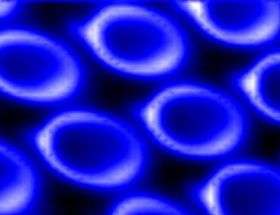
(PhysOrg.com) -- What is there to see inside a magnet that's smaller than the head of a pin? Quite a lot, say physicists who've invented a new kind of MRI technique to do just that.
The technique may eventually enable the development of extremely small computers, and even give doctors a new tool for studying the plaques in blood vessels that play a role in diseases such as heart disease.
In a recent issue of Physical Review Letters, the scientists report the first-ever magnetic resonance image of the inside of an extremely tiny magnet.
Specifically, the magnet is a "ferromagnet" -- a magnet made of ferrous metal such as iron. It's what most people think of when they hear the word "magnet."
"The magnets we study are basically the same as a refrigerator magnet, only much smaller," said project leader Chris Hammel, Ohio Eminent Scholar in Experimental Physics at Ohio State University. The disk-shaped magnets in this study measured only two micrometers (millionths of a meter) across.
"Because ferromagnets generate such strong magnetic fields, we can't study them with typical MRI. A related technique, ferromagnetic resonance, or FMR, would work, but it's not sensitive enough to study individual magnets that are this small."
Likewise, medical researchers can't use MRI to image plaques formed in the body, because plaques are too small. That's why this new kind of magnetic resonance could eventually become a tool for biomedical research.
The technique combines three different kinds of technology: MRI, FMR, and atomic force microscopy.
They dubbed the technique "scanned probe ferromagnetic resonance force microscopy," or scanned probe FMRFM, and it involves detecting a magnetic signal using a tiny silicon bar with an even tinier magnetic probe on its tip.
As the probe passes over a material, it captures a bowl-shaped image: a curved cross-section of an object. The magnetic signal is more intense in the middle (the "bottom" of the bowl), and fades away toward the edges.
It may sound like an odd configuration, but that's why the new technique works.
Every atom emits radio waves at a particular frequency. But to know where those atoms are, scientists need to be able to localize where the radio waves are coming from.
Large-scale MRI machines, such as those in hospitals, get around this problem by varying the magnetic field by precise amounts as it sweeps over an object. The computer controlling the MRI knows that where the magnetic field equals X, the location equals Y. Sophisticated software combines the data, and doctors get a 3D view inside a patient's body.
For Hammel's tiny magnets, no methods were previously known that would image the inside of them, much less allow for precise localization. But since the new probe system generates a magnetic field that varies naturally, the physicists discovered that they could sweep the probe over an array of magnets and get a 2D view that's similar to a medical MRI. In Physical Review Letters, they reported an image resolution of 250 nanometers (billionths of a meter).
Now that they have their imaging technique, Hammel and his team are beginning to record the properties of many different kinds of tiny magnets -- a critical first step toward developing them for computer memory.
Experts believe that one day, tiny magnets could be implanted on a computer's central processing unit (CPU) chip. Because system data could be recorded on the magnets, such a computer would never need to boot up. It would also be very small; essentially, the entire computer would be contained in the CPU.
For biomedical research, the technique could be used to study tissue samples taken from plaques that form in brain tissues and arteries in the body. Many diseases are associated with plaques, including Alzheimer's and atherosclerosis. Currently, researchers are trying to study the structure of plaques in detail to understand how they form and how they affect conventional MRI images.
Hammel and his team hope to contribute to the development of an instrument that could be sold and used routinely in laboratories. But the technique needs some further development before it could become an everyday tool for the computer industry or for biomedicine.
Provided by Ohio State University


