Iceberg Scour Affects Biodiversity
July 17th, 2008 Iceberg Scour Affects Biodiversity

Enlarge

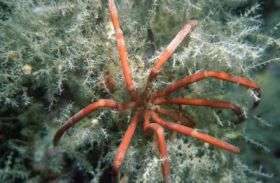
Large red sea spider (Arthropoda pcynogonida) walking over white hydroid at 25 m. Antarctic sea spiders can be up to 500mm across and have up to 12 legs. (Simon Brockington @ British Antarctic Survey)

Antarctic worms, sea spiders, urchins and other marine creatures living in near-shore shallow habitats are regularly pounded by icebergs. New data suggests this environment along the Antarctic Peninsula is going to get hit more frequently. This is due to an increase in the number of icebergs scouring the seabed as a result of shrinking winter sea ice. The results are published this week in the journal Science.

Scientists from the British Antarctic Survey (BAS) show how the rate of iceberg scouring on the West Antarctic Peninsula seabed is affected by the duration of winter sea ice, which has dramatically declined (in space and time) in the region over the last few decades due to climate warming. This increase in iceberg disturbance on the seabed, where the majority of all Antarctic life occurs (80%), could have severe effects on the marine creatures living as deep as 500m underwater.

Lead author, Dr Dan Smale from BAS, says: "It has been suggested previously that iceberg disturbance rates may be controlled by the formation of winter sea ice, but nobody's been able to go out and measure it before. We were surprised to see how strong the relationship between the two factors is. During years with a long sea ice season of eight months or so, the disturbance rates were really low, whereas in poor sea ice years the seabed was pounded by ice for most of the year. This is because icebergs are locked into position by winter sea ice, so they are not free to get pushed around by winds and tides until they crash into the seabed."

By using grids of small concrete markers on the seabed at three different depths for five years, BAS SCUBA divers were able to determine the frequency of iceberg scour by counting the number of damaged or destroyed markers annually.

Ice disturbance has been recognised as a driving force in the structure of the Antarctic seabed animal communities. Iceberg scouring damages areas of the seabed creating space for a high diversity of animals to use. However, an increase in iceberg scour with the seabed would affect the type and number of marine creatures found on the seabed and may cause changes in the distributions of key species.

Source: British Antarctic Survey


print this article email this article download pdf blog this article bookmark this article     Digg this Stumble it share on Facebook share on Reddit add to delicious save to Yahoo! bookmarks
3.3/5 after 9 votes

Rank Filter

Move the slider to adjust rank threshold, so that you can hide some of the comments.


Display comments: newest first

  • zevkirsh - Jul 17, 2008
    • Rank: 2.3 / 5 (3)
    what a life!. sonds like living in a video game.
  • mikiwud - Jul 17, 2008
    • Rank: 1.3 / 5 (3)
    If the sea ice is shrinking surely there would be less and/or smaller icebergs.Also data shows that Antarctic sea ice is increasing anyway.All this (whatever) has been going on for millennia atleast with no lasting effects,ill or otherwise.

July 17th, 2008 all stories
Space & Earth / Environment

Comments: 2
Rank: 3.3/5 after 9 votes

  • Stumble this up

  • Digg this

  • Share it:
  • share on Facebook
  • share on MySpace
  • share on Slashdot
  • rss-newsfeed
  • share on Google
  • share on Reddit
  • add to delicious
  • save to Yahoo! bookmarks
  • share on Windows Live
  • Add to Mixx!
Rating: 3.3/5 after 9 votes


  • Physicists Demonstrate Quantum Memory with Matter Qubits
    Physicists Demonstrate Quantum Memory with Matter Qubits
    Physics / General Physics
    created Jul 03, 2009 | popularity 4.4 / 5 (17) | comments 1
  • 'Holey' Nanosheets for Wastewater Dye Removal
    Nanotechnology / Nanomaterials
    created Jul 01, 2009 | popularity 5 / 5 (5) | comments 1
  • Jellyfish Robot Swims Like its Biological Counterpart
    Jellyfish Robot Swims Like its Biological Counterpart
    Electronics / Robotics
    created Jun 26, 2009 | popularity 4.4 / 5 (8) | comments 1
  • Could Maxwell's Demon Exist in Nanoscale Systems?
    Could Maxwell's Demon Exist in Nanoscale Systems?
    Physics / General Physics
    created Jun 24, 2009 | popularity 4.4 / 5 (18) | comments 29
  • Living Safely with Robots, Beyond Asimov's Laws
    Living Safely with Robots, Beyond Asimov's Laws
    Electronics / Robotics
    created Jun 22, 2009 | popularity 4.6 / 5 (52) | comments 40
  • Other News

    Forty years ago man first walked on the moon

    Space & Earth / Space Exploration

    created 16 hours ago | popularity 5 / 5 (2) | comments 1

    Forty years ago on July 20, 1969, American astronaut Neil Armstrong realized the oldest dream of human civilizations when he became the first man to walk on the moon.


    The least sea ice in 800 years

    The least sea ice in 800 years

    Space & Earth / Earth Sciences

    created Jul 01, 2009 | popularity 4.2 / 5 (62) | comments 57

    New research, which reconstructs the extent of ice in the sea between Greenland and Svalbard from the 13th century to the present indicates that there has never been so little sea ice as there is now. The ...


    Gas around young galaxy

    Intense heat killed the Universe's would-be galaxies, researchers say

    Space & Earth / Astronomy

    created Jul 01, 2009 | popularity 3.4 / 5 (21) | comments 27

    (PhysOrg.com) -- Our Milky Way galaxy only survived because it was already immersed in a large clump of dark matter which trapped gases inside it, scientists led by Durham University's Institute for Computational ...


    Scientists' Drill Hits Magma: Only Third Time on Record

    Scientists' Drill Hits Magma: Only Third Time on Record

    Space & Earth / Earth Sciences

    created Jun 29, 2009 | popularity 4.7 / 5 (22) | comments 19

    (PhysOrg.com) -- Scientists drilling a borehole deep into Iceland’s rocky crust to explore new methods of using geothermal energy hit a major roadblock on Thursday: Their drill ran into molten rock at a depth ...


    NASA manager pitches a cheaper return-to-moon plan

    Space & Earth / Space Exploration

    created Jun 30, 2009 | popularity 4 / 5 (7) | comments 18

    (AP) -- Like a car salesman pushing a luxury vehicle that the customer no longer can afford, NASA has pulled out of its back pocket a deal for a cheaper ride to the moon.