First full 3-D view of cracks growing in steel
July 17, 2008 3-D Stainless Steel with Crack

Enlarge

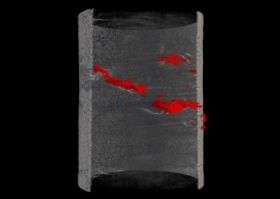
Sample surface with cracks colored red. (Andrew King)

A team of researchers from the University of Manchester (United Kingdom), the National Institute of Applied Sciences in Lyon (France) and the ESRF has revealed how a growing crack interacts with the 3D crystal structure of stainless steel. By using a new grain mapping technique it was possible to determine the internal 3D structure of the material without destroying the sample.

Afterwards, a crack was initiated in the stainless steel, and the scientists were able to study how the crack grew between the grains. This is the first time that such an experiment has used the 3D grain mapping technique, and the first results are published in the journal Science this week.

Cracks can appear in stainless steel components when stress or strain is combined with a corrosive environment that attacks sensitive grain boundaries. These cracks represent a critical failure mechanism. In power generation plants, certain grain boundaries can become sensitive during heat treatments or during fast neutron irradiation in nuclear power stations.

Most metals used for engineering are made up of many small crystals or grains. The scientists used a new technique called diffraction contrast tomography, developed at the ESRF, to obtain a 3D map of all grains in a section of a stainless steel wire measuring 0.4 mm in diameter. This map contained the shapes, positions, and orientations of 362 different grains.

The next stage of the experiment involved putting the wire into a suitable corrosive liquid, and applying a load to cause microcracks to grow between grains. During the crack growth, 3D tomographic scans (of 30 minutes each) were made at intervals of between two hours and a few minutes to follow the progress of the crack. This is the first in-situ experiment of this kind to use non-destructive 3D grain mapping techniques.

"The cracks grew along the boundaries between the grains which we had mapped in 3D, and we could visualize both the growing crack and certain special boundaries that resist cracking", explains Andrew King, corresponding author of the paper in Science. "Some of these resistant boundaries were not the ones that we expected".

The special, crack-resistant boundaries may be of key importance to the metallurgy industry. Materials containing more of these boundaries are also more resistant to this type of cracking. Being able to study crack growth in-situ will allow scientists to understand what types of grain structures will give the best performing materials, leading, for example, to more efficient and safer power plants, and more generally to more lightweight alloys in other sectors of metallurgy and engineering.

Source: European Synchrotron Radiation Facility


print this article email this article download pdf blog this article bookmark this article     Stumble it Digg this share on Facebook retweet share on Reddit add to delicious
Rate this story - 4 /5 (9 votes)


July 17, 2008 all stories

Comments: 0

4 /5 (9 votes)
  • Stumble this up

  • Digg this

  • share this

  • hide
  • Related Stories

  • Glass you can build with: Metallic glass that's stronger and lasts longer
    created Mar 24, 2009 | popularity not rated yet | comments 0
  • Scientists Find Atomic Clues to Tougher Ceramics
    created Dec 08, 2004 | popularity not rated yet | comments 0
  • Research helps overcome barrier for organic electronics
    created Nov 10, 2009 | popularity not rated yet | comments 0
  • INL scientist is harnessing the power of plasma
    created Oct 27, 2009 | popularity not rated yet | comments 0
  • Graphite mimics iron's magnetism
    created Oct 04, 2009 | popularity not rated yet | comments 0


  • hide
  • Relevant PhysicsForums posts

  • Wave dispersion
    created 2 hours ago
  • Neutron
    created 3 hours ago
  • Obtaining research papers from journals
    created 8 hours ago
  • Vibration into Electricity?
    created 10 hours ago
  • More from Physics Forums - General Physics

Other News

Spin polarization achieved in room temperature silicon

Spin polarization achieved in room temperature silicon

Physics / General Physics

created 23 hours ago | popularity 4.9 / 5 (17) | comments 0

(PhysOrg.com) -- A group in The Netherlands has achieved a first: injection of spin-polarized electrons in silicon at room temperature. This has previously been observed only at extremely low temperatures, ...


Multiferroic compounds used to produce smaller and cheaper digital memories

Multiferroic compounds used to produce smaller and cheaper digital memories

Physics / Condensed Matter

created 17 hours ago | popularity 4.7 / 5 (3) | comments 0

(PhysOrg.com) -- Is it possible to make even more compact digital memories for portable electronic devices and which consume even less energy? A team of French researchers has recently demonstrated that it ...


Superconductor magnet heat shield being developed

Superconductor magnet spacecraft heat shield being developed

Physics / General Physics

created Nov 26, 2009 | popularity 5 / 5 (25) | comments 23

(PhysOrg.com) -- European space agencies and an aerospace giant are developing a new re-entry heat shield that will use superconductor magnets to generate a magnetic field strong enough to deflect the superhot ...


Restored machine to explore mysteries of Big Bang (AP)

Restored machine to explore mysteries of Big Bang

Physics / General Physics

created Nov 21, 2009 | popularity 4.6 / 5 (18) | comments 26

(AP) -- Scientists are preparing the world's largest atom smasher to explore the depths of matter after successfully restarting the $10 billion machine following more than a year of repairs.


Scientists react as they stand in front of a screen at CERN

First atoms reported smashed in Large Hadron Collider (Update)

Physics / General Physics

created Nov 23, 2009 | popularity 4.5 / 5 (31) | comments 22

Two circulating beams on Monday produced the first particle collisions in the world's biggest atom smasher, the Large Hadron Collider (LHC), three days after its restart, scientists announced.