'Nanosculpture' could enable new types of heat pumps, energy converters
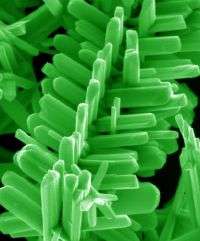
July 17, 2008 Branched Nanorods

Enlarge

Researchers have discovered a new method to create branched nanorods, such as those in this scanning electron microscope image. Such nanorods could one day enable new nanoscale thermoelectric devices for power generation, as well as nanoscale heat pumps for cooling hot spots in nanoelectronics devices. Image: Rensselaer/Ramanath

A new technique for growing single-crystal nanorods and controlling their shape using biomolecules could enable the development of smaller, more powerful heat pumps and devices that harvest electricity from heat.

Researchers at Rensselaer Polytechnic Institute have discovered how to direct the growth of nanorods made up of two single crystals using a biomolecular surfactant. The researchers were also able to create "branched" structures by carefully controlling the temperature, time, and amount of surfactant used during synthesis.

"Our work is the first to demonstrate the synthesis of composite nanorods with branching, wherein each nanorod consists of two materials — a single-crystal bismuth telluride nanorod core encased in a hollow cylindrical shell of single-crystal bismuth sulfide," said G. Ramanath, professor of materials science and engineering at Rensselaer and director of the university's Center for Future Energy Systems, who led the research project. "Branching and core-shell architectures have been independently demonstrated, but this is the first time that both features have been simultaneously realized through the use of a biomolecular surfactant."

Most nanostructures comprised of a core and a shell generally require more than one step to synthesize, but these new research results demonstrate how to synthesize such nanorods in only one step.

"Our single-step synthesis is an important development toward realizing large-scale synthesis of composite nanomaterials in general," said Arup Purkayastha, who worked on the project as a postdoctoral researcher at Rensselaer and is now a scientist with Laird Technologies in Bangalore, India.

Because of their attractive properties, core-shell nanorods are expected to one day enable the development of new nanoscale thermoelectric devices for power generation, as well as nanoscale heat pumps for cooling hot spots in nanoelectronics devices.

"Our discovery enables the realization of two very important attributes for heat dissipation and power generation from heat," Ramanath said. "First, the core-shell junctions in the nanorods are conducive for heat removal upon application of an electrical voltage, or generating electrical power from heat. Second, the branched structures open up the possibility of fabricating miniaturized conduits for heat removal alongside nanowire interconnects in future device architectures."

The researchers discovered that synthesis at high temperatures or with low amounts of the biomolecular surfactant L-glutathonic acid (LGTA) yields branched nanorod structures in highly regulated patterns. In contrast, synthesis at low temperatures or with high levels of LGTA results in straight nanorods without any branching. It is interesting to note that at the point of branching, atoms in the branch resemble a mirror image of the parent crystal – a finding that reinforces Ramanath's conclusion that LGTA is able to induce branching through atomic-level sculpture.

"Since LGTA is similar to biological molecules, our discovery could be conceivably used as a starting point to explore the use of proteins and enzymes to atomically sculpt such nanorod architectures through biological processes," said Ramanath.

Results of the study, titled "Surfactant-Directed Synthesis of Branched Bismuth Telluride/Sulfide Core/Shell Nanorods," were recently published online and will be featured in an upcoming issue of the journal Advanced Materials.

Source: Rensselaer Polytechnic Institute


print this article email this article download pdf blog this article bookmark this article     Stumble it Digg this share on Facebook retweet share on Reddit add to delicious
Rate this story - 4.6 /5 (25 votes)


July 17, 2008 all stories

Comments: 0

4.6 /5 (25 votes)
  • Stumble this up

  • Digg this

  • share this

  • hide
  • Related Stories

  • Golden Nanorods for Medical Applications
    created Sep 08, 2008 | popularity not rated yet | comments 0
  • Engineering new uses for gold
    created Aug 22, 2008 | popularity not rated yet | comments 0
  • Tiny tubes and rods show promise as catalysts, sunscreen
    created Sep 10, 2007 | popularity not rated yet | comments 0
  • Researchers develop new method for nanomaterials synthesis
    created Mar 30, 2006 | popularity not rated yet | comments 0
  • SMOS, Proba-2: Two new ESA satellites successfully lofted into orbit (w/ Video)
    created Nov 02, 2009 | popularity not rated yet | comments 0


  • hide
  • Relevant PhysicsForums posts

  • Polymer Properties Question
    created 20 hours ago
  • Fatigue Properties of Chinese steel
    created Nov 04, 2009
  • Finding Hardness values
    created Nov 04, 2009
  • Fluid flow, pressure drop simulation in Comsol
    created Nov 04, 2009
  • More from Physics Forums - Materials & Chemical Engineering

Other News

Engineers image nanostructure of a solid acid catalyst and boost its catalytic activity

Nanotechnology / Nanomaterials

created 1hour ago | popularity 5 / 5 (1) | comments 1

The catalytic processes that facilitate the production of many chemicals and fuels could become much more environmentally friendly thanks to a breakthrough achieved by researchers from Lehigh and Rice Universities.


New transparent insulating film could enable energy-efficient displays

New transparent insulating film could enable energy-efficient displays

Nanotechnology / Nanomaterials

created 5 hours ago | popularity 4.8 / 5 (6) | comments 0

Johns Hopkins materials scientists have found a new use for a chemical compound that has traditionally been viewed as an electrical conductor, a substance that allows electricity to flow through it. By orienting ...


Ideal nanoparticle cancer therapies surf the bloodstream

Nanotechnology / Bio & Medicine

created 6 hours ago | popularity 5 / 5 (1) | comments 0

Eric Shaqfeh studies blood at Stanford University, using computer models that simulate how the fluid and the cells it contains move around. On November 11 at a meeting of the scientific society AVS, he will present his latest ...


New Digital 'Electronics' Concept May Continue Moore's Law

New Digital 'Electronics' Concept May Continue Moore's Law

Nanotechnology / Nanophysics

created Nov 05, 2009 | popularity 4.6 / 5 (56) | comments 9

(PhysOrg.com) -- Computers of the future could be operating not on electrons, but on tiny waves traveling through an electron "fluid," if a new proposal is successful. The new circuit design, recently introduced ...


Findings show nanomedicine promising for treating spinal cord injuries

Findings show nanomedicine promising for treating spinal cord injuries

Nanotechnology / Bio & Medicine

created Nov 08, 2009 | popularity 4.5 / 5 (4) | comments 0

(PhysOrg.com) -- Researchers at Purdue University have discovered a new approach for repairing damaged nerve fibers in spinal cord injuries using nano-spheres that could be injected into the blood shortly ...