Lionfish Decimating Other Tropical Fish Populations, Threaten Coral Reefs
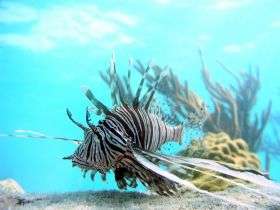
The invasion of predatory lionfish in the Caribbean region poses yet another major threat there to coral reef ecosystems – a new study has found that within a short period after the entry of lionfish into an area, the survival of other reef fishes is slashed by about 80 percent.
Aside from the rapid and immediate mortality of marine life, the loss of herbivorous fish also sets the stage for seaweeds to potentially overwhelm the coral reefs and disrupt the delicate ecological balance in which they exist, according to scientists from Oregon State University.
Following on the heels of overfishing, sediment depositions, nitrate pollution in some areas, coral bleaching caused by global warming, and increasing ocean acidity caused by carbon emissions, the lionfish invasion is a serious concern, said Mark Hixon, an OSU professor of zoology and expert on coral reef ecology.
The study is the first to quantify the severity of the crisis posed by this invasive species, which is native to the tropical Pacific and Indian Ocean and has few natural enemies to help control it in the Atlantic Ocean. It is believed that the first lionfish – a beautiful fish with dramatic coloring and large, spiny fins – were introduced into marine waters off Florida in the early 1990s from local aquariums or fish hobbyists. They have since spread across much of the Caribbean Sea and north along the United States coast as far as Rhode Island.
"This is a new and voracious predator on these coral reefs and it's undergoing a population explosion," Hixon said. "The threats to coral reefs all over the world were already extreme, and they now have to deal with this alien predator in the Atlantic. These fish eat many other species and they seem to eat constantly."
Findings of the new research will be published soon in Marine Ecology Progress Series. The lead author is Mark Albins, a doctoral student working with Hixon.
In studies on controlled plots, the OSU scientists determined that lionfish reduced young juvenile fish populations by 79 percent in only a five-week period. Many species were affected, including cardinalfish, parrotfish, damselfish and others. One large lionfish was observed consuming 20 small fish in a 30-minute period.
Lionfish are carnivores that can eat other fish up to two-thirds their own length, while they are protected from other predators by long, poisonous spines. In the Pacific Ocean, Hixon said, other fish have learned to avoid them and they also have more natural predators, particularly large groupers. In the Atlantic Ocean, native fish have never seen them before and have no recognition of danger. There, about the only thing that will eat lionfish is another lionfish – they are not only aggressive carnivores, but also cannibals.
"In the Caribbean, few local predators eat lionfish, so there appears to be no natural controls on them," Hixon said. "And we've observed that they feed in a way that no Atlantic Ocean fish has ever encountered. Native fish literally don't know what hit them."
When attacking another fish, Hixon said, the lionfish will use its large, fan-like fins to herd smaller fish into a corner and then swallow them in a rapid strike. Because of their natural defense mechanisms they are afraid of almost no other marine life. And the poison released by their sharp spines can cause extremely painful stings to humans – even leading to fatalities for some people with heart problems or allergic reactions.
"These are pretty scary fish, and they aren't timid," Hixon said. "They will swim right up to a diver in their feeding posture, looking like they're ready to eat. That can be a little spooky."
Their rapid reproduction potential, Hixon said, must now be understood in context with their ability to seriously depopulate coral reef ecosystems of other fish. Parrotfishes and other herbivores prevent seaweeds from smothering corals. A major, invasive predator such as lionfish could disrupt the entire system.
Options to manage the lionfish threat are limited, Hixon said. They can be collected individually, which may be of localized value, but that approach offers no broad solution. Recovery or introduction of effective predators might help. Groupers, a fish that has been known to eat lionfish in the Pacific Ocean, have been heavily over-fished in the tropical Atlantic Ocean, Hixon said.
"We have to figure out something to do about this invasion before it causes a major crisis," Hixon said. "We basically had to abandon some studies we had under way in the Atlantic on population dynamics of coral reef fish, because the lionfish had moved in and were eating everything."
Source: Oregon State University


