Shimmering ferroelectric domains
July 18th, 2008 Shimmering ferroelectric domains

Enlarge

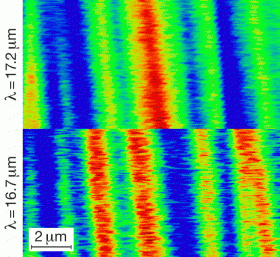
False color image of the electric domains on the surface of a bariumtitanate crystal. Image (a) was measured with a wavelength of 17.2 micrometers, image (b) of 16.7 micrometers. The color red means a strong signal. The change of the colors from red to blue is clearly visible.

Ferroelectric materials are named after ferromagnetic ones because they behave in a similar way. The main difference: these materials are not magnetic, but permanently electrically polarized. They have great importance for data storage technology and novel piezoelectric devices. Dresden scientists were able to produce microscopic images of ferroelectric domains - tiny regions of a ferroelectric material -, where the electric polarization points into different directions. These results were published in the journal Physical Review Letters recently.

Dr. Lukas M. Eng and his group at the Technische Universität Dresden used the free-electron laser at the Forschungszentrum Dresden-Rossendorf (FZD) to study ferroelectric domains. Ferroelectric materials are special crystals like, e.g. bariumtitanate, where the titanium atoms in the crystal lattice are slightly shifted into one direction. This shift results in a polarization and, therefore, in a permanent electric field.

The ferroelectric domains differ only by the direction of the permanent electric field in the material. The two possible types of domains show either an electric field which is oriented parallel to the surface of the crystal or which points perpendicular to the surface. By applying an external field (e.g. electric voltage) one can reverse the polarity of the domains. Because of these properties ferroelectric materials are widely used in novel technological devices, such as in Ferroelectric Random Access Memory (FRAM or FeRam).

The Dresden scientists aimed at getting as clear an image as possible of the domains in order to understand better how they function, and to specifically manipulate the electric charge of the domains for future devices. The size of a bariumtitanate domain is about one to ten micrometers. Optical methods are dependent on the wavelength of the type of “light” which is applied. The free-electron laser at the FZD emits powerful radiation in a wide range of the infrared and THz region of the electromagnetic spectrum – a region where not many other laser sources exist.

The scientists tuned the laser to a frequency which was in resonance with the atomic motion in the bariumtitanate (near 18 Terahertz). Then they shone the invisible laser beam onto a sharp needle (the tip of an atomic force microscope), moving across the sample surface. Finally they measured the light that was scattered away from the needle. It turns out that this signal contains microscopic information about the sample, in fact with a resolution better than 200 nanometers, which is hundred times smaller than the wavelength of the light.

The domains of the ferroelectric material shimmered in different colors. This is due to the fact that the interaction of the infrared light with the crystal via the tip is different for the two types of domains. The technique itself is called near-field microscopy. The researches were taking advantage of the fact that the two types of domains have their individual resonance frequency. This is the frequency at which the largest amount of infrared light is scattered. In the experiment, areas that appear bright in the image (red in false-color) at a wavelength of 16.7 micrometers, become dark (blue in false color), if the wavelength is tuned to 17.2 micrometers, and vice versa.

The results show the huge potential the free-electron laser has when used for near-field microscopy. The large power and tunability are indispensable for this type of investigations. The group is presently extending its activities thanks to funding by the German Science Foundation (DFG). The scientists of TU Dresden and FZD envision applications for other novel material systems like the so-called multi-ferroics, but also for biomolecules or semiconductor nanostructures (e.g. for wafer inspection).

Citation: S.C. Kehr, M. Cebula, O. Mieth, T. Härtling, J Seidel, S. Grafström, L.M. Eng, S. Winnerl, D. Stehr, M. Helm: „Anisotropy contrast in phonon-enhanced apertureless near-field microscopy using a free-electron laser“, in Physical Review Letters, 100, 256403 (2008), doi:10.1103.

Source: Forschungszentrum Dresden-Rossendorf (FZD)


print this article email this article download pdf blog this article bookmark this article     Digg this Stumble it share on Facebook share on Reddit add to delicious save to Yahoo! bookmarks
4.6/5 after 14 votes

Rank Filter

Move the slider to adjust rank threshold, so that you can hide some of the comments.


Display comments: newest first

  • holoman - Jul 18, 2008
    • Rank: not rated yet
    Ferroelectric materials are named after ferromagnetic ones because they behave in a similar way.

    Man did the author of this article get wrong !
  • menkaur - Jul 19, 2008
    • Rank: not rated yet
    Ferroelectric materials are named after ferromagnetic ones because they behave in a similar way.

    Man did the author of this article get wrong !

    well, that's web... it's up to users to fix everything....

July 18th, 2008 all stories
Physics / General Physics

Comments: 2
Rank: 4.6/5 after 14 votes

  • Stumble this up

  • Digg this

  • Share it:
  • share on Facebook
  • share on MySpace
  • share on Slashdot
  • rss-newsfeed
  • share on Google
  • share on Reddit
  • add to delicious
  • save to Yahoo! bookmarks
  • share on Windows Live
  • Add to Mixx!
Rating: 4.6/5 after 14 votes

  • Related Stories

  • Electric Switches Hold Promise for Data Storage
    created May 22, 2009 | popularity not rated yet | comments 0
  • Vise Squad: Putting the Squeeze on a Crystal Leads to Novel Electronics
    created May 06, 2009 | popularity not rated yet | comments 0
  • Domain walls that conduct electricity
    created Jan 29, 2009 | popularity not rated yet | comments 0
  • Nanopencil Can Provide Terabit Data Storage Density
    created Sep 22, 2008 | popularity not rated yet | comments 0
  • Strange-behaving crystals could have impact on research, technology
    created Jan 03, 2008 | popularity not rated yet | comments 0


  • Physicists Demonstrate Quantum Memory with Matter Qubits
    Physicists Demonstrate Quantum Memory with Matter Qubits
    Physics / General Physics
    created Jul 03, 2009 | popularity 4.4 / 5 (17) | comments 1
  • 'Holey' Nanosheets for Wastewater Dye Removal
    Nanotechnology / Nanomaterials
    created Jul 01, 2009 | popularity 5 / 5 (5) | comments 1
  • Jellyfish Robot Swims Like its Biological Counterpart
    Jellyfish Robot Swims Like its Biological Counterpart
    Electronics / Robotics
    created Jun 26, 2009 | popularity 4.4 / 5 (8) | comments 1
  • Could Maxwell's Demon Exist in Nanoscale Systems?
    Could Maxwell's Demon Exist in Nanoscale Systems?
    Physics / General Physics
    created Jun 24, 2009 | popularity 4.4 / 5 (18) | comments 29
  • Living Safely with Robots, Beyond Asimov's Laws
    Living Safely with Robots, Beyond Asimov's Laws
    Electronics / Robotics
    created Jun 22, 2009 | popularity 4.6 / 5 (52) | comments 40
  • Other News

    Scientists create first electronic quantum processor

    Scientists create first electronic quantum processor

    Physics / General Physics

    created Jun 28, 2009 | popularity 4.8 / 5 (53) | comments 40

    A team led by Yale University researchers has created the first rudimentary solid-state quantum processor, taking another step toward the ultimate dream of building a quantum computer.


    Science journals

    How to Spot an Influential Paper Based on its Citations

    Physics / General Physics

    created Jul 04, 2009 | popularity 4 / 5 (9) | comments 5

    (PhysOrg.com) -- At first it may seem that the number of citations received by a published scientific paper is directly related to that paper's quality of content. The higher the quality, the more people read ...


    Fermilab's CDF observes Omega-sub-b baryon

    Fermilab's CDF observes Omega-sub-b baryon

    Physics / General Physics

    created Jun 29, 2009 | popularity 4.7 / 5 (17) | comments 7

    (PhysOrg.com) -- At a recent physics seminar at the Department of Energy’s Fermi National Accelerator Laboratory, Fermilab physicist Pat Lukens of the CDF experiment announced the observation of a new particle, ...


    New insights, and a new angle, on high-temperature superconductivity

    New insights, and a new angle, on high-temperature superconductivity

    Physics / Superconductivity

    created Jun 29, 2009 | popularity 4.8 / 5 (13) | comments 6

    (PhysOrg.com) -- A Princeton-led research team has revealed surprising information about how electron behavior influences the conduction of electricity in a class of high-temperature superconductors. An increased ...


    The art of invisibility and the perfect cat's eye

    The art of invisibility and the perfect cat's eye

    Physics / Optics & Photonics

    created Jun 30, 2009 | popularity 4 / 5 (8) | comments 6

    (PhysOrg.com) -- In recent years scientists have explored the impossible by developing invisibility or 'cloaking' devices, but can the same technology also help make things more visible?