The International Space Station, a test-bed for future space exploration
July 18, 2008
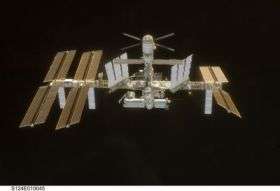
Backdropped by the darkness of space, the International Space Station is seen from Space Shuttle Discovery as the two spacecraft begin their relative separation. Earlier the STS-124 and Expedition 17 crews concluded almost nine days of cooperative work on board the Shuttle and Station. (11 June 2008) Credits: NASA/JSC
The Heads of the International Space Station (ISS) Agencies from Canada, Europe, Japan, Russia and the United States met today at ESA Headquarters in Paris, France, to review ISS cooperation.
As part of their discussions, they noted the significantly expanded capability the ISS now provides for on-orbit research and technology development activities and as an engineering test-bed for flight systems and operations critical to future space exploration initiatives. These activities improve the quality of life on Earth by expanding the frontiers of human knowledge.
The Heads of Agency also noted the Partners' significant accomplishments since their last meeting in January 2007, including the delivery of Node 2 (Harmony), two new laboratories (the ESA Columbus Module and the Japanese Experiment Module Kibo), and Dextre, Canada's two-armed special purpose dexterous manipulator.
In addition to the completion of six challenging ISS assembly missions with the U.S. Space Shuttle, the Heads of Agency recognised the successful maiden flight of the European Automated Transfer Vehicle, the establishment of the global ISS ground operation control centre network with the addition of new European and Japanese ISS operations centres and the successful flights of Russian Soyuz and Progress vehicles. The Partners emphasised the critical importance of expanded operations of Russian Soyuz and Progress vehicles for ISS total crew transportation, rescue and cargo delivery.
The Heads of Agency reviewed current ISS development, configuration and operations activities across the partnership. They considered implementing plans to maximise the benefits from the increase to a six-person crew in 2009 and discussed efforts to ensure that essential space transportation capabilities (both crew and cargo) will be available across the partnership for the life of the programme. The Partners acknowledged the need for the additional Russian modules to be provided in 2009 and 2010 that will maximise six-person ISS operations and utilisation.
The Heads of Agency discussed their respective ongoing activities to enhance upmass and downmass transportation capabilities required for a robust utilisation of the ISS and to prepare capabilities for the future. These include Japan's H-2 Transfer Vehicle in the coming year, the U.S. Commercial Orbital Transportation Services and the U.S. Orion Crew Exploration Vehicle; together with the current operational vehicles, the U.S. Shuttle (up to 2010), Russian Soyuz and Progress, and ESA ATV. These capabilities will respond to the ISS operations and utilisation requirements.
They also noted new initiatives such as the ESA plan for an Automated Transfer Vehicle-Advanced Return Vehicle system for downmass from the ISS and the Russia-ESA joint preparatory activities on an advanced Crew Space Transportation System. The Heads of Agency expressed their interest in making these capacities available for the benefit of the whole partnership and can provide ISS sustainability and prepare for future exploration endeavours.
As the partnership moves closer to completion of ISS assembly, the Heads of Agency reaffirmed their common interest in utilising the space station to its full capacity for a period meaningful for stakeholders and users. The Partners noted that a continuation of operations beyond 2015 would not be precluded by any significant technical challenges. Recognising the substantial programmatic benefits to continued ISS operations and utilisation beyond the current planning horizon, the Heads of Agency committed to work with their respective governments to assess support for such a goal.
Source: European Space Agency
-
Next manned ISS mission to launch May 15: Russia
Feb 02, 2012 |
5 / 5 (1) |
0
-
Canada looks to the future in space
Feb 01, 2012 |
4.7 / 5 (3) |
0
-
Russia will replace Soyuz for next ISS mission: source
Feb 01, 2012 |
5 / 5 (2) |
0
-
Russia blames radiation for space probe failure
Jan 31, 2012 |
4 / 5 (2) |
4
-
Russia to postpone next manned space launch
Jan 31, 2012 |
5 / 5 (1) |
0
-
Engineers build first sub-10-nm carbon nanotube transistor
Feb 01, 2012 |
4.9 / 5 (32) |
30
-
Something old, something new: Evolution and the structural divergence of duplicate genes
Jan 31, 2012 |
4.6 / 5 (7) |
1
-
The hidden nanoworld of ice crystals: Revealing the dynamic behavior of quasi-liquid layers
Jan 30, 2012 |
5 / 5 (4) |
1
-
Stock market network reveals investor clustering
Jan 27, 2012 |
3.9 / 5 (23) |
8
-
Of microchemistry and molecules: Electronic microfluidic device synthesizes biocompatible probes
Jan 26, 2012 |
5 / 5 (2) |
0
-
Never ending outer space.....
16 hours ago
-
Neutron Star fragments?
18 hours ago
-
stationary or not?
22 hours ago
-
Scale of the Universe
Feb 10, 2012
-
Titan's lack of impact craters
Feb 09, 2012
-
Real pictures of black hole eating a star?
Feb 08, 2012
- More from Physics Forums - General Astronomy
More news stories
Salvage workers begin pumping fuel from Italian shipwreck
Salvage workers Sunday began pumping fuel from the shipwrecked Italian cruise liner Costa Concordia, a day ahead of schedule, officials said.
1 hour ago |
not rated yet |
0
Latin America mining boom clashes with conservation
Latin America is experiencing a mining boom as prices rise fuelled by a hike in global demand, but the region is also being hit by a wave of violent protests, strikes and rallies by environmentalists.
9 hours ago |
5 / 5 (1) |
1
Political leaders play key role in how worried Americans are by climate change: study
More than extreme weather events and the work of scientists, it is national political leaders who influence how much Americans worry about the threat of climate change, new research finds.
Feb 06, 2012 |
5 / 5 (6) |
73
NASA budget will axe Mars deal with Europe: scientists
US President Barack Obama's budget proposal to be submitted next week for 2013 will cut NASA's budget by 20 percent and eliminate a major partnership with Europe on Mars exploration, scientists said Thursday.
Space & Earth / Space Exploration
Feb 10, 2012 |
5 / 5 (3) |
55
Humans may have helped the decline of African rainforests 3000 years ago
(PhysOrg.com) -- Large areas of rainforests in Central Africa mysteriously disappeared over three thousand years ago, to be replaced by savannas. The prevailing theory has been that the cause was a change ...
Lab study raises questions over nano-particle impact
Tests involving chickens have raised questions about the impact on health from engineered nano-particles, the ultra-fine grains commonly used in drugs and processed foods, scientists said on Sunday.
Iran blocks email, restricts net access: reports
Iran has further restricted access to the Internet and blocked popular email services for the past few days, in a move a top lawmaker said could "cost the regime dearly," media reports said on Sunday.
Scientists discover molecular secrets of 2,000-year-old Chinese herbal remedy
For roughly two thousand years, Chinese herbalists have treated Malaria using a root extract, commonly known as Chang Shan, from a type of hydrangea that grows in Tibet and Nepal. More recent studies suggest that halofuginone, ...
New method to examine batteries -- MRI from the inside
There is an ever-increasing need for advanced batteries for portable electronics, such as phones, cameras, and music players, but also to power electric vehicles and to facilitate the distribution and storage of energy derived ...
A mitosis mystery solved: How chromosomes align perfectly in a dividing cell
Although the process of mitotic cell division has been studied intensely for more than 50 years, Whitehead Institute researchers have only now solved the mystery of how cells correctly align their chromosomes during symmetric ...
Starve a virus, feed a cure? Findings show how some cells protect themselves against HIV
A protein that protects some of our immune cells from the most common and virulent form of HIV works by starving the virus of the molecular building blocks that it needs to replicate, according to research published online ...
Jul 19, 2008
Rank: not rated yet
Henri