Researchers use salmonella to administer vaccines
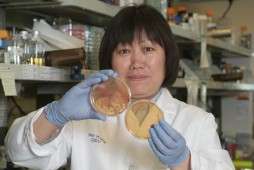
(PhysOrg.com) -- Researchers at the Biodesign Institute at Arizona State University have made a major step forward in their work to develop a biologically engineered organism that can effectively deliver an antigen in the body. The researchers report that they have been able to use live salmonella bacterium as the containment/delivery method for an antigen.
The work is a major step forward in development of a new means of biological containment that would be a key component to a new way to deliver vaccines in animals and humans. If fully developed, the new method could be used to administer vaccines to many of those who do not benefit from traditional vaccines because of their cost, because of drug resistance or because of limited effects on children.
Outlined in the paper, “Regulated programmed lysis of recombinant Salmonella in host tissues to release protective antigens and confer biological containment,” published on the online version (July 7) of the Proceedings of the National Academy of Sciences, the researchers describe a new, novel and effective means of biological containment for antigen delivery. The method not only effectively delivers the antigen in the body, but does so in a way that does not infect the body with salmonella and does not leave any vaccine cells in the environment.
The research team includes scientists formerly at Washington University, St. Louis, and Megan Health Inc., St. Louis, as well as those at ASU’s Biodesign Institute and the School of Life Sciences.
“Our goal is to design, engineer and evaluate a live bacterial (using salmonella) antigen delivery system that would display regulated delayed lysis in vivo after invasion into and colonizing internal lymphoid tissues in an immunized individual,” said Roy Curtiss, director of the Center for Infectious Diseases and Vaccinology at the Biodesign Institute and a professor in ASU’s School of Life Sciences. Curtiss was part of the research team that made the discovery.
“We wanted to do this in a way so that no disease symptoms due to salmonella would arise, a protective immune response would be induced to the pathogen whose protective antigen was delivered by the vaccine construction (in this case against S. pneumoniae due to an immune response to PspA), and there would be no ability for live bacterial vaccine cells to either persist in vivo or to survive if shed into the environment,” Curtiss added.
“The biological containment system we developed is sufficient by itself on conferring attenuation, the inability to cause disease symptoms, and ability to deliver an antigen to induce protective immunity,” Curtiss said. “We have high expectations that this delivery system will be safe and effective when administered to animals and humans.”
A key to the project, according to Curtiss, is “turning a foe into a friend.” That foe is the salmonella bacterium—the leading cause of human food-borne illness and which is currently in the news due to contaminated tomatoes and other food crops. Curtiss’ team, through genetic know-how, has developed a variety of ways to tame salmonella in the lab and use it as a delivery vector for vaccines.
“We try to genetically modify the salmonella bacterium to eliminate its harmful effects -- the diarrhea, gut inflammation and fluid secretion -- while keeping the wherewithal to induce immunity against the bacteria causing pneumonia or other infectious diseases,” Curtiss said. Several in his research team attack the problem from different angles, with some focusing on weakening salmonella, others boosting the immune response and others optimizing the self-destruct mechanism.
Speaking about the application of a pneumonia antigen, team leader Wei Kong, of the Biodesign Institute, said: “If we tried to use live Streptococcus pneumoniae causing pneumonia for a vaccine, we would obviously kill the patient. The benefit of a live vaccine that uses a weakened form of salmonella, is that the salmonella can be taken up through the intestinal lining and stimulate an immune response by using just a portion of the bacteria causing pneumonia that itself is not deadly.”
In experiments, the genetically modified Salmonella enterica bacterium colonizes the lymph tissues of the host and manufactures a protein from the S. pneumoniae bacterium, which then triggers a strong antibody response. Unlike most vaccines that are entirely manufactured by a vaccine company, the attenuated recombinant salmonella vaccine after entry into the immunized individual serves as its own factory to produce (manufacture) the protective antigens (proteins) from the S. pneumoniae pathogen. This ability to cause manufacture in the immunized individual dramatically decreases the cost of such vaccines to make them affordable for use in the developing world, Curtiss said.
An important factor for the research team was to genetically program the S. enterica bacterium to destroy itself so that it is not released into the environment, Curtiss said.
“Biological containment systems are important to address the potential risk posed by any unintentional release of the modified salmonella into the environment,” he explained. The salmonella life cycle is balanced to allow enough time to enter the body and build an immune response, while leading to cell death by bursting the cells and preventing the vaccine strain from spreading into the environment.
“The data show that the system we have devised results in cell lysis in the absence of arabinose and clearance of the strain from host tissues,” the researchers state in the PNAS article.
“More importantly, our strain was fully capable of delivering a test antigen and inducing a robust immune response comparable to that of a vaccine strain without this containment system, thereby demonstrating that this system has all of the features required for biological containment of a recombinant attenuated salmonella vaccine,” they added.
Provided by ASU


