Mars Sample Return: bridging robotic and human exploration
July 21, 2008 Mars Sample Return: bridging robotic and human exploration

Enlarge

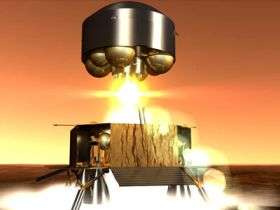
Artist's view of the Mars Sample Return (MSR) ascent module lifting off from Mars' surface with the Martian soil samples. Credits: ESA

The first robotic mission to return samples to Earth from Mars took a further step toward realisation with the recent publication of a mission design report by the iMARS Working Group. The report, defines key elements of the future internationally-funded mission involving the cooperation of ESA, NASA and other national agencies.

iMARS, which stands for the International Mars Architecture for the Return of Samples is a committee of the International Mars Exploration Working Group made up of scientists, engineers, strategic planners, and managers. The report, which comes after months of deliberation, outlines the scientific and engineering requirements of such an international mission to be undertaken in the timeframe 2020-2022.

The Mars Sample Return mission is an essential step with respect to future exploration goals and the prospect of establishing a future human mission to Mars. Returned samples will increase the knowledge of the properties of Martian soil and contribute significantly to answering questions about the possibility of life on the Red Planet. This mission will improve our understanding of the Mars environment to support planning for the future human exploration.

The iMARS report outlines the mission’s scientific objectives including the types and quantities of samples to be returned from Mars; the different mission elements (launchers, spacecraft, Mars lander, a rover and a Mars ascent vehicle) and ground processing facilities necessary to contain and analyse the received samples in a protected environment. A preliminary timeline for the mission and approximate budget has also been defined.

“Exploration is gaining momentum year by year, as is the experience and knowledge gained by ESA and its international partners in this area” said Bruno Gardini ESA’s Exploration Programme Manager in the Directorate of Human Spaceflight and iMARS study leader. “The information we gain from current Mars missions and from the ISS provide a basis not only for future robotic missions but also a stepping stone for the human exploration missions.”

Source: ESA


print this article email this article download pdf blog this article bookmark this article     Stumble it Digg this share on Facebook retweet share on Reddit add to delicious
Rate this story - 4.3 /5 (8 votes)


July 21, 2008 all stories

Comments: 0

4.3 /5 (8 votes)
  • Stumble this up

  • Digg this

  • share this

  • hide
  • Related Stories

  • NASA and Microsoft Allow Earthlings to Become Martians
    created Nov 17, 2009 | popularity not rated yet | comments 0
  • Dawn Enters Asteroid Belt -- For Good
    created Nov 16, 2009 | popularity not rated yet | comments 0
  • Taking a Bite of Antarctic Ice
    created Nov 16, 2009 | popularity not rated yet | comments 0
  • NASA to Begin Attempts to Free Sand-Trapped Mars Rover
    created Nov 12, 2009 | popularity not rated yet | comments 0
  • A Mars Rover Named 'Curiosity'
    created Oct 30, 2009 | popularity not rated yet | comments 0


  • hide
  • Relevant PhysicsForums posts

  • astronomy
    created 13 hours ago
  • mass of molecular clouds versus stars
    created 17 hours ago
  • Astronomy Problems PLEASE HELP! PLEASE PLEASE
    created 17 hours ago
  • geographic location determination
    created Nov 29, 2009
  • More from Physics Forums - General Astronomy

Other News

ISS astronauts land safely in Kazakhstan

Space & Earth / Space Exploration

created 51 minutes ago | popularity not rated yet | comments 0

A space capsule carrying a Belgian, a Canadian and a Russian landed safely in the steppes of Kazakhstan on Tuesday after the trio spent half a year on the International Space Station (ISS).


First comprehensive review of the state of Antarctica's climate

Space & Earth / Earth Sciences

created 1hour ago | popularity not rated yet | comments 0

The first comprehensive review of the state of Antarctica's climate and its relationship to the global climate system is published this week by the Scientific Committee on Antarctic Research (SCAR). The review - Antarctic ...


Winds drive icebergs away from New Zealand

Space & Earth / Earth Sciences

created 1hour ago | popularity 5 / 5 (1) | comments 0

(AP) -- Strong westerly winds in the southern Pacific Ocean have driven scores of icebergs originally headed toward New Zealand to the east, away from the country, an oceanographer said Tuesday.


 Chang'E-1 has blazed a new trail in China's deep space exploration

Chang'E-1 has blazed a new trail in China's deep space exploration

Space & Earth / Space Exploration

created 1hour ago | popularity not rated yet | comments 0

A huge amount of scientific data have been accumulated by the CE-1 lunar orbiter. Using laser altimeter data, Jinsong Ping and Qian Huang et al obtained improved 3D lunar topography, and based on this, they ...


Superior Super Earths

Superior Super Earths

Space & Earth / Space Exploration

created 14 hours ago | popularity 4.9 / 5 (27) | comments 5

Super Earths are named for their size, but these planets - which range from about 2 to 10 Earth masses - could be superior to the Earth when it comes to sustaining life. They could also provide an answer to ...