Physicists shed light on key superconductivity riddle
July 21, 2008
Physicists shed light on key superconductivity riddle

Enlarge

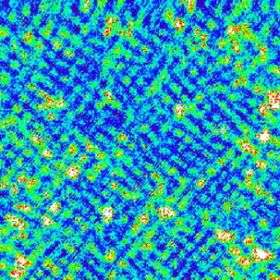
This scanning tunneling microscope image of a bismuth superconducting compound shows a characteristic checkerboard pattern. The researchers believe this pattern indicates the presence of a charge density wave. Image / Doug Wise, Kamalesh Chatterjee and Michael Boyer, MIT

(PhysOrg.com) -- MIT physicists believe they have identified a mysterious state of matter that has been linked to the phenomenon of high-temperature superconductivity.

Led by Eric Hudson, associate professor of physics, the researchers are exploring materials that conduct electricity with no resistance at temperatures around 30 degrees Kelvin above absolute zero. Such materials could have limitless applications if they could be made to superconduct at room temperature.

Hudson's team is focusing on the state of matter that exists at temperatures just above the temperature at which materials start to superconduct. This state, known as the pseudogap, is poorly understood, but physicists have long believed that characterizing the pseudogap is important to understanding superconductivity.

In their latest work, published online on July 6 in Nature Physics, they suggest that the pseudogap is not a precursor to superconductivity, as has been theorized, but a competing state.

If that is true, it could completely change the way physicists look at superconductivity, said Hudson.

"Now, if you want to explain high-temperature superconductivity and you believe the pseudogap is a precursor, you need to explain both. If it turns out that it is a competing state, you can instead focus more on superconductivity," he said.

The researchers studied several samples of a bismuth compound that superconducts at high temperatures. Each has a different level of doping (number of extra oxygen atoms that change the material's electrical properties), which influences both its superconducting and pseudogap properties.

"We've studied a variety of samples and found trends which point toward one possible identity, which is a charge-density wave," said Hudson.

Others have suggested that the pseudogap might be a charge-density wave, but this is the first systematic study of a "checkerboard" pattern, which appears when the material is imaged with scanning tunneling microscopy (STM) across a range of samples. The doping dependency of the checkerboard pattern offers strong evidence of a charge-density wave, Hudson said.

"If it is true that the pseudogap is a charge-density wave, that would be a major, major outcome because people have been looking for this for the past decade," he said.

Lead author of the paper is graduate student William Wise. Other MIT authors are graduate students Michael Boyer and Kamalesh Chatterjee, postdoctoral associate Yayu Wang, and former postdoctoral associate Takeshi Kondo.

Provided by MIT

4.4 /5 (43 votes)  

Rank 4.4 /5 (43 votes)
Relevant PhysicsForums posts
  • Question on Kirchoff's Laws
    created1 hour ago
  • Changes in Water Weight
    created2 hours ago
  • Some superconductor help
    created2 hours ago
  • perturbance in a model
    created3 hours ago
  • Combustion: where does the heat come from?
    created4 hours ago
  • How does dynamic pressure affect static pressure?
    created4 hours ago
  • More from Physics Forums - General Physics

More news stories

Borexino Collaboration succeeds in spotting pep neutrinos emitted from the sun

(PhysOrg.com) -- To learn more about how the sun works, scientists study particles that are emitted from it into space due to thermonuclear reactions that occur inside; by applying known physics principles, ...

Physics / General Physics

created 9 hours ago | popularity 5 / 5 (4) | comments 0 | with audio podcast report

Explained: Sigma

It's a question that arises with virtually every major new finding in science or medicine: What makes a result reliable enough to be taken seriously? The answer has to do with statistical significance -- but ...

Physics / General Physics

created 9 hours ago | popularity 5 / 5 (6) | comments 9

Physics research suggests new pathways for cancer progression

Observing that certain cancer cells may exhibit greater flexibility than normal cells, some scientists believe that this capability promotes rapid tumor growth. Now computer simulations developed by Boston University Biomedical ...

Physics / General Physics

created 7 hours ago | popularity 5 / 5 (1) | comments 0

Quantum physicist explains $100K offer for proof scaled-up quantum computing is impossible

(PhysOrg.com) -- MIT researcher Scott Aaronson has certainly riled the physics community with his offer this past Friday, of $100,000 to anyone who can prove that scaled-up quantum computing is impossible. ...

Physics / Quantum Physics

created Feb 08, 2012 | popularity 4 / 5 (10) | comments 30 | with audio podcast weblog

Physicists build highly efficient 'no-waste' laser

A team of University of California, San Diego researchers has built the smallest room-temperature nanolaser to date, as well as an even more startling device: a highly efficient, "thresholdless" laser that ...

Physics / General Physics

created Feb 08, 2012 | popularity 5 / 5 (18) | comments 5 | with audio podcast


Decoding the molecular machine behind E. coli and cholera

Scientists from Queen Mary, University of London have discovered the workings behind some of the bacteria that kill hundreds of thousands every year, possibly paving the way for new antibiotics that could treat infections ...

Deadly bird parasite evolves at exceptionally fast rate

A new study of a devastating bird disease that spread from poultry to house finches in the mid-1990s reveals that the bacteria responsible for the disease evolves at an exceptionally fast rate. What's more, ...

Flexible paper robots

(PhysOrg.com) -- These inexpensive robots can stretch, bend and twist under control, and lift objects up to 120 times their own weight. Being soft, they can apply gentle and even pressure, and adapt to varied ...

Cell biologists describes mechanism by which some people may be more susceptible to colon cancer

An international research team led by cell biologists at the University of California, Riverside has uncovered a new insight into colon cancer, the third leading cause of cancer-related deaths in the United ...

Tell me how you are -- and I know how long you will live

The way people rate their health determines their probability of survival in the following decades. Researchers from the Institute of Social and Preventive Medicine at the University of Zurich demonstrate that for ratings ...

New research reveals why fishermen keep fishing despite dwindling catches

Half of fishermen would not give up their livelihood in the face of drastically declining catches according to research led by the University of East Anglia (UEA).