NASA works to improve short-term weather forecasts
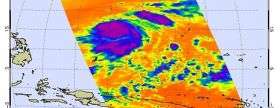
Sometimes seconds count. If a furious, tornado-spitting thunderstorm was bearing down on your home town, a few moments might make all the difference in the world.
Will McCarty, a graduate student at the National Space Science and Technology Center, is working with data from NASA's Aqua satellite to improve short-term weather predictions--the kind that could help you dodge that thunderstorm.
Guided by his NASA mentor, Gary Jedlovec, McCarty has already learned how to improve 48-hour forecasts by 3 hours. "That may not sound like a big deal, but tell that to someone who escaped a weather disaster by the skin of their teeth," says McCarty.
They accomplished the improvement by entwining measurements from Aqua's Atmospheric Infrared Sounder (AIRS), into weather models. To understand how AIRS works its magic, let's first take a look at how forecasts are made:
Twice a day, all over the world, weather balloons measure temperature, wind, air pressure and humidity. These balloons sample the lowest 7 to 10 miles of Earth's atmosphere, where weather happens. More measurements are made by surface observing stations, aircraft, and weather radars. All these data form a "snapshot" of the weather over the land at one point in time, every 12 hours.
Next, the measurements are plugged into forecast models--computer-coded equations that describe the interactions among the weather-influencing variables mentioned above, plus others. A forecaster interprets the model output to make his local weather prediction.
Sometimes lives ride on this mundane sounding process.
"The better we make the model output, the more the forecaster can trust it and use it as a tool for forecasting, and the more accurate forecasts the public receives," says McCarty.
AIRS improves the model output by improving its input: Riding on NASA's Aqua spacecraft and viewing the atmosphere through nearly 2,400 different spectral channels, AIRS creates an accurate global 3-D map of atmospheric temperature, water vapor, clouds and greenhouse gases.
"AIRS has finer resolution than previous instruments, so it can make more detailed measurements," says McCarty. "This makes analyses sharper, which improves the forecasts based on them."
McCarty and Jedlovec are most interested in AIRS infra-red "radiances," i.e., measurements of thermal energy emitted by the Earth's surface and atmosphere. The researchers look at radiances because they provide large scale measurements of the temperature and water vapor patterns in the atmosphere.
"Radiance measurements, in general, allow the observation of many places, particularly over the oceans, that are sparsely measured directly by traditional means, if at all," explains McCarty. "AIRS gives us the best picture of the vertical temperature and moisture structures ever made from space."
AIRS' claim to fame, then, is its capacity to increase both the area of Earth's atmosphere measured and the detail of those measurements.
What's the next step? "Dealing with clouds," says McCarty. "Infrared energy doesn't penetrate clouds well. When clouds are around, the instrument is really only seeing the tops of clouds."
When clouds are low, however, there's still some good data from the air above them because most of the atmosphere is still being measured. These data have been wasted up to now – thrown out in the bathwater along with all the other cloud-contaminated data.
McCarty is now working on an algorithm to identify which channels are truly useless and which are valid. His method will help identify what is good, useful data and increase the amount of data collected, making even better forecasts possible. He will soon plug his data into a forecast model to find out just how much better.
A 3-hour improvement may be just the beginning.
Source: Science@NASA, by Dauna Coulter


