Researchers pursue grasses as Earth-friendly biofuel
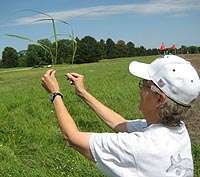
(PhysOrg.com) -- At a small site on the Batavia campus of Fermilab, ecologist Julie Jastrow of Argonne National Laboratory pushes the scientific frontier in a new and exciting way: She watches the grass grow.
As part of an effort to develop a new collection of alternative fuels, Jastrow and her colleagues from the U.S. Department of Energy's (DOE) Argonne National Laboratory and the University of Chicago have planted seven different combinations of native Midwestern prairie grasses on the 13-acre site at Fermilab's campus.
The experimental facility that Jastrow planted in June will examine the sustainability of different perennial bioenergy crops – plants that could be turned into energy either by being burned directly or by being converted into cellulosic ethanol.
While crops with high starch or sugar contents -- most notably corn grain and sugarcane -- are the focus of current bioenergy applications, botanists have also seen potential in perennial grasses. "Right now, if you looked at the list of perennial bioenergy crops being studied, switchgrass will be at the top of the list," Jastrow said.
According to Jastrow, DOE began to consider perennial forage crops as possible sources of alternative fuels during the oil crisis of the late 1970s and early 1980s. As Americans lost access to imported oil due to political instability in the Persian Gulf states, scientists saw an opportunity in the open grazing land of the Great Plains and the prairie remnants of the Midwest, where switchgrass and other native perennial grasses grow in dense stands from four to eight feet high.
The Argonne ecologists are working with several varieties, or cultivars, of switchgrass that differ in geographic origin and genetic attributes. In addition to switchgrass, they planted a number of other species, including big bluestem, Indiangrass and Canadian wild rye.
Jastrow and her colleagues are seeking to determine which grasses produce high yields of harvestable biomass while also pumping the most carbon underground through root growth. When roots die and decompose, some carbon is sequestered in soil organic matter, and nutrients such as nitrogen are recycled to sustain future plant growth.
“We expect to use some of the new genetic, bioinformatics, and molecular tools available through Argonne's Biosciences and Mathematics and Computer Science divisions, the joint Argonne-University of Chicago Institute for Genomics and Systems Biology, and Argonne's Advanced Photon Source to help tease out how differing plant traits and microbial communities interact in the soil environment to control these processes,” Jastrow explained.
In general, researchers interested in perennial grasses as bioenergy crops typically compare species or cultivars one at a time in “monocultures.” But recent studies suggest that planting a diverse mixture of grass species might lead to greater sustained yields over time.
"Diverse plantings are better equipped to deal with annual variations in climate and probably have fewer problems with pathogen buildup than monocultures," Jastrow said.
But growing a feedstock consisting of several different grass species would complicate up-and-coming efforts to convert the cellulose in plant matter into ethanol, a process that might require the use of a separate set of microbes for each grass species. Jastrow and her colleagues believe they can avoid this problem while reaping the benefits of diverse plantings by using a mixture of switchgrass cultivars to increase genetic diversity.
Although a number of other grass species grew abundantly in the prairies of the Midwest and Great Plains, switchgrass soon found favor among botanists selecting grasses for grazing and biomass production because of its unusually high response to fertilization.
"Most of the other prairie grasses," she said, "are more nutrient-use efficient. If you fertilize them, it's all excess, and they don't grow much larger. Switchgrass, however, can really take off when it's fertilized."
Next year, after the grasses are established, half of the area planted with each of the seven cultivar/species combinations will be fertilized annually while the other half will remain unfertilized.
The addition of fertilizer, however, represents a "carbon cost" to the environment that derives from the process of making the fertilizer as well as the fuel for the vehicles required to ship and spread it; the planting, harvesting, transporting and processing of feedstocks creates other carbon costs as well. In Jastrow's view, the "carbon balance" of a particular type of grass – the difference between its "carbon cost" and the amount of carbon it offsets or sequesters – has to be considered when evaluating its potential effectiveness as a bioenergy crop.
"One of our ideas," she said, "is that maybe you won't get as much production with some of the other grasses; but if you don't have to fertilize or if these grasses are better at sequestering carbon in the soil, then the overall carbon balance might be about the same or even better."
Jastrow's collaborators on this project include Mike Miller and Roser Matamala from Argonne and Geoff Morris and Justin Borevitz from the University of Chicago. Jastrow coordinates Argonne's contributions to the DOE Consortium for Research on Enhancing Carbon Sequestration in Terrestrial Ecosystems (CSiTE), which also includes scientists from Oak Ridge and Pacific Northwest national laboratories.
Provided by Argonne National Laboratory


