NASA Conducts Full-Scale Test Firing of Orion Jettison Motor
July 21, 2008 NASA Conducts Full-Scale Test Firing of Orion Jettison Motor

Enlarge

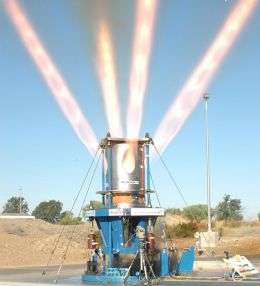
A full-scale rocket motor fires from the Aerojet facility in Sacramento, Calif. This test will help in the development of NASA's Orion jettison motor that is being designed to separate the spacecraft's launch abort system from the crew module during launch. (Aerojet)

(PhysOrg.com) -- NASA completed a full-scale rocket motor test on Thursday, July 17, to further development of the Orion jettison motor, which will separate the spacecraft's launch abort system from the crew module during launch. Orion, the Constellation Program's crew exploration vehicle now under development, will fly to the International Space Station and be part of the spaceflight system to conduct sustained human exploration of the moon.

NASA and Aerojet successfully fired the jettison motor at the Aerojet facility in Sacramento, Calif. The demonstration is part of a series of developmental tests that pave the way for delivery of the motor to be used for the first full-scale test of the launch abort system at the U.S. Army’s White Sands Missile Range in New Mexico late this year.

Engineers will use the test firing to verify that the motor meets specification requirements and to help define induced acoustic, vibration and shock loads caused by the motor. The successful test firing of the jettison motor increases the technical readiness of the launch abort system and is the first full-scale rocket propulsion element qualified to proceed into a system-level demonstration. The test firing also verified that the system’s design criteria and manufacturing processes are in place.

This test and others like it are critical milestones in NASA's preparations for a series of flight tests of the full Orion abort system. The launch abort system will provide a safe escape for the crew in an emergency on the launch pad or during the climb to orbit.

Provided by NASA


print this article email this article download pdf blog this article bookmark this article     Stumble it Digg this share on Facebook retweet share on Reddit add to delicious
Rate this story - 4.3 /5 (7 votes)


July 21, 2008 all stories

Comments: 0

4.3 /5 (7 votes)
  • Stumble this up

  • Digg this

  • share this

  • hide
  • Related Stories

  • NASA's Ares I-X moon rocket makes first test flight
    created Oct 28, 2009 | popularity not rated yet | comments 0
  • NASA is 'go' for crucial rocket test
    created Oct 25, 2009 | popularity not rated yet | comments 0
  • NASA Tests Load Limits for Ares I Rocket Main Parachute
    created Oct 09, 2009 | popularity not rated yet | comments 0
  • New aluminum-water rocket propellant promising for future space missions
    created Oct 07, 2009 | popularity not rated yet | comments 0
  • Space tourism yet to fly, 5 years since 1st flight
    created Oct 03, 2009 | popularity not rated yet | comments 0


  • hide
  • Relevant PhysicsForums posts

  • The shape of our solar system's orbits.
    created Nov 07, 2009
  • Above or Below the Line of Nodes
    created Nov 07, 2009
  • Supernova vs. Nova?
    created Nov 07, 2009
  • Supernova's Gamma Rays and Comets
    created Nov 06, 2009
  • More from Physics Forums - General Astronomy

Other News

Deep creep means milder, more frequent earthquakes along Southern California's San Jacinto fault

Deep creep means milder, more frequent earthquakes along Southern California's San Jacinto fault

Space & Earth / Earth Sciences

created 18 hours ago | popularity 4.5 / 5 (4) | comments 0

With an average of four mini-earthquakes per day, Southern California's San Jacinto fault constantly adjusts to make it a less likely candidate for a major earthquake than its quiet neighbor to the east, the ...


Success in 'space elevator' competition (AP)

Success in 'space elevator' competition (Update 3)

Space & Earth / Space Exploration

created Nov 05, 2009 | popularity 4.3 / 5 (33) | comments 50

(AP) -- A robot powered by a ground-based laser beam climbed a long cable dangling from a helicopter on Wednesday to qualify for prize money in a $2 million competition to test the potential reality of the ...


In a Galaxy Far, Far Away...

In a Galaxy Far, Far Away...

Space & Earth / Astronomy

created Nov 06, 2009 | popularity 4.8 / 5 (5) | comments 17

(PhysOrg.com) -- Astronomers have published the discovery of the farthest known object in the cosmos: a star that exploded when the universe was only 630 million years old -- only 4.6% of its current age. ...


'Dropouts' pinpoint earliest galaxies

'Dropouts' pinpoint earliest galaxies

Space & Earth / Astronomy

created Nov 06, 2009 | popularity 4.2 / 5 (10) | comments 13

Astronomers, conducting the broadest survey to date of galaxies from about 800 million years after the Big Bang, have found 22 early galaxies and confirmed the age of one by its characteristic hydrogen signature ...


Space hotel taking bookings for 2012 opening

Space hotel taking bookings for 2012 opening

Space & Earth / Space Exploration

created Nov 05, 2009 | popularity 4.4 / 5 (21) | comments 11

(PhysOrg.com) -- The first orbiting space hotel is on track to open for its first customers in 2012, but hurry, as bookings are filling fast.