Lost castle solves riddle of Buckton Moor
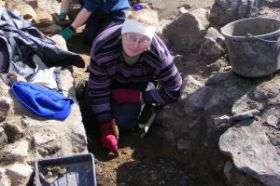
(PhysOrg.com) -- A mysterious monument standing on a windswept Lancashire hilltop for nearly a thousand years has been identified as one of England’s most important castles – causing a sensation among archaeologists.
The University of Manchester team expected the mound on Buckton Moor near Stalybridge to be an earthwork of relatively little importance constructed for defensive purposes out of earth and timber.
But to their surprise, the excavation revealed it is in fact a top ranking castle built in the twelfth century, solving a riddle which has intrigued locals for hundreds of years.
The discovery is a significant addition to Britain’s tally of 1,400 castles.
The team excavated a huge ditch and massive “curtain” wall which indicates that it was built by the upper echelons of society.
“The discovery of a high ranking castle in England is a tremendously rare event – and was definitely not what we were expecting,” said the Director of University of Manchester Field Archaeology Centre Mike Nevell.
“It’s been an object of curiosity for a very long time - perhaps going all the way back to a reference in a 1359 survey carried out by the Black Prince – who had just acquired the lands.
“Then it was described as a ruined castle.
“Much of the stonework has been stolen and its walls are overgrown with heather and peat – which explains why it has been mistaken for an earthwork all this time.”
The archaeologists realised they had made a major discovery after excavating the castle’s outer wall - which they found to be made of stone and 2.8 metres wide – a massive size.
They also managed to date some pottery remains which they found scattered on the roadway to the gate house.
“The large scale of the defences clearly indicates castle building at the top end of the social hierarchy “said Greater Manchester County Archaeologist Norman Redhead, also from the University of Manchester.
“We also found that the castle was defended by a large rectangular gate tower – which helps to date it to the 12th century.
“Greater Manchester is not well known for its castles, but Buckton Castle will put the area well and truly on the castle map as it is clearly the best preserved of the eight known castles in the county area.”
The excavation was partly funded from a £300,000 grant by Tameside Council in Greater Manchester.
More questions remain about who owned the castle though the leading contenders are Ranulf the second and Ranulf the third – Earls of Chester who ruled in the 12th century.
One idea is that one of the second Earl of Chester built a castle on the edge of his lands to protect himself from his sworn enemy William of Peveril – who went on to poison him in 1153.
Equally the castle could have been erected during the Civil War of King Stephen’s reign. At this time the Earl was one of the most powerful noblemen in the kingdom and changed sides several times.
Another is that it was built during a period of rebellion against King Henry Second.
The team also want to understand why the castle faced north and west - rather than south where the Earl of Chester’s enemy, Peveril, lived.
Nevell added: “When we return to Buckton next year we’ll hopefully find more answers to these still intriguing questions.”
Provided by University of Manchester


