Killer Kevlar -- clothing that shields from germs
July 21, 2008 Kevlar

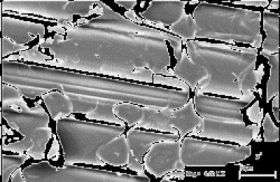
Researchers have developed a process to coat Kevlar with germ-fighting agents, including antibacterial and antiviral substances. Above is coated Kevlar fabric exposed to a fungus called Candida tropicalis. Courtesy of the American Chemical Society

Protective clothing worn by firemen and other emergency workers may soon get a germ-fighting upgrade. Researchers in South Dakota report progress toward the first Kevlar fabrics that can kill a wide range of infectious agents, including bacteria, viruses, and the spores that cause anthrax. Their study is scheduled for the August 6 issue of ACS' Industrial & Engineering Chemistry Research.

In the new study, Yuyu Sun and Jie Luo point out that Kevlar fabrics are widely used as fire-resistant materials for firefighters, police and emergency medical workers. But amid increased threats of bioterrorism, there's a growing need for new protective clothing that can also provide multiple protection against a wide variety of dangerous microorganisms.

The scientists developed a special process to coat Kevlar samples with acyclic N-Halamine, a potent germ-fighting substance. They then exposed coated and uncoated fabric samples to E. coli, Staphylococcus aureus, Candida tropicalis (a fungus), MS2 virus, and Bacillus subtilis spores (to mimic anthrax).

After a short time, large amounts of microorganisms stuck to untreated fabric samples, but the coated fabrics showed little to no adherence of the infectious agents, the researchers say. The coating is long-lasting, can be reactivated, and does not cause any loss of fabric comfort or strength, they add.

Source: ACS


print this article email this article download pdf blog this article bookmark this article     Stumble it Digg this share on Facebook retweet share on Reddit add to delicious
Rate this story - 4.1 /5 (9 votes)


July 21, 2008 all stories

Comments: 0

4.1 /5 (9 votes)
  • Stumble this up

  • Digg this

  • share this

  • hide
  • Related Stories


Other News

Sandia CR5

Machine Converts CO2 into Gasoline, Diesel, and Jet Fuel

Chemistry / Biochemistry

created Nov 23, 2009 | popularity 4.6 / 5 (31) | comments 20

(PhysOrg.com) -- Researchers at Sandia National Laboratories have built a machine that uses the sun's energy to convert carbon dioxide waste from power plants into transportation fuels such as gasoline, diesel, ...


New hydrogen-storage method discovered

New hydrogen-storage method discovered

Chemistry / Materials Science

created Nov 22, 2009 | popularity 4.3 / 5 (42) | comments 15

Scientists at the Carnegie Institution have found for the first time that high pressure can be used to make a unique hydrogen-storage material. The discovery paves the way for an entirely new way to approach ...


New chemical reaction offers opportunities for drug development

Chemistry / Biochemistry

created Nov 26, 2009 | popularity not rated yet | comments 2

Researchers led by Conway Fellow, Professor Pat Guiry have solved a chemistry problem that has stumped researchers worldwide for more than a decade. The results have earned the group the cover story of the leading scientific ...


Research sheds light on workings of anti-cancer drug

Chemistry / Analytical Chemistry

created Nov 26, 2009 | popularity not rated yet | comments 0

(PhysOrg.com) -- The copper sequestering drug tetrathiomolybdate (TM) has been shown in studies to be effective in the treatment of Wilson disease, a disease caused by an overload of copper, and certain metastatic cancers. ...


Chemists get custom-designed microscopic particles to self-assemble in liquid crystal

Chemists get custom-designed microscopic particles to self-assemble in liquid crystal

Chemistry / Materials Science

created Nov 25, 2009 | popularity 5 / 5 (5) | comments 0

(PhysOrg.com) -- The scientists anticipate their "LithoParticles" will have significant applications in photonics, optical communications and other areas.