Study sets high economic value on threatened Mexican mangroves
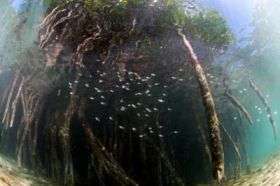
The ecological value of coastal mangrove forests in Mexico has been apparent to marine scientists for years. Now, for the first time, researchers have used a wide-ranging compilation of fisheries landings, the official record of fish catches, to place an economic price tag on that value.
Scientists at Scripps Institution of Oceanography at UC San Diego, writing in the new online edition of the Proceedings of the National Academy of Sciences, show that Mexican mangroves, trees that form forest ecosystems at the land-sea interface, demonstrably boost fishery yields in the Gulf of California. The more mangroves, the more landings, the study showed.
The researchers arrived at their results through a combination of field studies, geographical analyses and economic valuations.
They found that thirteen fishing regions in the Gulf of California produced an average of 11,500 tons of mangrove-derived fish and blue crab per year between 2001 and 2005, generating nearly $19 million for local fishermen.
The researchers worked with landing records provided by Mexico's National Fisheries and Aquaculture Commission (CONAPESCA).
The geographic information was derived from several sources, including satellite images. To fill in gaps related to small mangrove wetlands, the researchers conducted field trips in 2005 and 2006 to survey mangrove patches distributed in small bays and islands. Using small boats, the researchers navigated inside lagoons and hiked across the inland parts of the forests to document the geographic bearings of the extent of mangrove trees.
Mangroves in the Gulf of California serve as homes to a variety of fish and crab species, and host nursery habitats for commercially valuable fishes such as snappers, snooks and mullets. The trees also protect the coastline from erosion and filter water between the continent and ocean. They provide a resource to generate money for local economies and more than 30 percent of the annual small-scale fishery landings in the Gulf of California come from a mangrove source, according to the study.
The annual worth of mangrove ecosystem services worldwide has been estimated at more than $1.6 billion. Such services benefit human populations through climate regulation, water supply availability, erosion control, waste treatment, food production and recreation.
Despite their value, the number of mangrove forests is dwindling at a regional rate of two percent per year in Mexico, as trees are cut to make way for new coastal developments, among other reasons. A report published in 1984 indicated that 23 percent of the mangrove forests near La Paz were eliminated between 1973 and 1981.
The researchers weighed economic, geographic and ecological factors and determined that a hectare (10,000 square meters, or roughly 2.5 acres) of mangrove fringe—the edge of mangrove forest in contact with the sea—in the Gulf of California is on average valued at about $37,500 per year.
Octavio Aburto-Oropeza, lead author of the study, of the Scripps Center for Marine Biodiversity and Conservation, said that although human density is low in the mangrove regions of the Gulf of California, there is increasing pressure to transform mangroves into shrimp farms and coastal developments. He added that the study's end valuation is a low estimate, as the researchers only included fishery value, rather than any potential recreational or ecotourism earnings.
Exequiel Ezcurra, newly appointed adjunct professor with Scripps Oceanography and Provost of the San Diego Natural History Museum, said that coastal development is putting mangroves under growing threats in all the coasts of Mexico and the tropical seas in general. This study is a first interdisciplinary effort to appraise the environmental services provided by mangroves to fisheries, and hopefully will serve to underscore the urgent need for mangrove protection and for the serious appraisal of environmental services provided by common-access resources, he indicated.
"The forest is essential to the long term well-being of many other people whose livelihoods depend on the fisheries," said research coauthor Enric Sala, an adjunct professor at Scripps and a National Geographic Fellow based at the National Council of Scientific Research of Spain.
"Because property rights are poorly defined for critical environmental inputs such as mangroves, it is necessary to measure and highlight the real monetary benefits they provide," said coauthor Jason Murray, a former Ph.D. student from the economics department at UC San Diego, and current Professor of the University of South Carolina. "Our results suggest much higher values for mangroves than in previous work and should inform future development decisions in the Gulf of California; if mangroves are to be converted for development and services of the ecosystem lost, then users depending on these ecosystem services should be compensated," added Professor Murray.
Source: University of California - San Diego


