Portuguese team makes first paper based transistor
July 22, 2008 Portuguese team makes first paper based transistor

Enlarge

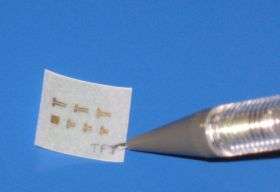
(PhysOrg.com) -- Elvira Fortunato and colleagues from the Centro de Investigação de Materiais (Cenimat/I3N), at Faculdade de Ciências e Tecnologia, Universidade Nova de Lisboa, made the first Field Effect Transistor (FET) with a paper "interstrate" layer.

A new device which rivals in electrical performance with the actual state of the art of oxide based thin film transistors (TFTs) produced on glass or crystalline silicon substrates. These results will be published next September in IEEE Electron Device Letters.

Nowadays, there is an increased interest in the use of biopolymers for low-cost electronic applications. Since cellulose is the Earth’s major biopolymer, some international teams have reported using paper as the physical support (substrate) of electronic devices. But, until now, no one had used paper as an interstrate component of a FET.

In a new approach, scientists from Cenimat/I3N – a research group coordinated by Elvira Fortunato and Rodrigo Martins – used a common sheet of paper as the dielectric layer on oxide FETs.

The research team fabricated the devices on both sides of the paper sheet. This way, the paper acts simultaneously as the electric insulator and as the substrate. "Is a two in one," says Elvira Fortunato.

Furthermore, electric characterization of devices showed that the hybrid FETs’ performance outpace those of amorphous silicon TFTs, and rival with the actual state of the art of oxide thin film transistors.

These results suggest promising new disposable electronics devices, like paper displays, smart labels, smart packaging, bio-applications, RFID tags, among others.

Citation: High Performance Flexible Hybrid Field Effect Transistors based on Cellulose Fiber-Paper will be published next September in IEEE Electron Device Letters.

Provided by Universidade Nova de Lisboa


Rate this story - 4.6 /5 (61 votes)

Rank Filter

Move the slider to adjust rank threshold, so that you can hide some of the comments.


Display comments: newest first

  • patnclaire - Jul 22, 2008
    • Rank: 4 / 5 (3)
    I seem to recall the editor of Analog magazine, the late Joseph Campbell, publishing articles about this sort of thing back in the 1960s. He and the author were speculating about being able to draw circuts with pencil on paper and have a working circut.
    What took so long?
  • Wasabi - Jul 22, 2008
    • Rank: 2.5 / 5 (4)
    I'd be curious to know how they handle the heat issue with something as heat sensitive as a paper based material.
  • Soylent - Jul 22, 2008
    • Rank: 4 / 5 (3)
    I'd be curious to know how they handle the heat issue with something as heat sensitive as a paper based material.


    They don't, there is no heat issue.
  • Arikin - Jul 22, 2008
    • Rank: not rated yet
    I would also assume that recycling would be easier. Metals and paper are valuable and recycling techniques for them are efficient.

    If the vending machine of these disposable items had a recycle slot it would make collection easy. Buy a disposable phone, use it, drop it at the next phone vending machine.

July 22, 2008 all stories

Comments: 4

4.6 /5 (61 votes)

  • hide
  • Related Stories


  • hide
  • Relevant PhysicsForums posts

  • how to welding thin SS foil (0.002")?
    created Feb 08, 2010
  • Civil Engineering is hazardous to your career prospects
    created Feb 06, 2010
  • hot water circulator, kitchen faucet, ? mixing
    created Feb 06, 2010
  • Static or dynamic pressures in duct
    created Feb 06, 2010
  • More from Physics Forums - General Engineering

Other News

The power of 'random'

The power of 'random': 'Seemingly loopy' technique could dramatically improve communications networks

Technology / Computer Sciences

created 17 hours ago | popularity 4.8 / 5 (8) | comments 5 | with audio podcast

A radical new approach to the design of communications networks, called "network coding," promises to make Internet file sharing faster, streaming video more reliable, and cell-phone reception better -- among ...


'Revolutionary' water treatment units on their way to Afghanistan

Technology / Engineering

created 11 hours ago | popularity 4.3 / 5 (6) | comments 4 | with audio podcast

The United States Army has taken delivery of the first two units of a "revolutionary" waste-water treatment system that will clean putrid water within 24 hours and leave no toxic by-products, according to scientists at Sam ...


Imec and Holst Centre achieve breakthrough in battery-less radios

Imec achieves breakthrough in battery-less radios

Technology / Semiconductors

created 12 hours ago | popularity 4.9 / 5 (11) | comments 1 | with audio podcast

At today's International Solid State Circuit Conference, Imec and Holst Centre report a 2.4GHz/915MHz wake-up receiver which consumes only 51µW power. This record low power achievement opens the door to battery-less ...


Android

Google developing a translator for smartphones

Technology / Software

created 18 hours ago | popularity 4.8 / 5 (8) | comments 3 | with audio podcast report

(PhysOrg.com) -- Google is developing a translator for its Android smartphones that aims to almost instantly translate from one spoken language to another during phone calls.


GMail logo

Google gives Gmail social-networking 'Buzz' (Update)

Technology / Internet

created 13 hours ago | popularity 5 / 5 (1) | comments 1

Google is giving its free email service a "Buzz" by adding social-networking features which could challenge the supremacy of platforms like Facebook and Twitter.