Robot playmates may help children with autism
July 22, 2008
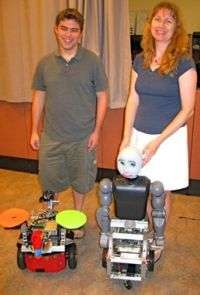
Feil-Seifer, Matarić and assistants: "a doorway into the attention" of ASD children. Credit: USC Viterbi School of Engineering
Papers delivered at three conferences in the US and Europe this summer report on new research at the University of Southern California Viterbi School of Engineering studying interactions of children with Autism Spectrum Disorders (ASD) with bubble-blowing robots.
The preliminary studies, by Professor Maja Matarić and PhD student David Feil-Seifer of the USC Interaction Laboratory, confirm what has been widely reported anecdotally: that ASD children in many cases interact more easily with mechanical devices than with humans.
Matarić and Feil-Seifer, both specialists in Socially Assisted Robotics (SAR), are now engaged in further research to confirm their findings, and to develop a robot "control architecture" which will tailor robot interactions to the specific needs of ASD children to help therapists treating their condition.
The initial study, reported in the June Conference on Interaction Design for Children with Special Needs in Chicago, tested whether interaction as opposed to simple passive observation was going on between ASD children and a colorful bubble-blowing wheeled robot.
The robot had two settings. In one, it carried on its rolling and bubble blowing on its own internal schedule, regardless of the behavior of the child. In the other, "when the child pushes a button, then the bubbles blow," in the words of the Chicago presentation.
The study watched the children and observed differences. "We found that the behavior of the robot affects the social behavior of a child (both human-human interaction and human-robot interaction): social behavior with a contingent robot was greater than with a random robot.
"Total speech went from 39.4 to 48.4 utterances, robot speech from 6.2 to 6.6 utterances, and parent speech from 17.8 to 33 utterances. Total robot interactions went from 43.42 to 55.31, with button pushes increasing from 14.69 to 21.87 and other robot interactions going from 24.11 to 28. Total directed interactions (interactions that were clearly directed at either the robot or the parent) went up from 62.75 to 89.47. Generally, when the robot was acting contingently, the child was more sociable."
While only four children were part of the initial study, Feil-Seifer and Matarić believe the work clearly demonstrates the ability of robots to actively engage with ASD children - "offer a doorway into their attention," Matari? says. A much more extensive follow-up with more subjects is already in progress, in collaboration with Los Angeles Childrens Hospital and the Autism Genetic Resource Exchange.
Two other presentations by Feil-Seifer and Matarć, at the 11th International Symposium on Experimental Robotics 2008 in Athens, Greece in July, 2008, and at the IEEE Proceedings of the International Workshop on Robot and Human Interactive Communication, discuss these results in more detail, particularly in regard to the "Behavior-Based Behavior Intervention Architecture" (B3IA) they have developed to make the robots flexible and useful tools help ASD children.
This architecture (the system, including robotic and non-robotic components, plus provisions for recording and analyzing the proceedings) is based on an ASD therapy format called DIR/Floortime, in which a therapist shares floor with various toys used to try to engage the child.
Matarić and Feil-Seifer, in collaboration with Dr. Marian Williams from Childrens Hospital Los Angeles and Shri Narayanan from Viterbi School's Department of Electrical Engineering, are replacing toys with robots, both the rolling robots with horns and bubble blowers used in the initial results, and humanoid robots capable of smiles and other expression.
Behind the scenes, the architecture also includes an overhead video view that analyzes, documents, and stores every interaction, and a control system for the therapist operator that allows for switching between scenarios for interaction with the child, to concentrate on what works, and change what works to make it work better -- while still retaining a standard record-keeping and monitoring system used in ASD therapy.
Matarić has for years been working in the field of socially assisted robots to help a variety of other user populations, including patients with Alzheimer's Disease and stroke victims receiving help in rehabilitation. She notes that ASD is now an at "epidemic" proportions in the United States.
"I am gratified by these preliminary results," she said. "I believe that Socially Assistive Robotics has a part to play in helping families, both the affected children and their parents and siblings."
Source: University of Southern California
-
Robot Speaks the Language of Kids
Aug 05, 2010 |
5 / 5 (1) |
0
-
Robots that monitor emotions of ASD children
Feb 17, 2009 |
not rated yet |
0
-
Researchers find social robots require astute tuning to improve acceptability by the human mind
Feb 03, 2012 |
5 / 5 (1) |
0
-
Toddlers don't listen to their own voice like adults do
Dec 22, 2011 |
5 / 5 (2) |
1
-
Domestic robots: Harmony on the homefront?
Dec 21, 2011 |
2.5 / 5 (2) |
2
-
Engineers build first sub-10-nm carbon nanotube transistor
Feb 01, 2012 |
4.9 / 5 (33) |
30
-
Something old, something new: Evolution and the structural divergence of duplicate genes
Jan 31, 2012 |
4.6 / 5 (7) |
1
-
The hidden nanoworld of ice crystals: Revealing the dynamic behavior of quasi-liquid layers
Jan 30, 2012 |
5 / 5 (4) |
1
-
Stock market network reveals investor clustering
Jan 27, 2012 |
3.9 / 5 (23) |
8
-
Of microchemistry and molecules: Electronic microfluidic device synthesizes biocompatible probes
Jan 26, 2012 |
5 / 5 (2) |
0
-
Is Everyday Technology Killing Us?
Feb 08, 2012
-
Exercise and weight loss
Feb 08, 2012
-
Why do we have head aches? Our brains can't feel anything.
Feb 07, 2012
-
"The end of diseases" by David Agus, interview from Daily Show with Jon Stewart
Feb 04, 2012
-
Oncolytic adenovirus
Feb 04, 2012
-
Nutrition label stuffs and diets
Feb 02, 2012
- More from Physics Forums - Medical Sciences
More news stories
Starve a virus, feed a cure? Findings show how some cells protect themselves against HIV
A protein that protects some of our immune cells from the most common and virulent form of HIV works by starving the virus of the molecular building blocks that it needs to replicate, according to research published online ...
11 hours ago |
5 / 5 (2) |
0
|
Overeating may double risk of memory loss
New research suggests that consuming between 2,100 and 6,000 calories per day may double the risk of memory loss, or mild cognitive impairment (MCI), among people age 70 and older. The study was released today and will be ...
Medicine & Health / Neuroscience
7 hours ago |
5 / 5 (2) |
0
|
Injured boomers beware: Know when to see doctor
(AP) -- It happened to nurse Jane Byron years after an in-line skating fall, business owner Haralee Weintraub while doing "men's" push-ups, and avid cyclist Gene Wilberg while lifting a heavy box.
12 hours ago |
5 / 5 (1) |
0
Declining health-care productivity in England: Who says so?
Reports that the National Health Service in England has been declining in productivity in the last decade appear to have been accepted as fact. However, a Viewpoint published Online First by The Lancet disputes this. The Vi ...
5 hours ago |
1 / 5 (1) |
0
FDA-approved drug rapidly clears amyloid from the brain, reverses Alzheimer's symptoms in mice
Neuroscientists at Case Western Reserve University School of Medicine have made a dramatic breakthrough in their efforts to find a cure for Alzheimer's disease. The researchers' findings, published in the journal Science, show t ...
Medicine & Health / Neuroscience
Feb 09, 2012 |
4.9 / 5 (58) |
17
|
Scientists discover molecular secrets of 2,000-year-old Chinese herbal remedy
For roughly two thousand years, Chinese herbalists have treated Malaria using a root extract, commonly known as Chang Shan, from a type of hydrangea that grows in Tibet and Nepal. More recent studies suggest that halofuginone, ...
New method to examine batteries -- MRI from the inside
There is an ever-increasing need for advanced batteries for portable electronics, such as phones, cameras, and music players, but also to power electric vehicles and to facilitate the distribution and storage of energy derived ...
Google might launch Drive for cloud storage soon
(PhysOrg.com) -- Google's next big move, according to the Wall Street Journal, is a cloud storage service called Drive. Hardly first to the plate, Google is simply catching up to introducing its cloud reposi ...
A mitosis mystery solved: How chromosomes align perfectly in a dividing cell
Although the process of mitotic cell division has been studied intensely for more than 50 years, Whitehead Institute researchers have only now solved the mystery of how cells correctly align their chromosomes during symmetric ...
Lab study raises questions over nano-particle impact
Tests involving chickens have raised questions about the impact on health from engineered nano-particles, the ultra-fine grains commonly used in drugs and processed foods, scientists said on Sunday.
Researchers find extensive RNA editing in human transcriptome
In a new study published online in Nature Biotechnology, researchers from BGI, the world's largest genomics organization, reported the evidence of extensive RNA editing in a human cell line by analysis of RNA-seq data, demons ...