New breast cancer test under study
July 22, 2008 New breast cancer test under study

Enlarge

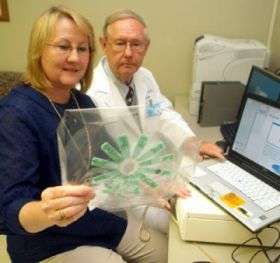
Whether a painless, portable device that uses electrical current rather than X-ray to look for breast cancer could be an alternative to traditional mammograms is under study at the Medical College of Georgia. Pictured here are study coordinator Charlene Weathers and Dr. James Craft, MCG radiologist and principal investigator. Credit: Phil Jones

Whether a painless, portable device that uses electrical current rather than X-ray to look for breast cancer could be an alternative to traditional mammograms is under study at the Medical College of Georgia.

MCG is one of 20 centers internationally and the only place in Georgia studying new technology developed by Z-Tech Inc., to compare traditional mammograms with impedence scanning, a technique based on evidence that electrical current passes through cancerous tissue differently than through normal tissue.

This phase of the study will focus on women age 40-50. Older women have less dense breast tissue so cancer is easier to find, says Dr. James Craft, MCG radiologist and principal investigator on the study. Mammograms, also performed in the study, are more accurate in this population, so this phase will be a tougher test of the new technology, he says. The first phase of the study, which began in 2005, was open to women of all ages.

"Normal breast tissue is very dense, especially in younger women, and can hide tumors," Dr. Craft says. "While we've known for a while that water flows more freely through cancerous cells, we also know that electrical current flows easier through cancerous and tumor tissue."

The Z-Tech scan works by placing a flower-shaped grouping of electrodes over each breast and sending a small, painless amount of electricity through them. Unlike traditional mammography, the scan does not involve breast compression or radiation.

"It's like doing an EKG of the breast," Dr. Craft says.

A computer immediately calculates and presents a report based on the electrical signature of the breast tissue. Rather than waiting on breast image from a traditional mammogram, the computer immediately notes whether the scan is positive or negative for cancer.

However, for study purposes, neither Dr. Craft nor the patient will know the results. Patients must undergo a mammogram within 90 days, which Dr. Craft interprets. Z-Tech compares those results to the electrical study.

The hope is that the new test – called HEDA for Homologous Electrical Difference Analysis – will provide an alternative to mammograms. While Dr. Craft believes that having this test should help find more cancers, he doesn't think it will replace traditional mammography.

"This method doesn't use radiation, is portable and there is no pain associated with the squeezing that mammograms require," he says. "I can see it being used as an additional test. I don't think it will replace mammography, but it could increase our chances of catching breast cancer."

The second phase of the Z-Tech trial is open to women age 40-50 having routine mammograms as well as those who have a suspicious lump scheduled for biopsy.

Source: Medical College of Georgia


print this article email this article download pdf blog this article bookmark this article     Stumble it Digg this share on Facebook retweet share on Reddit add to delicious
Rate this story - 5 /5 (2 votes)

Rank Filter

Move the slider to adjust rank threshold, so that you can hide some of the comments.


Display comments: newest first

  • E_L_Earnhardt - Jul 23, 2008
    • Rank: not rated yet
    GREAT! X-ray CAUSES cancer, ACCELERATES mitosis!
    Increased conduction is further proof that cancer
    is of ELECTRONIC root! A SINGLE ELECTRON CAN BREAK A HYDROGEN BOND! MORE OF THEM JUST BREAK MORE BONDS!

July 22, 2008 all stories

Comments: 1

5 /5 (2 votes)
  • Stumble this up

  • Digg this

  • share this

  • hide
  • Related Stories


  • hide
  • Relevant PhysicsForums posts

  • Chemical Burns
    created Nov 16, 2009
  • How to prevent another stroke?
    created Nov 11, 2009
  • Swine flu vaccination
    created Nov 10, 2009
  • Improving the brain through chemistry
    created Nov 07, 2009
  • More from Physics Forums - Medical Sciences

Other News

Transcendental Meditation helped heart disease patients lower cardiac disease risks by 50 percent

Medicine & Health / Health

created 7 hours ago | popularity 5 / 5 (6) | comments 1

Patients with coronary heart disease who practiced the stress-reducing Transcendental Meditation® technique had nearly 50 percent lower rates of heart attack, stroke, and death compared to nonmeditating controls, according ...


Analyzing structural brain changes in Alzheimer's disease

Analyzing structural brain changes in Alzheimer's disease

Medicine & Health / Diseases

created 9 hours ago | popularity 4.3 / 5 (3) | comments 0

In a study that promises to improve diagnosis and monitoring of Alzheimer's disease, scientists at the University of California, San Diego have developed a fast and accurate method for quantifying subtle, ...


Researchers create compound that boosts anti-inflammatory fat levels

Medicine & Health / Research

created 9 hours ago | popularity 3 / 5 (2) | comments 1

UC Irvine pharmacology researchers have discovered a way to boost levels of a natural body fat that helps decrease inflammation, pointing to possible new treatments for allergies, illnesses and injuries related to the immune ...


Scientists begin to unravel what makes pandemic H1N1 tick

Medicine & Health / Diseases

created 10 hours ago | popularity 5 / 5 (2) | comments 0

As the number of deaths related to the pandemic H1N1 virus, commonly known as "swine flu," continues to rise, researchers have been scrambling to decipher its inner workings and explain why the incidence is lower than expected ...


Antioxidant found in vegetables has implications for treating cystic fibrosis

Medicine & Health / Research

created 10 hours ago | popularity 3 / 5 (3) | comments 0

Scientists at the University of Pennsylvania School of Medicine discovered that a dietary antioxidant found in such vegetables as broccoli and cauliflower protects cells from damage caused by chemicals generated during the ...