The 2008 Perseid Meteor Shower
July 22nd, 2008 The 2008 Perseid Meteor Shower

Enlarge

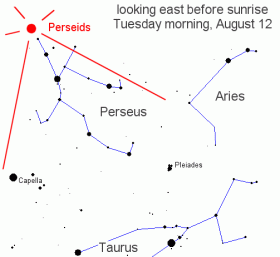
The eastern sky viewed during the hours before sunrise on Tuesday, Aug. 12, 2008.

Mark your calendar: The 2008 Perseid meteor shower peaks on August 12th and it should be a good show.

"The time to look is during the dark hours before dawn on Tuesday, August 12th," says Bill Cooke of NASA's Meteoroid Environment Office at the Marshall Space Flight Center. "There should be plenty of meteors--perhaps one or two every minute."

The source of the shower is Comet Swift-Tuttle. Although the comet is far away, currently located beyond the orbit of Uranus, a trail of debris from the comet stretches all the way back to Earth. Crossing the trail in August, Earth will be pelted by specks of comet dust hitting the atmosphere at 132,000 mph. At that speed, even a flimsy speck of dust makes a vivid streak of light when it disintegrates--a meteor! Because, Swift-Tuttle's meteors streak out of the constellation Perseus, they are called "Perseids."

Serious meteor hunters will begin their watch early, on Monday evening, August 11th, around 9 pm when Perseus first rises in the northeast. This is the time to look for Perseid Earthgrazers--meteors that approach from the horizon and skim the atmosphere overhead like a stone skipping across the surface of a pond.

"Earthgrazers are long, slow and colorful; they are among the most beautiful of meteors," says Cooke. He cautions that an hour of watching may net only a few of these at most, but seeing even one can make the whole night worthwhile.

A warm summer night. Bright meteors skipping overhead. And the peak is yet to come. What could be better?

The answer lies halfway up the southern sky: Jupiter and the gibbous Moon converge on August 11th and 12th for a close encounter in the constellation Sagittarius: sky map. It's a grand sight visible even from light-polluted cities.

For a while the beautiful Moon will interfere with the Perseids, lunar glare wiping out all but the brightest meteors. Yin-yang. The situation reverses itself at 2 am on Tuesday morning, August 12th, when the Moon sets and leaves behind a dark sky for the Perseids. The shower will surge into the darkness, peppering the sky with dozens and perhaps hundreds of meteors until dawn.

For maximum effect, "get away from city lights," Cooke advises. The brightest Perseids can be seen from cities, he allows, but the greater flurry of faint, delicate meteors is visible only from the countryside. (Scouts, this is a good time to go camping.)

The Perseids are coming. Enjoy the show!

Source: Science@NASA, by Dr. Tony Phillips


print this article email this article download pdf blog this article bookmark this article     Digg this Stumble it share on Facebook share on Reddit add to delicious save to Yahoo! bookmarks
4.6/5 after 23 votes

Rank Filter

Move the slider to adjust rank threshold, so that you can hide some of the comments.


Display comments: newest first

  • warmer - Jul 23, 2008
    • Rank: not rated yet
    I for one would be a tad bit nervous to be aboard the ISS on that day. The risk is extremely minimal, but planes have been brought down by birds...

July 22nd, 2008 all stories
Space & Earth / Space Exploration

Comments: 1
Rank: 4.6/5 after 23 votes

  • Stumble this up

  • Digg this

  • Share it:
  • share on Facebook
  • share on MySpace
  • share on Slashdot
  • rss-newsfeed
  • share on Google
  • share on Reddit
  • add to delicious
  • save to Yahoo! bookmarks
  • share on Windows Live
  • Add to Mixx!
Rating: 4.6/5 after 23 votes

  • Related Stories

  • Perseid Earthgrazers
    created Aug 08, 2006 | popularity not rated yet | comments 0
  • Mars Joins The Perseid Meteor Shower For A Beautiful Display On August 12th.
    created Jul 26, 2005 | popularity not rated yet | comments 0
  • The 2004 Perseid Meteor Shower is Promising to Be Unusually Good
    created Aug 10, 2004 | popularity not rated yet | comments 0
  • NASA Begins Hunt for New Meteor Showers
    created Nov 11, 2008 | popularity not rated yet | comments 0
  • Amateur Astronomers See Perseids Hit the Moon
    created Sep 03, 2008 | popularity not rated yet | comments 0

Tags

meteors

  • Physicists Demonstrate Quantum Memory with Matter Qubits
    Physicists Demonstrate Quantum Memory with Matter Qubits
    Physics / General Physics
    created Jul 03, 2009 | popularity 4.4 / 5 (17) | comments 1
  • 'Holey' Nanosheets for Wastewater Dye Removal
    Nanotechnology / Nanomaterials
    created Jul 01, 2009 | popularity 5 / 5 (5) | comments 1
  • Jellyfish Robot Swims Like its Biological Counterpart
    Jellyfish Robot Swims Like its Biological Counterpart
    Electronics / Robotics
    created Jun 26, 2009 | popularity 4.4 / 5 (8) | comments 1
  • Could Maxwell's Demon Exist in Nanoscale Systems?
    Could Maxwell's Demon Exist in Nanoscale Systems?
    Physics / General Physics
    created Jun 24, 2009 | popularity 4.4 / 5 (18) | comments 29
  • Living Safely with Robots, Beyond Asimov's Laws
    Living Safely with Robots, Beyond Asimov's Laws
    Electronics / Robotics
    created Jun 22, 2009 | popularity 4.6 / 5 (52) | comments 40
  • Other News

    Forty years ago man first walked on the moon

    Space & Earth / Space Exploration

    created 9 hours ago | popularity 5 / 5 (2) | comments 0

    Forty years ago on July 20, 1969, American astronaut Neil Armstrong realized the oldest dream of human civilizations when he became the first man to walk on the moon.


    The least sea ice in 800 years

    The least sea ice in 800 years

    Space & Earth / Earth Sciences

    created Jul 01, 2009 | popularity 4.3 / 5 (59) | comments 52

    New research, which reconstructs the extent of ice in the sea between Greenland and Svalbard from the 13th century to the present indicates that there has never been so little sea ice as there is now. The ...


    Gas around young galaxy

    Intense heat killed the Universe's would-be galaxies, researchers say

    Space & Earth / Astronomy

    created Jul 01, 2009 | popularity 3.2 / 5 (19) | comments 25

    (PhysOrg.com) -- Our Milky Way galaxy only survived because it was already immersed in a large clump of dark matter which trapped gases inside it, scientists led by Durham University's Institute for Computational ...


    Scientists' Drill Hits Magma: Only Third Time on Record

    Scientists' Drill Hits Magma: Only Third Time on Record

    Space & Earth / Earth Sciences

    created Jun 29, 2009 | popularity 4.7 / 5 (20) | comments 19

    (PhysOrg.com) -- Scientists drilling a borehole deep into Iceland’s rocky crust to explore new methods of using geothermal energy hit a major roadblock on Thursday: Their drill ran into molten rock at a depth ...


    NASA manager pitches a cheaper return-to-moon plan

    Space & Earth / Space Exploration

    created Jun 30, 2009 | popularity 4 / 5 (7) | comments 18

    (AP) -- Like a car salesman pushing a luxury vehicle that the customer no longer can afford, NASA has pulled out of its back pocket a deal for a cheaper ride to the moon.