Engineers Prove Graphene is the Strongest Material
July 22, 2008 Engineers Prove Graphene is the Strongest Material

Enlarge

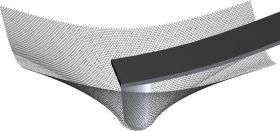
A representation of a diamond tip with a two nanometer radius indenting into a single atomic sheet of graphene.

(PhysOrg.com) -- Research scientists at Columbia University’s Fu Foundation School of Engineering and Applied Science have achieved a breakthrough by proving that the carbon material graphene is the strongest material ever measured.

Graphene holds great promise for the development of nano-scale devices and equipment. It consists of a single layer of graphite atoms arranged in a hexagonal lattice, similar to a honeycomb. As a two-dimensional material, every atom is exposed to the surface. It forms the basis of graphite fibers used in tennis racquets and other durable products. When rolled, very useful tiny tubes called nanotubes can be fabricated.

Until now, graphene’s estimated strength, elasticity and breaking point were based on complex computer modeling theories. Laboratory tests had been stymied because of two major experimental challenges: the complexity in mechanically grasping graphene specimens to measure their elongation under force, and the difficulty of making specimens small enough to be free of imperfections.

“Our team sidestepped the size issue by creating samples small enough to be defect-free,” said Columbia Professor Jeffrey Kysar.

The studies were conducted by postdoctoral researcher Changgu Lee and graduate student Xiaoding Wei, in the research groups of mechanical engineering professors Kysar and James Hone. The findings are published in the latest issue of Science.

“Our research establishes graphene as the strongest material ever measured, some 200 times stronger than structural steel,” Hone said. “It would take an elephant, balanced on a pencil, to break through a sheet of graphene the thickness of Saran Wrap.”

The team culled microscopic graphene samples, in which every single atom is on the surface, from larger graphite crystals. These newly created, two-dimensional samples were then placed over small circular holes etched in silicon to create miniature circular films only one atom thick. The graphene adhered to the silicon because of the attraction between their atoms.

The scientists tested the strength of the films by pushing on their centers with a diamond-tipped atomic force microscope with a radius of 20 billionths of a meter. The absence of flaws in the samples, each about one micron in diameter (one percent of the width of a human hair), enabled the scientists to test both elasticity and breaking point properties. The scientists collected more than 67 test values on 23 separate films.

“Until now, there’s been no definitive set of experiments that people can use to validate or invalidate the computer simulations that model the mechanical properties of materials at strains literally up to the breaking point, ” said Kysar. “It’s important because this is a fundamental parameter for all types of materials.

“The Air Force wants to introduce new materials within a five-year cycle, versus 20 years now, so being able to predict the mechanical behavior of how a new material will fail under the most extreme circumstances will make it much less expensive and less time consuming to develop, and with better materials for everyday life.”

“Though the strength of any practical material is still limited by many types of defects, the research can lead to a better understanding of the behavior of materials at extreme conditions, such as [those that] exist near the tip of a crack,” said Hone. “This can in turn lead to far more robust materials, ones more resistant to oxidation and fatigue. Achieving a better understanding of how materials fail allows us to design and create newer, safer materials, and ultimately to build a safer, more efficient environment for us.”

Proveded by Columbia University


print this article email this article download pdf blog this article bookmark this article     Stumble it Digg this share on Facebook retweet share on Reddit add to delicious
Rate this story - 4.7 /5 (46 votes)

Rank Filter

Move the slider to adjust rank threshold, so that you can hide some of the comments.


Display comments: newest first

  • JerryPark - Jul 22, 2008
    • Rank: not rated yet
    Could we actually build a beanstalk with graphene as the cable material?
  • mrlewish - Jul 22, 2008
    • Rank: 3.7 / 5 (3)
    Sorry no. This is just for measuring and comparing computer models to the real world. They can now adjust their computer models to better reflect the real world. Nothing more.
  • agg - Jul 22, 2008
    • Rank: 2 / 5 (1)
    Is there a chance the stalk could bend? Not one your life my Hindu friend.
  • D666 - Jul 22, 2008
    • Rank: 4.5 / 5 (2)
    I wish they'd indicated how the elasticity measurements came out. It'd be interesting to know if that Saran Wrap film would actually hold up the elephant, or whether it'd just stretch until the elephant hit the floor.
  • Mercury_01 - Jul 22, 2008
    • Rank: 4 / 5 (1)
    Is graphene always one atom thick, so that the saran wrap thickness would be multiple layers, or can this latice extend into 3 dimentions? Do you have to make a composite material to get any thickness for stuctural engineering?
  • Latrosicarius - Jul 22, 2008
    • Rank: 2 / 5 (1)
    "graphite atoms", hmm?
  • Arikin - Jul 22, 2008
    • Rank: not rated yet
    If only we could extend the size of these sheets. Or at least combine them without losing their strength. Imagine building materials made of this.
  • jeffsaunders - Jul 23, 2008
    • Rank: 2.8 / 5 (4)
    Grapene is defined as being one atom thick therefore your could not possible have graphene with the thickness of saren wrap (whatever that is).

    Graphene has its thickness - the thickness of graphene.

    So stating that graphene the thickness of something else is about as much nonsense as saying you could get an elephant to balance on the end of a pencil in real life.

  • superhuman - Jul 23, 2008
    • Rank: 4 / 5 (1)
    Sheets can be combined to form bulk material it will be a single crystal defect free graphite, it's strength in the Z axis will be relatively poor though. We could add special cross-linkers but that would require even more advanced nano technology.

    It should soon (5-15 years) be possible to make large defect free graphene and graphite carbon sheets, though their price will be astronomical at first.
  • warmer - Jul 23, 2008
    • Rank: not rated yet
    What I really want to know is whether that's a sharpened pencil, or a pencil with a rounded end...

    I am sure the thickness of Saran wrap was detailed based on multiplying the atomic width until you reached that thickness and then translating that into a pressure per square inch measurement.

    Does graphene increase it's strength like wood does when you alter it's grain like in plywood? Probably not unless you are precisely crossing it's lattice.

  • nano999 - Jul 23, 2008
    • Rank: not rated yet
    Neil Farbstein is at it again I see. Why is your website so bad?
  • ShadowRam - Jul 23, 2008
    • Rank: not rated yet
    Grapene is defined as being one atom thick therefore your could not possible have graphene with the thickness of saren wrap (whatever that is).
    Graphene has its thickness - the thickness of graphene.
    So stating that graphene the thickness of something else is about as much nonsense as saying you could get an elephant to balance on the end of a pencil in real life.


    I guess you missed the point that it was just a comparison for the laymen reader? and they weren't actually suggesting that graphene could be that thick?
  • googleplex - Jul 23, 2008
    • Rank: not rated yet
    The primary use for graphene is to create carbon nano tubes. These could then be woven into cables. Thus enabling space elevator. This reduces geostationary launch cost from 10,000 $/Kg to 10. It also enables extra terrestrial solar power.
  • Mercury_01 - Jul 23, 2008
    • Rank: 4.7 / 5 (3)
    Well neil, as soon as you figure out how to make me a sheet of woven graphene, Ill build you an airplane out of it, and you can fly off to smarty pants land.
  • warmer - Jul 23, 2008
    • Rank: not rated yet
    The primary use for graphene is to create carbon nano tubes.


    These aren't currently being made of graphene, but grown on a substrate like grass. The problem with making them out of rolled up Graphene is getting them to stick together at the seam.

    These could then be woven into cables. Thus enabling space elevator.


    They are looking at making a Graphene ribbon, a cable is not part of the plan.

    It also enables extra terrestrial solar power.


    How does Graphene enable extra terrestrial solar power?
  • Mercury_01 - Jul 23, 2008
    • Rank: not rated yet
    If graphene were 3 dimentional, would that be a diamond?
  • superhuman - Jul 23, 2008
    • Rank: 2 / 5 (1)
    In diamond each carbon atom is connected to 4 others while in graphene to 3 others, that leads to very different electronic configuration and properties.
    Nanotubes are a 3d form of graphen.
  • Star_Gazer - Jul 25, 2008
    • Rank: not rated yet
    and its all good old coal!
  • malapropism - Jul 27, 2008
    • Rank: 5 / 5 (1)
    Hi Neil, I might have a major scientific discovery to announce soon also; then again I might not, and my research has also yet to commence.

    Would you please refrain from making such nonsensical pronouncements in these forums. If your company was publicly traded I could understand it but then I'd be suspicious that you were ramping...

    Thank you.
  • googleplex - Jul 29, 2008
    • Rank: not rated yet
    How does Graphene enable extra terrestrial solar power?

    What I was trying to say is that like nano tubes, graphene might be a material that can be engineered into a space elevator cable or ribon as you corrected.
    My point is that once the space elevator is available then space mirrors/photovoltaics etc become affordable. If the cable is a good conductor then it can be used as a power transmission line.
    There are obstacles - literally. I recall that the experimental space tether was severed by space junk!
  • NeilFarbstein - Aug 13, 2008
    • Rank: 1 / 5 (1)
    There is something intermediate between graphene sheets and nanotubes. They are called nanoscrolls and they were invented by Ric Kaner at UCLA. When graphene platelets are treated with ultrasound they roll up into little scrolls that resemble nanotubes without the capped ends. There's nothing else that can do that when the rubber is wet! Or to oral mucosa.

    As far as malapropisms stupid parody of my "pronouncements." You should recall my webpage says Vulvox has a patented technology
    and we show pictures of our novel material clinging to soft rubber.
  • NeilFarbstein - Aug 13, 2008
    • Rank: 1 / 5 (1)
    Well neil, as soon as you figure out how to make me a sheet of woven graphene, Ill build you an airplane out of it, and you can fly off to smarty pants land.
    Well neil, as soon as you figure out how to make me a sheet of woven graphene, Ill build you an airplane out of it, and you can fly off to smarty pants land.


    You might be interested to know that the Air Force is planning to fund a research project at Vulvox-on high strength nanotube composites.
  • NOM - Aug 27, 2008
    • Rank: not rated yet
    Well neil, as soon as you figure out how to make me a sheet of woven graphene, Ill build you an airplane out of it, and you can fly off to smarty pants land.
    Well neil, as soon as you figure out how to make me a sheet of woven graphene, Ill build you an airplane out of it, and you can fly off to smarty pants land.


    You might be interested to know that the Air Force is planning to fund a research project at Vulvox-on high strength nanotube composites.


    If there was any truth to that claim Farbstein, you will soon be in jail when the Air Force finds out how non-existant your company, and all its so-called breakthroughs, is.

    Face it Farbstein, your fraudulent lies are coming back to haunt you. You have never developed anything. You are a phony. You are a liar. You are a fraud. You belong in jail for trying to rip off investors.
  • jpr0 - Sep 14, 2008
    • Rank: not rated yet
    Nanotubes are a 3d form of graphen.


    Nanotubes are 1D, Graphene is 2D, Buckyballs are 0D.
  • Soylent - Sep 25, 2008
    • Rank: not rated yet
    and its all good old coal!


    Carbon, not coal.

July 22, 2008 all stories

Comments: 25

4.7 /5 (46 votes)
  • Stumble this up

  • Digg this

  • share this

  • hide
  • Related Stories

  • Capturing those in-between moments: Researchers solves timing problem in molecular modeling
    created Nov 04, 2009 | popularity not rated yet | comments 0
  • Physicist wins Packard Fellowship
    created Oct 16, 2009 | popularity not rated yet | comments 0
  • Physicists discover novel electronic properties in two-dimensional carbon structure
    created Oct 14, 2009 | popularity not rated yet | comments 0
  • How Perfect Can Graphene Be?
    created Oct 13, 2009 | popularity not rated yet | comments 0
  • Graphite mimics iron's magnetism
    created Oct 04, 2009 | popularity not rated yet | comments 0


  • hide
  • Relevant PhysicsForums posts

  • Polymer Properties Question
    created 11 hours ago
  • Fatigue Properties of Chinese steel
    created Nov 04, 2009
  • Finding Hardness values
    created Nov 04, 2009
  • Fluid flow, pressure drop simulation in Comsol
    created Nov 04, 2009
  • More from Physics Forums - Materials & Chemical Engineering

Other News

Findings show nanomedicine promising for treating spinal cord injuries

Findings show nanomedicine promising for treating spinal cord injuries

Nanotechnology / Bio & Medicine

created 19 hours ago | popularity 4.5 / 5 (4) | comments 0

(PhysOrg.com) -- Researchers at Purdue University have discovered a new approach for repairing damaged nerve fibers in spinal cord injuries using nano-spheres that could be injected into the blood shortly ...


New Digital 'Electronics' Concept May Continue Moore's Law

New Digital 'Electronics' Concept May Continue Moore's Law

Nanotechnology / Nanophysics

created Nov 05, 2009 | popularity 4.6 / 5 (55) | comments 9

(PhysOrg.com) -- Computers of the future could be operating not on electrons, but on tiny waves traveling through an electron "fluid," if a new proposal is successful. The new circuit design, recently introduced ...


Nanoparticles for gene therapy improve

Nanoparticles for gene therapy improve

Nanotechnology / Bio & Medicine

created Nov 06, 2009 | popularity 5 / 5 (4) | comments 3

(PhysOrg.com) -- About five years ago, Professor Janet Sawicki at the Lankenau Institute in Pennsylvania read an article about nanoparticles developed by MIT's Robert Langer for gene therapy, the insertion ...


Breakthrough in industrial-scale nanotube processing

Breakthrough in industrial-scale nanotube processing

Nanotechnology / Nanomaterials

created Nov 02, 2009 | popularity 4.9 / 5 (20) | comments 3

(PhysOrg.com) -- Rice University scientists today unveiled a method for the industrial-scale processing of pure carbon-nanotube fibers that could lead to revolutionary advances in materials science, power ...


Nanoparticles may cause DNA damage across a cellular barrier

Nanoparticles may cause DNA damage across a cellular barrier

Nanotechnology / Bio & Medicine

created Nov 05, 2009 | popularity 4.3 / 5 (9) | comments 1

(PhysOrg.com) -- Scientists have shown in the laboratory that metal nanoparticles damaged the DNA in cells on the other side of a cellular barrier. The research, by the University of Bristol, is published ...