Research puts finger on virtual iPhone button
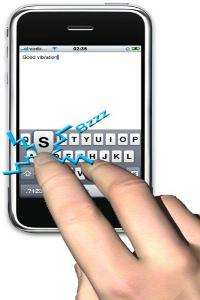
(PhysOrg.com) -- A virtual tactile keyboard could hold the key to making the iPhone easier to use.
The inclusion of a touchscreen keypad in place of a physical keyboard on the iPhone has enabled the manufacturer to incorporate a larger screen which means a better display of videos, web pages and games. However, without being able to feel when a button is selected users often experience a high level of errors, particularly when inputting text.
Now researchers are using tiny vibrations to imitate the feel of a button when a user touches the keypad. The user will be able to feel the edges of each key so will be able to identify where each key is without checking visually.
Researcher Eve Hoggan, from the University of Glasgow’s Department of Computing Science, said: “We found that, compared to a standard keyboard, touchscreen keypads were less accurate in terms of text input. Without being able to identify through touch when a key had been selected there was a significant increase in errors made. When in a rush it can be very time consuming to check each character has been entered correctly and is particularly difficult when travelling. Feedback through the finger is more natural and the brain can process it faster than visual feedback. By providing tactile feedback we will bring the iPhone keypad close to the performance of a real physical keyboard.”
As users run their fingers over the keypad a wave of vibration is triggered signifying a smooth rounded button. When the key is selected and released different vibration patterns give the user the feel of a key snapping back into place.
Co-researcher Malcolm Hall added: “The idea we have developed is very simple to apply because the vibration technology is already included in the iPhone. This technology is also not only restricted to the iPhone but can be applied to a range of other phones and electronic devices.”
The software can be trialled on the research team website: iphone-haptics.googlecode.com .
Provided by University of Glasgow


