Researcher shows evolution of milkweed defense system
July 22, 2008 Researcher shows evolution of milkweed defense system

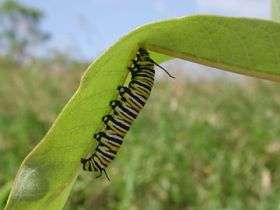
A monarch butterfly caterpillar gets ready to devour a milkweed leaf. Before feeding, the caterpillar disarms the plant's natural defense system by cutting the milkweed's veins that deliver a toxic and sticky latex. Credit: Anurag Agrawal

(PhysOrg.com) -- The adage that your enemies know your weaknesses best is especially true in the case of plants and predators that have co-evolved: As the predators evolve new strategies for attack, plants counter with their own unique defenses.

Milkweed is the latest example of this response, according to Cornell research suggesting that plant may be shifting away from elaborate defenses against specialized caterpillars toward a more energy-efficient approach. Genetic analysis reveals an evolutionary trend for milkweed plants away from resisting predators to putting more effort into repairing themselves faster than caterpillars -- particularly the monarch butterfly caterpillar -- can eat them.

"An important question with co-evolution is where does it end?" said Anurag Agrawal, Cornell associate professor of ecology and evolutionary biology and lead author of a paper in the current issue of the Proceedings of the National Academy of Sciences. "One answer is when it becomes too costly. Some plants seem to have shifted away from resisting herbivory [plant eating] and have taken that same energy and used it to repair themselves."

The paper is important because it sheds light on key theories of co-evolution, claiming that pressure by foraging insects makes plants diversify as they evolve new defensive strategies and that such diversification follows trends in one direction or another, said Agrawal.

Milkweed species have evolved elaborate resistance strategies to fight off caterpillars that eat their leaves. These include hairs on their leaves, heart poisons called cardenolides in their tissues and milky-white toxic latex that pours from the plants' tubes. A caterpillar's bite into a milkweed leaf leads to a flood of latex that is "like getting a gallon of sticky paint thrown into your face," said Agrawal.

Some caterpillars, in turn, have adapted by shaving the leaf, cutting a leaf's veins in a circle and then eating in the middle where the latex doesn't flow. Also, the monarch caterpillar has become immune to the cardenolides.

Using DNA sequence data to look at relationships between 38 species of milkweed, Agrawal and colleague Mark Fishbein, a Portland State University biologist, found evolutionary declines in milkweed's three most important resistance traits (hairs, cardenolides and latex) and an escalation in the plant's ability to regrow.

Agrawal was surprised, he said, to find that the plant became more tolerant rather than more diverse in its defenses. The reason, he speculated, could be because as its predators have become so specialized, the plant was better off choosing a new defensive tactic "to tolerate the herbivory damage instead of resisting it." It is unknown whether such strategies have also evolved in animals trying to evade parasites.

The findings address questions about plant evolution, biodiversity and keystone species and may give plant scientists clues about profitable pest control strategies.

Provided by Cornell University


print this article email this article download pdf blog this article bookmark this article     Stumble it Digg this share on Facebook retweet share on Reddit add to delicious
Rate this story - 4.2 /5 (9 votes)

Rank Filter

Move the slider to adjust rank threshold, so that you can hide some of the comments.


Display comments: newest first

  • no1nose - Jul 22, 2008
    • Rank: not rated yet
    Is this really evolution? The ability to adapt doesn't sound like evolution to me.
  • axemaster - Jul 23, 2008
    • Rank: not rated yet
    Adaptation across generations through genetic changes are exactly what evolution is supposed to be.
  • victor133 - Jul 23, 2008
    • Rank: not rated yet
    It is very nice article about predators evolve new strategies for attack, plants counter with their own unique defenses. This information is very important for me. Thanks for information.
    __________________________
    victor
    Addiction Recovery South Dakota


July 22, 2008 all stories

Comments: 3

4.2 /5 (9 votes)
  • Stumble this up

  • Digg this

  • share this

  • hide
  • Related Stories

  • Butterfly experiment a prairie masterpiece in the making
    created Sep 28, 2009 | popularity not rated yet | comments 0
  • Gulf fritillary is back
    created Sep 24, 2009 | popularity not rated yet | comments 0
  • Conflict between plant and animal hormones in the insect gut?
    created Sep 14, 2009 | popularity not rated yet | comments 0
  • Study confirms classic theory on the origins of biodiversity
    created Sep 09, 2009 | popularity not rated yet | comments 0
  • NY researchers breeding rare native ladybugs
    created Sep 04, 2009 | popularity not rated yet | comments 0


Other News

W. Africa's last giraffes make surprising comeback (AP)

China sends panda expert to Taiwan to aid breeding

Biology / Plants & Animals

created 4 hours ago | popularity not rated yet | comments 0

(AP) -- Nothing like a little time apart to rekindle the affections that could lead to a baby panda.


W. Africa's last giraffes make surprising comeback (AP)

W. Africa's last giraffes make surprising comeback

Biology / Ecology

created 4 hours ago | popularity not rated yet | comments 0

(AP) -- A crisp African dawn is breaking overhead, and Zibo Mounkaila is on the back of a pickup truck bounding across a sparse landscape of rocky orange soil.


Prized mushroom collection returns to China

Biology / Plants & Animals

created 23 hours ago | popularity 4.5 / 5 (2) | comments 0

(AP) -- A Chinese scholar persecuted during the Cultural Revolution for smuggling a rare collection of mushrooms out of China before World War II was honored Saturday when the collection was returned more than 70 years later.


Laser etching safe alternative for labeling grapefruit

Laser etching safe alternative for labeling grapefruit

Biology / Other

created Nov 03, 2009 | popularity 4.4 / 5 (14) | comments 8

Laser labeling of fruit and vegetables is a new, patented technology in which a low-energy carbon dioxide laser beam is used to label, or "etch" information on produce, thereby eliminating the need for common ...


Sea lions killed, but Columbia salmon toll rises (AP)

Sea lions killed, but Columbia salmon toll rises

Biology / Ecology

created 23 hours ago | popularity not rated yet | comments 1

(AP) -- Killing or removing 25 California sea lions over the past two years has not reduced the toll on salmon at the base of Bonneville Dam in the Columbia River.