Gammasphere on a roll
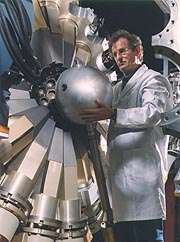
Gammasphere, the world's most sensitive gamma-ray detector, is already a seasoned traveler, having crossed the United States from Lawrence Berkeley National Laboratory to Argonne by truck, but the 20-ton instrument has recently gone truly mobile and can now be moved around the experiment hall in Argonne-East's Building 203 to meet the needs of physicists.
Previously, Gammasphere was rooted to a spot between an instrument called the Fragment Mass Analyzer (FMA) and a beamline from ATLAS, the Argonne Tandem Linac Accelerator System. Now, with a couple of days' work, Gammasphere can be moved about 20 feet across the floor to a different beamline.
"The ability to move Gammasphere gives the user community a substantial amount of flexibility,” said Kim Lister, who leads the Low Energy Research Group in Argonne's Physics Division. “Gammasphere can be an impediment to some kinds of experiments that require the FMA, and vice-versa.”
“The things we're looking for with the FMA are so exotic, they may be produced only once every couple of hours,” Lister said. “And you can't just crank up the beam intensity to make more as that would probably damage the sensitive Gammasphere detectors.”
________________________________________________________________
What is Gammasphere?
Gammasphere is the world’s most powerful spectrometer for nuclear structure research and is especially good at collecting gamma ray data following the fusion of heavy ions.
Gammasphere was built by a consortium of scientists from national laboratories and many universities. The project was coordinated by scientists at Lawrence Berkeley National Laboratory, where the device was first assembled. It consists of 110 high-purity germanium detectors, each about the size of a coffee cup, in a spherical arrangement.
Beams of ions from the Argonne Tandem Linac Accelerator System, or ATLAS, are directed at targets (usually a thin metal film). Nuclei from the beam fuse with those in the target, producing highly excited, much heavier nuclei. Gammasphere detects gamma rays — high-energy light particles — emitted from the excited nuclei as they spin and cool.
Gammasphere first moved from Lawrence Berkeley to Argonne in the fall of 1997 and returned to Argonne again in 2003. At Argonne, Gammapshere research has centered on stydying nuclei far from stability.
________________________________________________________________
Moving Gammasphere away from the FMA also allows experimenters to use new kinds of auxilliary detectors in conjunction with the device, or make existing instruments easier to use. For example, Gammasphere was recently used in combination with the Compact Heavy Ion Counter, or CHICO. Designed and built by researchers at the University of Rochester's Nuclear Structure Research Laboratory specifically for use with Gammasphere, CHICO sat in the center of Gammasphere to measure the mass and scattering angles of heavy ions while Gammasphere sought out the gamma rays they emitted. In Gammasphere's previous position, wedged between a concrete wall and the FMA, the skills of a contortionist were required to install and adjust CHICO. In the new location, CHICO was accessible from almost any angle.
Mechanical engineer Bruce Zabransky and chief technician John Rohrer, both of Argonne's Physics Division, conducted much of the planning and preparation for Gammasphere's first trek across the experiment hall. Planning for the first move included building an exact scale model of the experiment hall floor and the obstacles Gammasphere had to avoid. A forest of data cables and liquid-nitrogen lines had to be disconnected, and without these lifelines, the relocation team had only a few hours to move Gammas phere. If the germanium crystals are allowed to warm above a certain point, Gammasphere loses a significant level of its energy resolution and selectivity for rare events.
“The only remedy is to anneal the detectors, which involves taking them all out and baking them in our annealing factory,” Lister said. “The whole process would take about three months.” Rolling on heavy-duty industrial casters across a steel-plate “dance floor” that provided a smooth rolling surface, Gammasphere made its way 20 feet to a new location in front of the old APEX beamline. The move required about eight hours and a crew of 20 to complete.
Lister said Gammasphere will probably move back and forth across the experiment hall once a year or so. The scheduling will depend on the needs of the user community.
Gammasphere will be a major asset for research with the proposed Rare Isotope Accelerator (RIA) in the future, where its efficiency and high resolution will have great importance.
RIA will enable broad-based physics research with intense, high-quality energetic beams of short-lived isotopes of all chemical elements from the very lightest to the very heaviest. The isotopes will be available over a range of energies, from thousands of electron volts per particle for radioactive decay studies and trapping, through millions of electron volts (MeV) for astrophysics, to tens of MeV for reactions studies and hundreds of MeV for fast fragment physics. Gammasphere is optimised for the lower energy studies, where it will remain an important tool.
Gammasphere's unique sensitivity will enhance research in several of RIA's target areas, Lister said, so it's likely to move from beamline to beamline once or twice a year at RIA just as it now does at ATLAS. — Dave Jacqué
The nation's first national laboratory, Argonne National Laboratory conducts basic and applied scientific research across a wide spectrum of disciplines, ranging from high-energy physics to climatology and biotechnology. Since 1990, Argonne has worked with more than 600 companies and numerous federal agencies and other organizations to help advance America's scientific leadership and prepare the nation for the future. Argonne is operated by the University of Chicago for the U.S. Department of Energy's Office of Science.
Source: Argonne National Laboratory


