Study suggests human visual system could make powerful computer
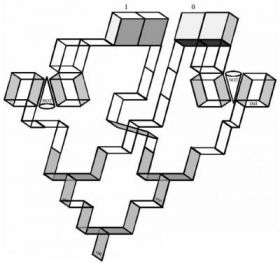
Since the idea of using DNA to create faster, smaller, and more powerful computers originated in 1994, scientists have been scrambling to develop successful ways to use genetic code for computation. Now, new research from a professor at Rensselaer Polytechnic Institute suggests that if we want to carry out artificial computations, all we have to do is literally look around.
Assistant Professor of Cognitive Science Mark Changizi has begun to develop a technique to turn our eyes and visual system into a programmable computer. His findings are reported in the latest issue of the journal Perception.
Harnessing the computing power of our visual system, according to Changizi, requires visually representing a computer program in such a way that when an individual views the representation, the visual system naturally carries out the computation and generates a perception.
Ideally, we would be able to glance at a complex visual stimulus (the software program), and our visual system (the hardware) would automatically and effortlessly generate a perception, which would inform us of the output of the computation, Changizi said.
Changizi has begun successfully applying his approach by developing visual representations of digital circuits. A large and important class of computations used in calculators, computers, phones, and most of today's electronic products, digital circuits are constructed from assemblies of logic gates, and always have an output value of zero or one.
"A digital circuit needs wire in order to transmit signals to different parts of the circuit. The 'wire' in a visual representation of a digital circuit is part of the drawing itself, which can be perceived only in two ways," said Changizi, who created visual stimuli to elicit perceptions of an object tilted toward (an output of one) or away (an output of zero) from the viewer. "An input to a digital circuit is a zero or one. Similarly, an input to a visual version of the circuit is an unambiguous cue to the tilt at that part of the circuit."
Changizi used simple drawings of unambiguous boxes as inputs for his visually represented digital circuits. The positioning and shading of each box indicates which direction the image is tilted.
He also created visual representations of the logic gates NOT, which flips a circuit's state from 0 to 1 or vice versa; OR, which outputs 1 if one or both inputs are 1; and AND, which outputs 1 only if both inputs are 1.
"Visually represented NOT gates flip a box's perceived tilt as you work through a circuit, and OR gates are designed with transparency cues so that the elicited perception is always that the box is tilted toward you, unless overridden," Changizi said. "The AND gate is similarly designed with transparency cues, but contrary to the OR gate, it will always favor the perception that it is tilted away from you."
By perceptually walking through Changizi's visual representation of a digital circuit, from the inputs downward to the output, our visual system will naturally carry out the computation so that the "output" of the circuit is the way we perceive the final box to tilt, and thus a one or zero.
"Not only may our visual system one day give DNA computation a run for its money, but visual circuits have many potential advantages for teaching logic," Changizi said. "People are notoriously poor logical reasoners — someday visual circuits may enable logic-poor individuals to 'see their way' through complex logical formulae."
Although Changizi's visual stimuli are successful at eliciting viewer perception, he says there are still serious difficulties to overcome. The visual logic gates do not always transmit the appropriate perception at the output, and it can be difficult to perceive one's way through these visual circuits, although Changizi argues we may have to train our visual system to work through them, similar to the way we need to be taught to read.
Additionally, building larger circuits will require smaller or more specialized visual circuit components.
"My hope is that other perception and illusion experts will think of novel visual components which serve to mimic some digital circuit component, thereby enriching the powers of visual circuits," Changizi said.
Source: Rensselaer Polytechnic Institute


