'Nanonet' circuits closer to making flexible electronics reality
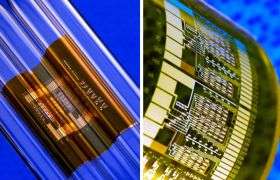
Researchers have overcome a major obstacle in producing transistors from networks of carbon nanotubes, a technology that could make it possible to print circuits on plastic sheets for applications including flexible displays and an electronic skin to cover an entire aircraft to monitor crack formation.
The so-called "nanonet" technology - circuits made of numerous carbon nanotubes randomly overlapping in a fishnet-like structure - has been plagued by a critical flaw: The network is contaminated with metallic nanotubes that cause short circuits.
The discovery solves this problem by cutting the nanonet into strips, preventing short circuits by breaking the path of metallic nanotubes.
"This is a fundamental advance in how nanotube circuits are made," said Ashraf Alam, a professor of electrical and computer engineering at Purdue University. He is working with Kaushik Roy, Purdue's Roscoe H. George Professor of Electrical and Computer Engineering, and doctoral students Ninad Pimparkar and Jaydeep P. Kulkarni.
Researchers at the University of Illinois at Urbana-Champaign led experimental laboratory research to build the circuits, and Purdue led research to develop and use simulations and mathematical models needed to design the circuits and to interpret and analyze data.
Findings will be detailed in a research paper appearing in the journal Nature on July 24. The paper was written by the Purdue engineers and University of Illinois researchers : John A. Rogers, Founder Professor of Materials Science and Engineering and a professor of chemistry; Moonsub Shim, Racheff Assistant Professor of Materials Science and Engineering; and doctoral students Qing Cao, Hoon-sik Kim and Congjun Wang.
"These findings represent the culmination of four years of collaborative efforts between the Illinois and Purdue groups," Rogers said. "The work established the fundamental scientific knowledge that led to this particular breakthrough and the ability to make circuits."
The nanonets are made of tiny semiconducting cylinders called single walled carbon nanotubes. Metallic nanotubes form unavoidably during the process of making carbon nanotubes. These metal tubes then link together in meandering threads that eventually stretch across the width of the transistor, causing a short circuit.
"Other researchers have proposed eliminating the metallic nanotubes," Rogers said. "Instead, we found a very nice way of essentially removing the effect of these metallic nanotubes without actually eliminating them."
The researchers created a flexible circuit containing more than 100 transistors, the largest nanonet ever produced and the first demonstration of a working nanonet circuit, Alam said.
"Now there is no fundamental reason why we couldn't develop nanonet technologies," he said. "If you can make a flexible circuit with 100 transistors, you can make circuits with 10,000 or more transistors."
The advance may allow researchers to use carbon nanotube transistors to create high-performance, shock-resistant, lightweight and flexible integrated circuits at low cost, Alam said.
A key advantage of the nanonet technology is that it can be produced at low temperatures, enabling the transistors to be placed on flexible plastic sheets that would melt under the high temperatures required to manufacture silicon-based transistors, he said.
Possible applications include an electronic skin that covers an aircraft and automatically monitors the formation of cracks to alert technicians and prevent catastrophic failures.
Such shape-conforming electronics are not possible using conventional silicon-based circuits, which are manufactured on rigid wafers or glass plates.
"Now electronics are flat, which limits their utility since most objects in real life are not flat," Roy said.
Flexible displays could be integrated into automotive windshields to provide information for drivers. Other potential applications include "electronic paper" that displays text and images, solar cells that could be printed on plastic sheets and television screens capable of being rolled up for transport and storage.
"For these types of applications, manufacturers might literally print, or stamp, circuits onto plastic sheets, like the roll-to-roll printing used to print newspapers," Alam said.
Conventional circuits for flat-panel televisions contain transistors made of materials called polysilicon or amorphous silicon, which cannot be used in flexible applications.
Nanonet transistors are promising for so-called macroelectronics because they are best suited for large-scale applications, but these transistors may not be as well suited for the requirements of microelectronic circuits, such as those in computer chips, Alam said.
The nanotubes are arranged randomly and overlap each other like tiny needles. If the nanonet area is large enough, the overlapping metallic nanotubes will eventually form a meandering string across the entire transistor, causing a short circuit. But if the device is segmented into strips, this meandering path of metallic rods is cut at the point where the lines separate one strip from another, preventing short circuits.
The metallic nanotubes make up about one-third of the nanotubes in the transistor. Because the carbon nanotubes are twice as numerous as the metallic tubes, enough of them exist to form a complete circuit. The models and simulations are needed to tell researchers precisely how wide to make the strips so that the pathway of metallic tubes is cut but the carbon nanotubes complete their circuit.
"The theory and simulation work done at Purdue shows there is always a way to break the metallic path and still keep the semi conducting carbon-nanotube path intact," Alam said. "The teams at Illinois and Purdue continuously provide insights about why things work the way they do and how to make them work better through combined modeling and experimental efforts."
Each nanonet transistor consists of numerous strips of nanotubes, separated bylines that are etched in place. The lines are easy to create with a standard etching process used in the semiconductor industry.
Future research may include work focusing on learning the reliability of the carbon nanotube circuits.
The research has been funded by the National Science Foundation through the Network for Computational Nanotechnology at the Birck Nanotechnology Center in Purdue's Discovery Park. The Illinois portion of the research also was funded and supported by the NSF, U.S. Department of Energy, Motorola Corp., and by the university's Frederick Seitz Materials Research Lab, the Center for Microanalysis of Materials and the Department of Chemistry.
The researchers used computers made available by a global network called the nanoHUB, an Internet-based science gateway that provides computer-based resources for research and education in the areas of nanoelectronics and nanoelectromechanical systems and their application to nano-biosystems.
"This work requires tremendous computing resources because these are not trivial calculations," Alam said.
Nanoelectronics focuses on creating a class of electronic devices containing features measured in nanometers, equivalent to one-billionth of a meter. A nanometer is about the size of 10 atoms strung together.
The Network for Computational Nanotechnology uses advanced theory and simulations to explore new ideas for digital switching devices such as innovative types of transistors that promise to help researchers create future electronics.
Source: Purdue University


