Polarizing filter allows astronomers to see disks surrounding black holes
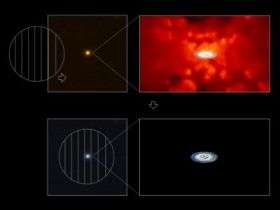
(PhysOrg.com) -- For the first time, a team of international researchers has found a way to view the accretion disks surrounding black holes and verify that their true electromagnetic spectra match what astronomers have long predicted they would be. Their work will be published in the July 24 issue of the science journal Nature.
A black hole and its bright accretion disk have been thought to form a quasar, the powerful light source at the center of some distant galaxies. Using a polarizing filter, the research team, which included Robert Antonucci and Omer Blaes, professors of physics at the University of California, Santa Barbara, isolated the light emitted by the accretion disk from that produced by other matter in the vicinity of the black hole.
"This work has greatly strengthened the evidence for the accepted explanation of quasars," said Antonucci.
According to Antonucci, the physical process that astronomers find most appealing to explain a quasar's energy source and light production involves matter falling toward a supermassive black hole and swirling around in a disk as it makes its way to the event horizon - the spherical surface that marks the boundary of the black hole. In the process, friction causes the matter to heat up such that it produces light in all wavelengths of the spectrum, including infrared, visible, and ultraviolet. Finally, the matter falls into the black hole and thereby increases the black hole's mass.
"If that's true, we can predict from the laws of physics what the electromagnetic spectrum of the quasar should be," said Antonucci. But testing the prediction has been impossible until now because astronomers have not been able to distinguish between the light emanating from the accretion disk and that of dust particle and ionized gas clouds in the area of the black hole.
By attaching a polarizing filter to the United Kingdom Infrared Telescope (UKIRT) on Mauna Kea in Hawaii, the research team, led by Makoto Kishimoto, an astronomer with the Max-Plank Institute for Radio Astronomy in Bonn, and a former postdoctoral fellow at UCSB, eliminated the extraneous light and was able to measure the spectrum of the accretion disk. Doing so, they demonstrated that the spectrum matches what previously had been predicted. The researchers also used extensive data gathered from the polarization analyzer of the Very Large Telescope, an observatory in Chile that is operated by the European Space Observatory.
What makes the polarizing filter able to perform its magic is the fact that direct light is not polarized - that is, it has no preference in terms of the directional alignment of its electrical field. The accretion disk emanates direct light, as do the dust particles and ionized gas. However, a small amount of light from the accretion disk, which is the exact light the researchers want to study, reflects off gas located very close to the black hole. This light is polarized.
"So if we plot only polarized light, it's as if the additional light isn't there and we can see the true spectrum of the accretion disk," Antonucci said. "With this knowledge we have a better understanding of how black holes consume matter and expand."
Studying the spectrum of a glowing object such as a quasar provides astronomers with an incredible amount of valuable information about its properties and processes, Antonucci noted. "Our understanding of the physical processes in the disk is still rather poor, but now at least we are confident of the overall picture," he said.
Provided by University of California - Santa Barbara


