Phoenix Completes Longest Work Shift
July 23, 2008 Phoenix Completes Longest Work Shift

Enlarge

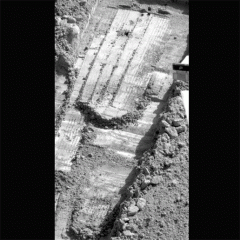
This animation combines two images of the trench informally named "Snow White" taken by the Surface Stereo Imager. Image credit: NASA/JPL-Caltech/University of Arizona/Texas A&M University

(PhysOrg.com) -- Phoenix early Tuesday finished its longest work shift of the mission. The lander stayed awake for 33 hours, completing tasks that included rasping and scraping by the robotic arm, in addition to atmosphere observations in coordination with simultaneous observations by NASA's Mars Reconnaissance Orbiter.

"Our rasping test yesterday gave us enough confidence that we're now planning for the next use of the rasp to be for acquiring a sample to be delivered to TEGA," said Phoenix project manager Barry Goldstein of NASA's Jet Propulsion Laboratory, Pasadena, Calif. TEGA is Phoenix's Thermal and Evolved-Gas Analyzer, an instrument that heats samples in small ovens and uses a mass spectrometer to study the vapors driven off by the heating.

As preparation for that sample delivery in coming days, the Phoenix team developed plans to command the lander Tuesday evening to conduct 80 scrapings of the bottom of a trench informally named "Snow White." The scraping is designed to freshly expose frozen material and ready the surface for using the rasp.

Provided by NASA


print this article email this article download pdf blog this article bookmark this article     Stumble it Digg this share on Facebook retweet share on Reddit add to delicious
Rate this story - 3.8 /5 (6 votes)


July 23, 2008 all stories

Comments: 0

3.8 /5 (6 votes)
  • Stumble this up

  • Digg this

  • share this

  • hide
  • Related Stories

  • Next Mars Soil Scoop Slated for Last of Lander's Wet Lab Cells
    created Sep 10, 2008 | popularity not rated yet | comments 0
  • Phoenix Mars Lander Working With Sticky Soil
    created Jul 29, 2008 | popularity not rated yet | comments 0
  • Phoenix Revises Method to Deliver Icy Sample
    created Jul 28, 2008 | popularity not rated yet | comments 0
  • Trench on Mars Ready for Next Sampling by NASA Lander
    created Jul 24, 2008 | popularity not rated yet | comments 0
  • Phoenix Mars Lander Continues Tests With Rasp
    created Jul 18, 2008 | popularity not rated yet | comments 0


  • hide
  • Relevant PhysicsForums posts

  • Question about 2-body gravity
    created Nov 24, 2009
  • life on Mars
    created Nov 24, 2009
  • Semi-major axis from cartesian co-ordinates
    created Nov 23, 2009
  • Primary Mirror grinding
    created Nov 23, 2009
  • More from Physics Forums - General Astronomy

Other News

Monster Waves on the Sun are Real

Monster Waves on the Sun are Real (w/ Video)

Space & Earth / Astronomy

created 2 hours ago | popularity 5 / 5 (6) | comments 0

Sometimes you really can believe your eyes. That's what NASA's STEREO (Solar Terrestrial Relations Observatory) spacecraft are telling researchers about a controversial phenomenon on the sun known as the "solar ...


Cosmic 'dig' reveals vestiges of the Milky Way's building blocks

Cosmic 'Dig' Reveals Vestiges of the Milky Way's Building Blocks

Space & Earth / Astronomy

created 7 hours ago | popularity 5 / 5 (11) | comments 1

(PhysOrg.com) -- Peering through the thick dust clouds of our galaxy's "bulge" (the myriads of stars surrounding its center), a team of astronomers has unveiled an unusual mix of stars in the stellar grouping ...


No Wheel Stall in Diagnostic Drive

Spirit Mars Rover: No Wheel Stall in Diagnostic Drive

Space & Earth / Space Exploration

created 2 hours ago | popularity 5 / 5 (1) | comments 0

(PhysOrg.com) -- On Sol 2095 (Tuesday, Nov. 24), Spirit performed a set of diagnostic actions related to a stall of the right-rear wheel on the previous drive, three days earlier.


Climate experts debate strategies for reducing atmospheric carbon and future warming

Climate experts debate strategies for reducing atmospheric carbon and future warming

Space & Earth / Environment

created 2 hours ago | popularity 3.7 / 5 (3) | comments 2

(PhysOrg.com) -- Reducing carbon dioxide to safe levels may require extracting carbon from the air, says Cornell climate researcher.


Oceanic crust formation is dynamic after all

Oceanic crust formation is dynamic after all

Space & Earth / Earth Sciences

created 6 hours ago | popularity 4 / 5 (1) | comments 0

Imagine the Earth's crust as the planet's skin: Some areas are old and wrinkled while others have a fresher, more youthful sheen, as if they had been regularly lathered with lotion.