New life given to ancient Egyptian texts stored at Stanford for decades
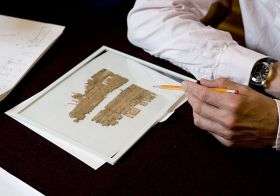
They're torn and faded and have the woven texture of a flattened Triscuit. At first glance, the ancient Egyptian texts look like scraps of garbage. And more than 2,000 years ago, that's exactly what they were—discarded documents, useless contracts and unwanted letters that were recycled into material needed to plaster over mummies, like some precursor to papier-mâché.
Now they are priceless clues to everyday life in the Ptolemaic Era, bits of history recently cleaned and sandwiched between pieces of glass so researchers at Stanford could begin translating the Greek writing and Egyptian script while studying the worn papyrus it is scribbled on.
The texts, collectively called papyri, were donated to Stanford in the 1920s by an alumnus who bought them from an antiquities dealer in London. They've been overlooked by generations of faculty who haven't focused on papyrology, said Joe Manning, an associate professor of classics.
"You cannot ignore this," said Manning, who is leaving Stanford this summer to be a professor of classics and history at Yale. "This is the raw material of history. If you're interested in social history or economic history or legal history, you need this material."
But deciphering something written on papyrus between 300 B.C. and 30 B.C. isn't easy.
About 70 texts in Stanford's collection of several hundred papyri were taken from storage and brought to the university's conservation lab in April. They were soaked in water to wash away the remains of an adhesive material applied to them for use as cartonnage—material molded into masks and panels to cover the mummified bodies of humans and animals. The texts were then mounted in thin glass frames, allowing for easy handling and close inspection. The ink, essentially a waterproof mixture of soot and resin, is faded but mostly legible.
The specimens are far from complete documents. Peeled from mummies by archaeologists and grave robbers, the once well-kept records now come with gaping holes. Many are fragments of larger pieces and offer a few hints about a transaction or contract. But there's not always enough to tell a complete story.
"I'm the one in charge of making sense of this," said John Sutherland, a Stanford graduate student puzzling over a text written in Greek, which was Egypt's official language during the Ptolemaic Era. He could make out a few names and realize the document was some type of list.
"That's about all I have now," he said. But he expects additional analysis will tell him more about Egypt's Fayoum region, where most of these texts were written. "We have such a lack of documentation about common people from this time period that you have to use every source you can get."
Sutherland is one of 18 students from 15 universities around the world working this month at Stanford to interpret some of the university's papyri and publish their findings. The group makes up the participants in this year's Papyrological Institute, an annual summer gathering of students and experts sponsored by the American Society of Papyrologists.
About $100,000 for this year's Papyrological Institute comes from Stanford's Department of Classics, the Dean of the School of Humanities and Sciences, the Social Science History Institute and the offices of the President and the Provost.
Working with modern technology to make sense of the ancient texts, the students use laptops to tap into databases of papyrological information maintained by Duke and Columbia universities. After the students enter individual words or phrases gleaned from the texts in front of them, the databases help determine whether the pieces in Stanford's collection are related to any previously published texts.
The matching system also can help put the Stanford pieces in context, revealing whether a text is a marriage certificate, land record or some other common document.
For Marja Vierros, a classicist from the University of Helsinki, one bit of misshapen and torn papyrus gave up plenty of detail.
According to her translation, the document recorded a financial transaction between Haryotes, a 65-year-old flat-faced man of medium height and honey-colored hair, and Thasies, a woman 20 years his junior whose head was shaped like a sugar loaf.
"And the scribe who wrote this was named Panas," Vierros said.
But she wasn't entirely sure if she had that part right. After all, the text was a bit faded.
Provided by Stanford University


