Circadian rhythm-metabolism link discovered
July 24, 2008 Circadian rhythm-metabolism link discovered

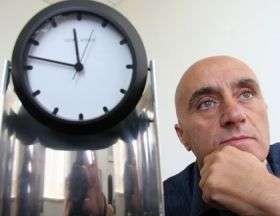
Paolo Sassone Corsi 1.

UC Irvine researchers have found a molecular link between circadian rhythms – our own body clock – and metabolism. The discovery reveals new possibilities for the treatment of diabetes, obesity and other related diseases.

Paolo Sassone-Corsi, Distinguished Professor and Chair of Pharmacology, and his colleagues have identified that an essential protein called CLOCK that regulates the body's circadian rhythms, works in balance with another protein called SIRT1 that modulates how much energy a cell uses.

"This interplay has far-reaching implications for human illness and aging, and it is likely vital for proper metabolism," said Sassone-Corsi, one of the world's leading researchers on circadian rhythms. The study appears in the July 25 issue of Cell.

Circadian rhythms of 24 hours govern fundamental physiological functions in almost all organisms. The circadian clocks are intrinsic time-tracking systems in our bodies that anticipate environmental changes and adapt themselves to the appropriate time of day.

Disruption of these rhythms can profoundly influence human health and has been linked to metabolic disorders, insomnia, depression, coronary heart diseases and cancer.

It is estimated that up to 15 percent of our genes are regulated by these circadian clocks. Sassone-Corsi identified in 2006 that the protein CLOCK is an essential molecular gear of the circadian machinery.

Now, he and his colleagues have shown that the protein SIRT1 counterbalances the function of CLOCK. Even though SIRT1's function differs from CLOCK's, the two proteins interact, creating a bond that is finely regulated in the cell.

SIRT1 senses energy levels in the cell; its activity is modulated by how many nutrients a cell is consuming. It also helps cells resist oxidative and radiation-induced stress, and for this reason SIRT1 is known to help control the process of aging.

CLOCK and SIRT1 are both part of the epigenome, which consists of proteins existing in connection with a cell's DNA that take external environmental factors and make the cell's genes behave differently, even though those genes do not structurally change.

"When this balance between these two vital proteins is upset, normal cellular function can be disrupted," Sassone-Corsi said. "Because of the role these two enzymes play, changes in our sleep patterns or our diets can directly be translated into how our cells act."

The findings also suggest that proper sleep and diet could help maintain or rebuild the CLOCK-SIRT1 equilibrium and may help explain why lack of proper rest or disruption in our normal sleep patterns is known to increase hunger, which can lead to obesity and related illnesses and can accelerate the aging process.

The specific interaction between CLOCK and SIRT1 also could lead to the development of drugs aimed at facilitating healthy metabolism, thereby helping to solve major social and medical problems such as diabetes and obesity.

Source: University of California - Irvine


Rate this story - 4.7 /5 (9 votes)

Rank Filter

Move the slider to adjust rank threshold, so that you can hide some of the comments.


Display comments: newest first

  • HenisDov - Dec 23, 2008
    • Rank: not rated yet
    Circadian Rhythm-Metabolism Link Is Self-Explanatory


    I.

    "Circadian rhythm-metabolism link discovered"
    http://esciencene...scovered

    The findings also suggest that proper sleep and diet could help maintain or rebuild the CLOCK-SIRT1 equilibrium and may help explain why lack of proper rest or disruption in our normal sleep patterns is known to increase hunger, which can lead to obesity and related illnesses and can accelerate the aging process.


    II.

    Circadian-rhythm is the genes' innate rest time,

    which - together with life's chirality - are the earliest evidences of Darwinian life evolution, the evolution of the primal, 1st stratum, Earth organisms, the genes.

    From "SC displaced more easily when off-duty"
    "It is unclear why the stem cells leave their niche during a patient's time of rest"
    [Dov Henis comment posted in TS, 2008-10-10]
    http://www.the-sc...y/55081/

    SC are more easily displaced during the organism's rest time simply because their genes and genome is off-duty then, part of the duty is to be on-call at the specific site where it is:

    "Life's Chirality And Circadian Rhythm,
    Evidence Of Updated Darwinian Evolution"


    A. Updated life's concepts:

    http://www.the-sc...page#423

    - Earth life consists of three strata: genes are primal organisms, genomes are evolved 2nd
    stratum organisms, and cellular organisms are evolved 3rd stratum.

    - Life's evolution started at genesis.

    - Life's evolution is not random. It is biased, driven by culture.


    B. Earliest evidences of updated Darwinian evolution:

    - Life's chirality
    http://www.the-sc...page#387
    http://www.physfo...ic=14988&st=180&#entry327715

    - Circadian rhythm
    http://forum.phys...ic=14988&st=135&#entry301299


    III.

    Circadian Rhythm-Metabolism Link Is Self-Explanatory, and new "findings" are not required for suggesting that proper sleep and diet could help maintain or rebuild organism's "equilibrium" and for explaining why lack of proper rest, or disruption in our normal sleep patterns, is known to
    cause several unhealthy things in us and accelerate our aging process.


    Suggesting,

    Dov Henis
    (Comments From The 22nd Century)
    http://blog.360.y...Q--?cq=1

July 24, 2008 all stories

Comments: 1

4.7 /5 (9 votes)

  • hide
  • Related Stories

  • Compound is key coordinator of clock and metabolism
    created Mar 19, 2009 | popularity not rated yet | comments 0
  • Body clock regulates metabolism
    created Mar 12, 2009 | popularity not rated yet | comments 0
  • Women With Variants in 'CLOCK' Gene Have Higher Risk of Breast Cancer
    created Feb 03, 2010 | popularity not rated yet | comments 0
  • The Medical Minute: Don't be SAD over winter blues
    created Jan 13, 2010 | popularity not rated yet | comments 0
  • Scientists show that plants have measure of the shortest day
    created Dec 23, 2009 | popularity not rated yet | comments 0


  • hide
  • Relevant PhysicsForums posts

Other News

Molecular pathways linked to sex, age affect outcomes in lung cancer

Medicine & Health / Cancer

created 32 minutes ago | popularity not rated yet | comments 0

The biology of lung cancer differs from one patient to the next, depending on age and sex, according to scientists at Duke University Medical Center. The findings may help explain why certain groups of patients do better ...


Neuroimaging study may pave way for effective Alzheimer's treatments

Medicine & Health / Neuroscience

created 47 minutes ago | popularity not rated yet | comments 0

(PhysOrg.com) -- Scientists have determined that a new instrument known as PIB-PET is effective in detecting deposits of amyloid-beta protein plaques in the brains of living people, and that these deposits are predictive ...


SFU creates portable extreme environment

Medicine & Health / Research

created 2 minutes ago | popularity not rated yet | comments 0

(PhysOrg.com) -- A Simon Fraser University lab's invention will make it easier for researchers to travel anywhere to study how extreme environments affect various populations, including the elderly, athletes and the sick.


boredom

Bored to death? It's possible

Medicine & Health / Psychology & Psychiatry

created 8 hours ago | popularity 4.1 / 5 (9) | comments 4 | with audio podcast report

(PhysOrg.com) -- Scientists from the University College London in the U.K. have found that living a life of boredom can kill you.


Anorexics found to have excess fat-- in their bone marrow

Medicine & Health / Research

created 1hour ago | popularity 5 / 5 (1) | comments 0

Boston, Mass.-- People with anorexia nervosa, paradoxically, have strikingly high levels of fat within their bone marrow, report researchers at Children's Hospital Boston. Their findings, based on MRI imaging of the knees ...