Revolutionary materials reflect ancient forms
(PhysOrg.com) -- Although order is pleasing to the eye, it can quickly become boring. In Islamic architecture therefore, decoration often follows a strict yet aperiodic pattern. Similar structures also form in certain materials, called quasicrystals.
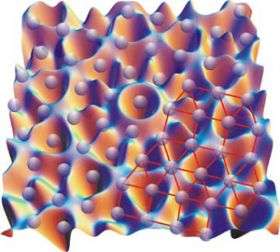
Physicists from the University of Stuttgart and the Max Planck Institute of Metals Research have succeeded in trapping a monolayer of colloidal particles, tiny plastic spheres, in a laser lattice with an aperiodic structure. How the particles arrange themselves in this lattice strongly depends on the laser power. At high intensity, the particles form a quasicrystalline pattern; at low intensities, the particles instead position themselves into a periodic crystalline arrangement.
The researchers were particularly surprised by what they observed at intermediate laser intensities: an Archimedean-like tiling combining both crystalline and quasicrystalline elements. As there are significant differences in the physical and chemical behaviour of quasicrystals and crystals, this combination of both in a single material can be expected to possess interesting and previously undiscovered characteristics. (Nature, July 24th 2008, doi: 10.1038/nature07074)
Tiles for kitchens and bathrooms are usually square or rectangular. There is a good reason for this: anyone trying to tile a bathroom with five-sided tiles will not be able to cover the wall without any gaps. This is only possible with three-, four-, or six-sided tiles. For a long time it seemed that Nature also adhered to this principle. In 1984, however, the Israeli physicist Dan Shechtman reported the first crystals whose surfaces are indeed described by tiles having pentagonal and other shapes and are as imaginative as Islamic decoration.
Now physicists at the University of Stuttgart and the Max Planck Institute of Metals Research have discovered structures that combine crystalline and quasicrystalline structural elements. They created a light lattice with a quasicrystalline structure by overlapping five laser beams. In the optical potential wells of this lattice they trapped a single layer of 3 micrometer plastic spheres floating in water that could easily be observed through a microscope.
At high laser intensities and deep wells, the light lattice forced the spheres into a quasicrystalline arrangement with pentagonal-, star-, and diamond-shaped basic elements. At low intensities, however, the negatively charged particles were barely influenced by the light lattice. Under these conditions, they position periodically with each particle surrounded by six neighbours at equal distance, behaving as the scientists had expected.
"What was actually intriguing is the structure we observed at intermediate intensities," says Clemens Bechinger, head of the 2nd Physical Institute at the University of Stuttgart and fellow at the Max Planck Institute for Metals Research. "In this case, the plastic spheres arrange strictly periodically in one direction, as in a crystal, however, perpendicular to this direction, the particles order not like in a crystal, but in a quasicrystal," explains Jules Mikhael, a doctoral student of Lebanese decent working on the project.
Evidently, the competition between the mutual particle´s interaction and that with the light field results in an intermediate structure which exhibits both crystalline and quasicrystalline properties. There are clearly recognizable bands of squares that are separated by randomly arranged single and double rows of equilateral triangles in an aperiodic rhythm.
This structure is similar to a specific Archimedean tiling, as first mentioned by Archimedes and fully characterized by Johannes Kepler in 1619. Archimedean tiles meet two conditions: first, their sides are all of the same length, irrespective of whether they have three, four or more angles.
Second, the points where tiles meet must be identical. Using these structural principles, one can construct exactly eleven different tiling patterns that can fully cover a surface. In one of them, rows of squares alternate with rows of equilateral triangles. "At short distances, the intermediate pattern we found is identical to this tiling pattern. At larger scales, however, we observe characteristic disruptions, as the strictly periodic Archimedean pattern would not fit into the quasiperiodic structure of the light lattice," explains Clemens Bechinger.
Because crystals and quasicrystals comprise different material classes with differing physical and chemical properties, the observed intermediate structure is striking. "The combination of crystalline and quasicrystalline structural elements will likely lead to novel material properties", says Clemens Bechinger. Because colloids - in contrast to atoms - can be directly observed with optical techniques and their pair interactions can be tailored over a large range, the knowledge gained by the Stuttgart physicists from their experiments with colloids will help to explore the conditions where similar structures form in atomic systems. In this respect, colloidal systems can be regarded as a model system as they reveal a great deal about the conditions under which particles arrange on quasicrystalline surfaces in the manner of Archimedean tilings.
Citation: Jules Mikhael, Johannes Roth, Laurent Helden, Clemens Bechinger
Archimedean-like tiling on decagonal quasicrystalline surfaces
(Nature, July 24th 2008, doi: 10.1038/nature07074)
Provided by Max Planck Institute


