Hubble Instruments Slated for On-Orbit 'Surgery'
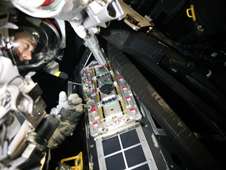
When astronauts visit the Hubble Space Telescope in October 2008 for its final servicing mission, they will be facing a task that has no precedence – performing on-orbit ‘surgery’ on two ailing science instruments that reside inside the telescope – the Space Telescope Imaging Spectrograph (STIS) and the Advanced Camera for Surveys (ACS).
Hubble was designed with servicing in mind, so its instrument bay doors are lined with handrails and, with custom tools, are relatively easy to open for the astronauts. The same cannot be said for the instruments themselves.
“The repair of STIS and of ACS in particular, involves techniques that the astronauts have never performed on Hubble, possibly never before anywhere,” explained HST senior scientist Dave Leckrone at Goddard. “That is, to open up an instrument that was not designed to be opened up and actually pull out electronic printed circuit boards and replace them with new boards.”
To accommodate these groundbreaking repairs, Hubble engineers and astronauts worked diligently to design special tools and procedures. Like doctors performing surgeries, preparation is imperative for success.
The Space Telescope Imaging Spectrograph
Astronauts installed STIS in Hubble in 1997 during Servicing Mission 2. Its main function is spectroscopy – the separation of light into its component colors, or wavelengths, to reveal information about the chemical content, temperature, and motion of stars and gas. Among its many accomplishments, STIS confirmed the existence of super-massive black holes and was the first instrument ever to detect and analyze the atmosphere of a planet orbiting another star.
Although spectrographs like STIS generally do not produce the beautiful images that Hubble is famous for, the data they provide are absolutely essential to understanding the physical properties of the universe. It could be said that they put the “physics” in astrophysics.
After a long life of scientific discovery, STIS experienced a power supply failure in August 2004, causing it to suspend operations. NASA engineers were able to pinpoint exactly where and how the failure occurred by examining data from STIS and determined that the inoperable power supply resides on a printed circuit board housed within the instrument.
The Advanced Camera for Surveys
Installed during Servicing Mission 3B in 2002, ACS quickly became Hubble’s workhorse imaging camera. Designed to survey large areas of the sky at visible and red wavelengths, it had twice the field-of-view and a finer resolution than its predecessor, the Wide Field Planetary Camera 2. It quickly became Hubble’s most heavily used instrument and was responsible for many of the telescope’s most popular and dramatic images.
It took three failures to put ACS out of commission – the first two were recovered by operating the instrument in different ways. To protect against failures, all Hubble instruments have some degree of “redundancy,” meaning that there are duplicate parts that can perform the same function. If one part fails, another can be activated to restore the function.
When the first two failures occurred in 2006, the ground operations team was able to keep the entire instrument fully operational by using a redundant power supply. The final failure came in January 2007 when the backup power supply failed.
With less than two years until the final servicing mission, there would have been little time to develop procedures and tools needed to repair ACS had the team not already been preparing for a very similar task involving the repair of STIS. Designing a repair process for ACS became very workable by adapting the processes already under development for STIS repair.
Tool and Procedure Development
The repair of STIS and ACS presented a multitude of challenges during the development process. Engineers needed to work around three major issues: (1) safely getting access to the failed boards; (2) figuring a way to pull them out wearing the pressurized gloves; and (3) closing out the worksite when repairs are complete.
Knowing exactly what needs to be fixed is not enough to make repairs a piece of cake. To access the failed circuit boards on these two instruments, astronauts will have to remove 111 screws from the cover of STIS, and 32 screws from ACS, a time-consuming process in an environment where time is a scarce commodity.
To confront this challenge, Goddard engineers developed a high-speed power screwdriver with low torque, or twisting force. This combination of operational abilities means that the drill will speed up the removal process without breaking the screws and fasteners.
The sheer number of screws to be removed is not the only issue with gaining access to the circuit boards. Despite its mammoth size and giant status in space discovery, Hubble’s instruments are extremely delicate. Floating debris pose the threat of contaminating exposed electronics, so as astronauts open Hubble’s outer shell to make their repairs they must exercise extreme caution. Even tiny metal shavings resulting from the removal of one screw could be kryptonite to this super telescope.
To avoid the debris issue, NASA engineers designed a fastener capture plate. Using the custom drill, astronauts will first remove four screws to install the transparent “capture plate” over the electronic access panel. Tiny, labeled holes in the plate will allow them to then insert the drill bit and remove screws as the capture plate contains them. When all of the screws have been removed, the entire capture plate can be released as one unit, safely taking the access panel and all debris with it.
The astronauts’ second challenge is grasping the failed circuit boards once the access panel has been removed. The boards are thin and the astronaut’s suits, including their gloves, are bulky and pressurized to protect them from the space environment. If you were to put on a pair of thick, wool mittens and try to grab a single piece of paper from the middle of a stack, you might have some idea of how difficult and time-consuming the task is for astronauts. NASA engineers got around this issue by developing a special card extraction tool which will allow the astronauts to easily grab and remove the circuit boards using large handles made specifically for their gloves.
The last major challenge of the repair process involves closing the instruments back up after repairs are complete. To conserve time, engineers designed a simplified version of the access panels. Two lever-like latches will be all it takes for the astronauts to securely lock the new STIS cover into place. A new panel is not required for ACS because the new electronic cards have all been built into one box that easily slides into place and covers the open side of the instrument.
Appreciating a Complement
Because NASA will be installing similar instruments into Hubble during SM4, you may wonder what purpose it serves to fix STIS and ACS. The answer lies in their differing, but complementary, capabilities.
While the new Wide Field Camera 3 (WFC3) will expand Hubble’s high resolution and provide a wide field-of-view into the near ultra-violet and near infra-red regions of the spectrum, the ACS has a slightly higher discovery potential in the visible wavelengths of light. STIS is a two-dimensional spectrograph while the Cosmic Origins Spectrograph (COS) is a point-source ultra-violet spectrograph. These two spectrographs working in tandem would give astronomers a full, spectroscopic suite of instruments.
The improvements will add years of science to Hubble’s mission and provide a full ‘toolkit’ to astronomers around the world. “Personally, I think that’s where the more exciting results will come from after this servicing mission,” explained Leckrone, “the new ideas that astronomers have about how to use these wonderful instruments now that they’re all together in a set that is internally complementary.”
Making History Again
Hubble has been arguably the most well-known and successful telescope in NASA history, but it is not solely a pathfinder for the science it has yielded over the years. The processes and procedures carried out during servicing missions have also always been innovative.
Before Hubble, nothing launched into space had even been built to be serviced and upgraded on orbit. The telescope is close to making history again with the first on-orbit repairs of existing instruments. Should these repair tasks be successful, Hubble is expected to be 90 times more powerful than ever before.
“At the end of SM4, when the astronauts leave Hubble for the last time, we have a very good prospect that Hubble will be at the apex of its capabilities. It will be better than it’s ever been before, which is quite awesome when you realize that it will be over eighteen years old as an observatory,” Leckrone said.
Provided by NASA, by Kelsey Paquin and Ann Jenkins


