Electron microscopy enters the picometer scale
July 24, 2008 Microscopic Image

Enlarge

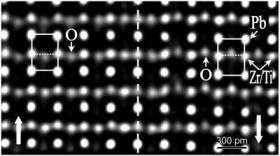
Using electron microscope methods of a hitherto unknown accuracy, scientists from Forschungszentrum Juelich have succeeded in locally demonstrating polarization in the ferroelectric PbZr0.2Ti0.8O3 and measuring it atom by atom. The broken line forms the boundary of two areas with different electrical polarization marked by the arrows. This is due to the fact that the atoms (Pb: lead; Z: zircon; Ti: titanium; O: oxygen) are displaced from their positions and therefore their electrical charges cannot compensate for each other. On the left, the oxygen atoms are displaced 38 pm downwards, and on the right to the same degree upwards out of the zircon/titanium atomic row. This row itself is displaced vertically by 10 pm from the center line between the lead atoms. In order to write information in applications for data storage, the boundary between these two areas of different polarization directions is displaced to the left or to the right so that only one polarization direction exists in the material. Image: Forschungszentrum Juelich

Jülich scientists have succeeded in precisely measuring atomic spacings down to a few picometres using new methods in ultrahigh-resolution electron microscopy. This makes it possible to find out decisive parameters determining the physical properties of materials directly on an atomic level in a microscope. Knut Urban from Forschungszentrum Jülich, a member of the Helmholtz Association, reports on this in the latest issue (25 July) of the scientific high-impact journal Science.

Progress in research in the area of physics is very frequently connected to an increase in the accuracy of measurements, which help researchers to track natural phenomena. With the aid of new methods in electron optics, researchers were able to microscopically measure atomic displacements precisely to a few picometres. A picometre corresponds to a billionth of a millimetre a distance that is one hundred times smaller than the diameter of an atom.

This is one of the highlights that Knut Urban, director of the Ernst Ruska-Centre in Jülich, reports on in Science as part of a review of ten years of electron microscopy with aberration-corrected lenses.

Jülich scientists investigated, for example, the configuration of atoms in orthogonal grain boundaries of the oxide superconductor YBa2Cu3O7. These atoms mark the boundary between two areas of the crystalline material with atomic structures that are tilted at an angle of exactly 90° to each other. From microscopic images taken under different conditions, the physicists succeeded in using computers to calculate the quantum-mechanical wave function of the electrons, which served as a basis for determining the exact position of the atoms.

In doing so, it became apparent that the relatively heavy atomic species barium, copper and yttrium are systematically displaced a few picometres from their ideal position in the grain boundary and that the leighter oxygen atoms follow this displacement. This provides an explanation for the attenuation of superconducting properties, which can be observed when electric current flows over such a grain boundary. This phenomenon is undesired if the superconductor is intended to be used for a loss-free current transport. However, it is useful for the construction of so-called SQUIDs (superconducting quantum interference devices), which exploit the magnetic field dependency of this disturbance to measure smallest magnetic fields, for example, to measure brain waves (magnetoencephalography).

Displacements of a few picometres decide on a whole number of physical properties, which are of eminent importance for technology. Another example is the ferroelectricity of titanates materials. Here, the electrical charges of the individual types of atoms inside the building blocks of crystals, the unit cells, cannot fully compensate for each other as they are not arranged in the necessary symmetry.

Therefore, electric dipoles are formed inside the unit cells, which add up over a larger crystal area to form the so-called polarisation. This is used to write information bits. An example is PbZr0.2Ti0.8O3 which is used in chip cards for data storage. With the aid of new electron optical methods, atomic displacements can be measured atom by atom thus making it possible to determine local polarisation for the first time.

Knut Urban explains: "This is the beginning of a new physics of materials which enables researchers to determine physical parameters and properties in the nano range through highly precise measurements of the atomic spacings. This will also provide clues on how these properties may be manipulated in order to gain new functions and better functional performance."

Source: Helmholtz Association of German Research Centres


print this article email this article download pdf blog this article bookmark this article     Stumble it Digg this share on Facebook retweet share on Reddit add to delicious
Rate this story - 4.8 /5 (33 votes)

Rank Filter

Move the slider to adjust rank threshold, so that you can hide some of the comments.


Display comments: newest first

  • yyz - Jul 25, 2008
    • Rank: 1 / 5 (1)
    The article states that a picometre corresponds to a distance 100 times smaller than an atom. Exactly what atomic element is being referred to? Hydrogen or uranium.

July 24, 2008 all stories

Comments: 1

4.8 /5 (33 votes)
  • Stumble this up

  • Digg this

  • share this

  • hide
  • Related Stories

  • New Digital 'Electronics' Concept May Continue Moore's Law
    created Nov 05, 2009 | popularity not rated yet | comments 0
  • Science Begins at the World's Most Powerful X-ray Laser (w/ Video)
    created Nov 02, 2009 | popularity not rated yet | comments 0
  • LCLS: The World's Largest Laser Writer?
    created Oct 20, 2009 | popularity not rated yet | comments 0
  • 3 Questions: Steven Nahn on the elusive Higgs boson
    created Oct 19, 2009 | popularity not rated yet | comments 0
  • Silicon brittle? Not this kind!
    created Oct 14, 2009 | popularity not rated yet | comments 0


  • hide
  • Relevant PhysicsForums posts

Other News

Stars Fueled by Dark Matter Could Hold Secrets to the Universe

Stars Fueled by Dark Matter Could Hold Secrets to the Universe

Physics / General Physics

created Nov 03, 2009 | popularity 4.5 / 5 (50) | comments 41

(PhysOrg.com) -- The first stars in the universe may have been very different from the stars we see today, yet they may hold clues to understanding some of the mysterious features of the universe. These "dark ...


Second Law of Thermodynamics May Explain Economic Evolution

Second Law of Thermodynamics May Explain Economic Evolution

Physics / General Physics

created Nov 02, 2009 | popularity 4.3 / 5 (30) | comments 28

(PhysOrg.com) -- Terms such as the "invisible hand," laissez-faire policy, and free-market principles suggest that economic growth and decline in capitalist societies seem to be somehow self-regulated. Now, ...


High-performance plasmas may make reliable, efficient fusion power a reality

High-performance plasmas may make reliable, efficient fusion power a reality

Physics / Plasma Physics

created Nov 02, 2009 | popularity 4.7 / 5 (39) | comments 31

In the quest to produce nuclear fusion energy, researchers from the DIII-D National Fusion Facility have recently confirmed long-standing theoretical predictions that performance, efficiency and reliability ...


'Teapot effect' solved

Solving Teapot Effect

Physics / General Physics

created Nov 02, 2009 | popularity 4.9 / 5 (11) | comments 10

(PhysOrg.com) -- A team of scientists from France have worked out why teapots dribble at low flow rates, and how to stop them. The effect is called the "teapot effect", and solving it could finally put an ...


Laser accelerated protons to the highest energies so far

Researchers use trident laser to accelerate protons to record energies

Physics / General Physics

created Nov 02, 2009 | popularity 4.6 / 5 (5) | comments 10

An international team of physicists at Los Alamos National Laboratory has succeeded in using intense laser light to accelerate protons to energies never before achieved. Using this technique, scientists can ...